All species › Waders, gulls and terns › Skimmers, noddies, terns and gulls › Great Black-backed Gull
Great Black-backed Gull | Larus marinus
Grote mantelmeeuw | Gavión atlántico
Great Black-backed Gull is the largest gull in the world: close to eighty centimetres long, with a slate-black mantle, a head that stays clean white even in midwinter, and a bill heavy enough to swallow a young auk whole. On the North American east coast it has moved south from Nova Scotia to North Carolina in a hundred years.
Voice
A deep, hoarse owk, lower and slower than any other gull's; once you know the voice you pick it out of a mixed flock at once. The long call is given with the head thrown back and the bill straight up, in a series of five to eight falling cries. Alarm is a short, barking gak-gak-gak, and over the colony the noise swells as soon as a person or an eagle comes near. Chicks beg with a thin, piping wee-ee while pecking at the red spot on the parent's bill.
Recording: Corentin Rivière — CC BY-NC-SA 4.0 · Pelet-Romond, Chausey, Granville, Manche, Normandie, France · xeno-canto
Identification
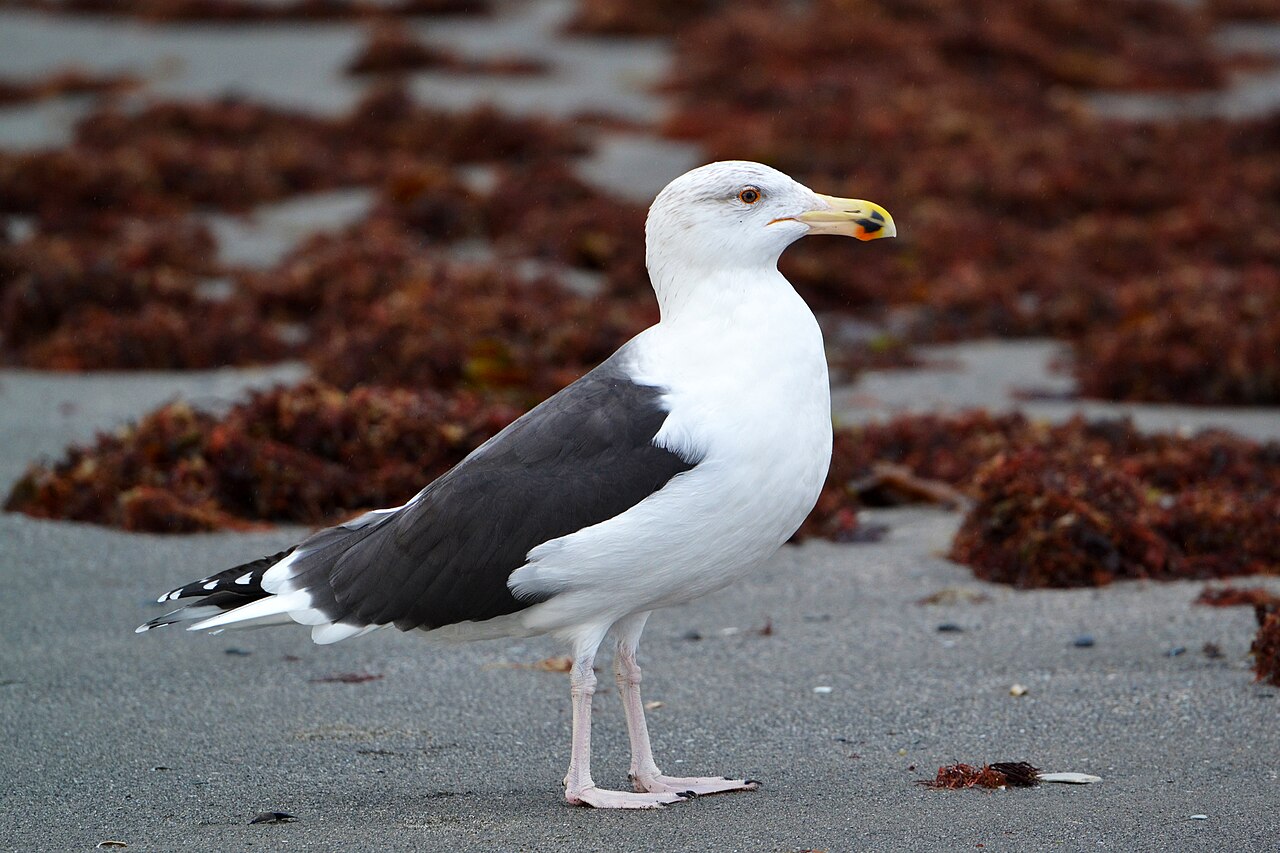
The adult has a slate-black mantle and upperwing with a broad white trailing edge, and large white mirrors at the wingtip that all but enclose the black. Head and underparts are clean white, in winter as well, while the other large gulls then have a streaked head and neck. The bill is yellow with a red spot on the lower mandible, deep and with a marked angle; the legs are flesh pink. The sexes are alike in pattern, but the male is larger and heavier-headed. Adult plumage comes only after four years: young birds are chequered black and white above, with a pale head, a sharply black bill and a white tail with a narrow black band. The flight is slow, with deep beats; on the ground it stands upright and towers over every other gull.
Confusion species
Ring-billed Gull is under a third of its weight, with a pale grey mantle, yellow legs, a yellow bill with a black ring and a streaked head in winter. Lesser Black-backed Gull (Larus fuscus), which winters in growing numbers on the east coast, is clearly smaller and slimmer, with yellow legs and a slate-grey rather than black mantle. American Herring Gull (Larus smithsonianus) has the same pink legs but a pale grey mantle, a finer bill and, in winter, a heavily streaked head and neck. At sea an adult is taken at distance for a Northern Gannet; the gannet is white with black only at the wingtips, pointed at both ends, and folds its wings to dive, while the gull has a broad, rounded wing and does not enter the water.
Compare gulls: legs, head, bill and wing tip side by side
Habitat
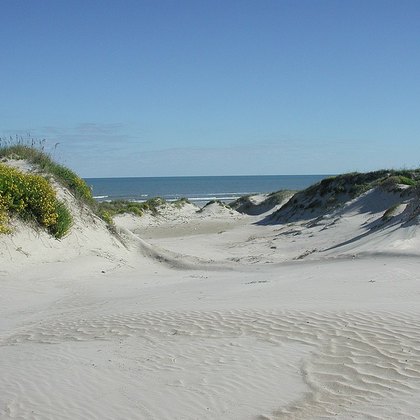
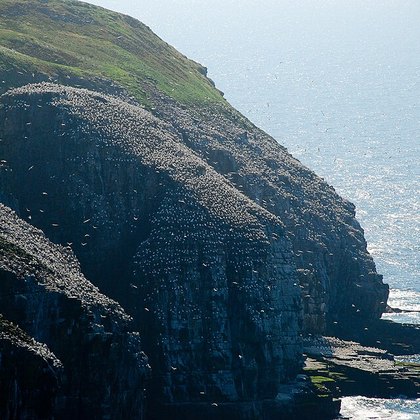
Coasts with open water: harbours, piers, river mouths, sandy beaches and the mudflats of estuaries, where at high tide it stands among the other gulls. To breed it uses rocky islets, salt marsh and coastal dunes, by preference on a rise from which it can see all around. It follows fishing boats far offshore and feeds at landfills and treatment works, though open dumps in North America have largely been closed. Far inland it occurs only along the Great Lakes and the large rivers.
Where the bird is most often found, arranged by the USNVC — the vegetation classification of the United States and Canada — and CMECS for sea and coast.



Range and movements
Breeds on both sides of the North Atlantic; on the American side from southwest Greenland and Labrador through the Gulf of St. Lawrence and the Maritimes south along the Atlantic coast. Around 1900 hunting for eggs and feathers had pushed it back to Nova Scotia; the breeding limit then moved south in steps — Maine in 1928, Massachusetts in 1931, New Jersey after 1960, today to North Carolina — and it settled on the Great Lakes as well. In winter the young birds in particular move south, as far as Florida and far inland over the interior waters. Adults often stay near the colony as long as the water remains open.
- Resident
- Breeding (summer)
- Winter
- Passage
- dark = core range, pale = thinly spread
Where and when to look
Go at high tide to a pier or a sandbar where gulls stand together and look for the bird that rises head and shoulders above the rest; the heavy, angular head catches the eye sooner than the black mantle. In January and February the clean white head is the quickest mark, because every other large gull around it is streaked then. Behind an incoming fishing boat it is usually the first at a fish thrown overboard.
Conservation
The species is listed as Least Concern (LC); the world population is put at a few hundred thousand birds, of which a smaller share breeds in North America. After a century of growth numbers in the Gulf of Maine and Atlantic Canada have fallen since about 1990, alongside the closing of open landfills and the decline in fish thrown overboard. In tern and auk colonies it is itself controlled, because it takes eggs and chicks there.
Scientific name
Larus marinus | Linnaeus, 1758
Linnaeus described the species in 1758 as Larus marinus; it still stands in the genus in which he placed it, and for that reason author and year carry no parentheses. Larus is the Latin form of Greek laros, an unspecified seabird in the classical writers. marinus simply means 'of the sea'. Linnaeus gave Europe as the origin; the type locality was later fixed at Gotland in Sweden.