All species › Waterfowl › Ducks, swans and geese › Falcated Duck
Falcated Duck | Mareca falcata
Bronskopeend | Cerceta de alfanjes
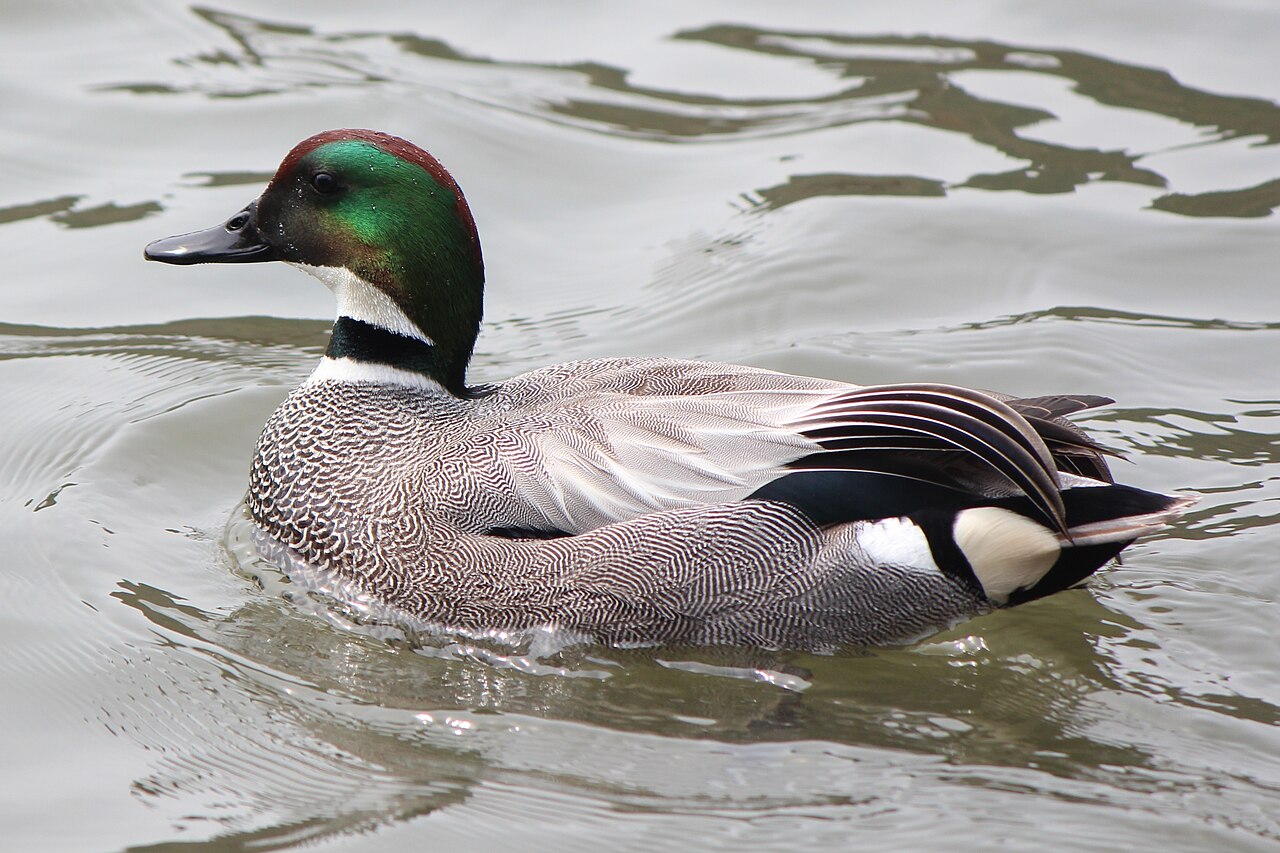
The Falcated Duck is an Asian species that turns up in this area at most once a year, almost always at the far western end of the Aleutians. The male carries a long, drooping crest and an iridescent bronze-green head, and behind the folded wing trail long, curved, sickle-shaped feathers that give the species its name. Elsewhere in its range, from Mongolia to Japan, it is a common wintering duck; here it remains a rare record.
Voice
During display the male gives a soft, trilling whistle, followed by a hoarse gak-gak, and sometimes a quieter whistle ending in a wavering uit-trrr. The female quacks like a Mallard, but during courtship also gives a soft, low rrr while preening. Outside the breeding season the species is largely silent, and in this area, where it rarely appears as more than a single bird, voice is of little use as a field mark.
Recording: Albert Lastukhin — CC BY-NC-SA 4.0 · Sibirtsevo, Chernigovskiy rayon, Primorskiy kray, Russian Federation · xeno-canto
Identification
The male has an iridescent bronze-green head with a long, backward-hanging crest, a black chin bordered white, and a grey vermiculated body with a cream-and-black patterned rear end. Behind the folded wing hang long, sickle-shaped tertials, which reach full length only after the moult. The female is mottled brown and closely resembles a female Gadwall, but carries a small crest on the back of the head and a green rather than white speculum in flight. Juveniles lack the adult male's long tertials and are hard to tell from the female.
Confusion species
The female most closely resembles the female Gadwall, one of the other species in this area (besides the wigeons) from the same genus Mareca; the small crest and the green rather than white speculum are then the best marks. The adult male, with its crest and sickle-shaped feathers, cannot be confused with anything else. Because the species is also kept in waterfowl collections, any record away from the Aleutians raises the question of captive origin; only spring birds in the far west of Alaska are generally accepted as genuinely wild.
Habitat
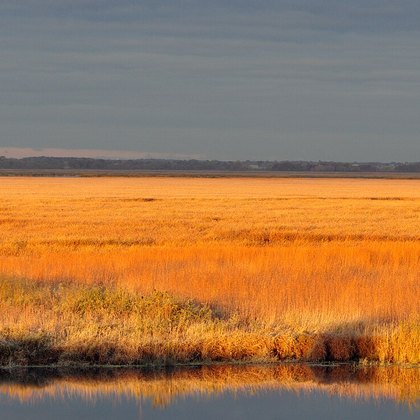
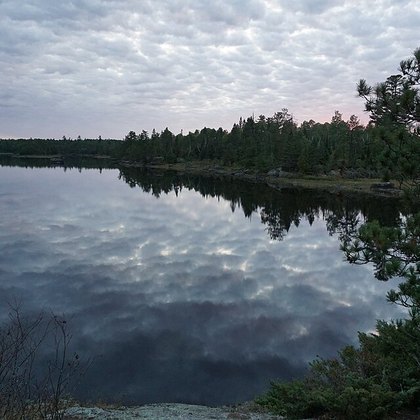
In its core range it breeds at remote marshes and slow rivers in the taiga and steppe of Mongolia, Transbaikalia and northeastern China, and winters on lowland marshes, flooded rice fields and lake shores further south. In the far west of Alaska, where it occurs as a migrant, it turns up on the shallow pools and wet tundra grassland, among other migrating ducks. It does not use fast-flowing water or the open sea coast.
Where the bird is most often found, arranged by the USNVC — the vegetation classification of the United States and Canada — and CMECS for sea and coast.



Range and movements
The breeding range runs from Transbaikalia and Mongolia to northeastern China and the adjoining part of eastern Siberia; wintering extends from northern India to southern and eastern China, Korea and Japan. This area lies entirely outside that range: here the species is reported not every year, but often enough in the far western Aleutians, usually in spring, to speak of a regular, if unpredictable, overshoot. Further east or south, records are incidental and widely scattered.
Where and when to look
The best chance is in spring on the westernmost Aleutian Islands, where Asian vagrants as a group turn up with some regularity; look among flocks of Gadwall and teal for the distinctive crested silhouette. A record further inland is rare enough to document with extra care, if only to rule out a captive origin.
Conservation
The world population is estimated at around 89,000 birds, a clear rise from an earlier estimate of around 35,000; the trend is mostly stable to slightly increasing. Hunting for meat and feathers and the drainage of marshes were the main threats in the East Asian wintering grounds during the twentieth century; about a quarter of the population now winters within protected nature reserves in China. Neither threat plays any role in this area — here the species is simply too scarce for anything to be said about its conservation.
Scientific name
Mareca falcata | (Georgi, 1775)
Georgi described the species in 1775 as Anas falcata; because it has been placed in the genus Mareca since 1824, author and year stand in parentheses. That genus was introduced that year by Stephens, from the Portuguese marreca, 'small duck'. falcata is Latin for 'sickle-shaped', from falx, 'sickle', after the male's long, curved tertials. The type locality is Lake Baikal.