All species › Passerines › Finches, euphonias and allies › Eurasian Bullfinch
Eurasian Bullfinch | Pyrrhula pyrrhula
Goudvink | Camachuelo común
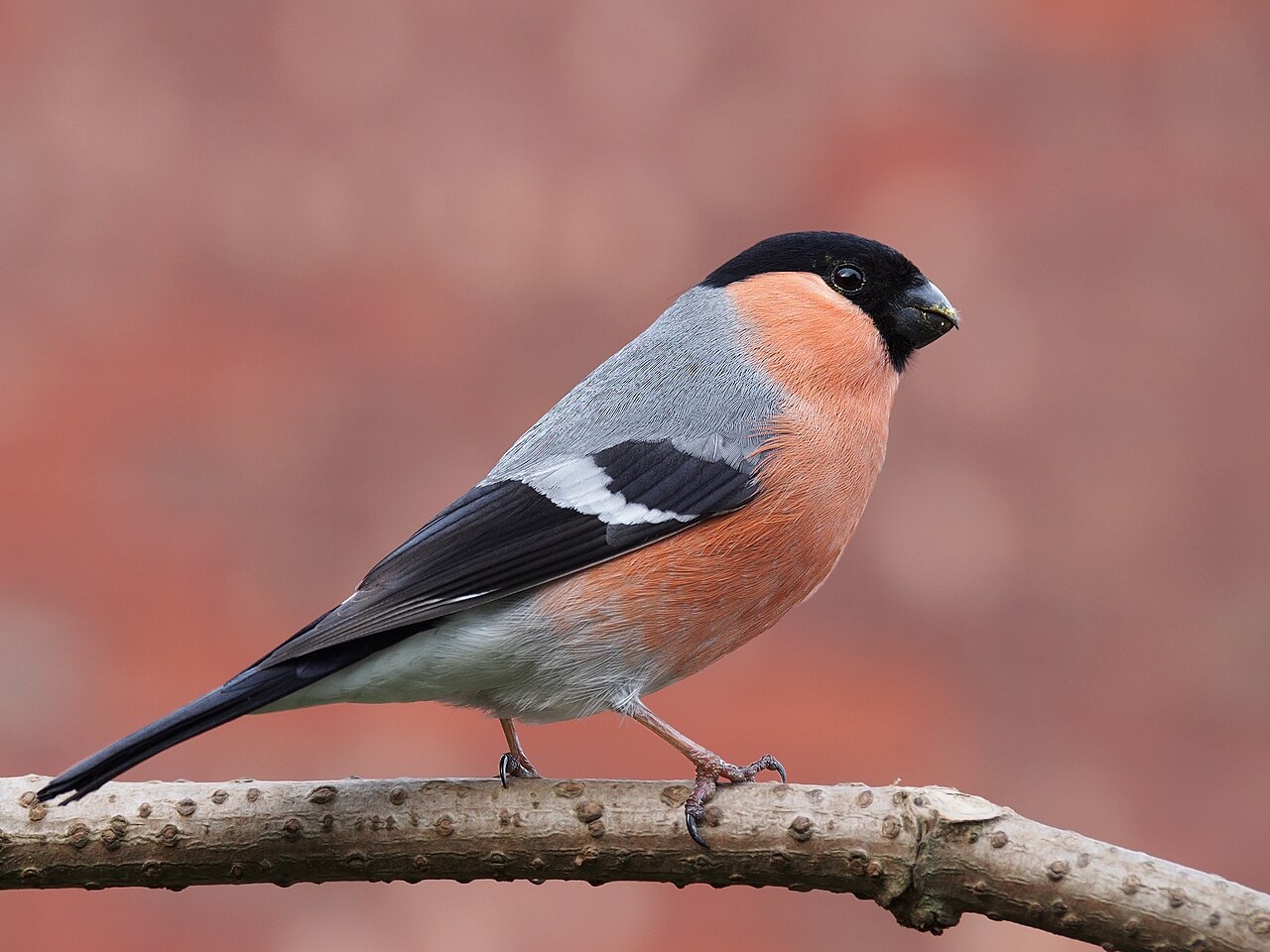
The Eurasian Bullfinch is a Eurasian finch with a black cap, a thick black bill and a white rump that flares as it flies off. In the guide area it is a vagrant: records come almost entirely from western Alaska, concentrated in spring on the western Aleutians.
Voice
The call is a soft, low, drawn-out whistled peeu with a slightly mournful tone, usually the first sign of the bird and carrying a fair distance. The song is a weak, scratchy warble alternating with soft whistles, so quiet that it is audible only at close range. The Siberian form that reaches Alaska has a different, louder and more trumpet-like call, which points to its origin in the field. Caged bullfinches can whistle back learned melodies.
Recording: Stanislas Wroza — CC BY-NC-SA 4.0 · Kuusamo - Konttainen, Finland · xeno-canto
Identification
A compact, bull-necked finch with a short, deep, black bill, a black cap running down below the eye, and black wings and tail. The male has a clear brick-red breast and belly, the female the same pattern but with grey-brown underparts. Both have a grey back, a broad pale wing bar and a sharply defined white rump contrasting with the black tail. The young bird lacks the black cap. The Siberian birds reaching Alaska are larger and paler than European ones.
Confusion species
Within the guide area no species combines a black cap, a thick blunt bill and a white rump. House Finch and Purple Finch are redder over head and back, have streaked flanks, and lack both the black cap and the white rump. Pine Grosbeak is much larger, with white wing bars and a hooked bill tip. On a bird flying away, the white rump patch above the plain black tail is the decisive mark.
Habitat
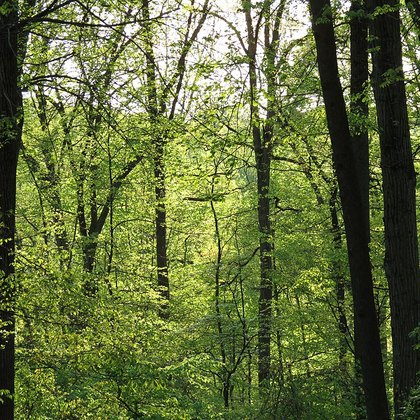
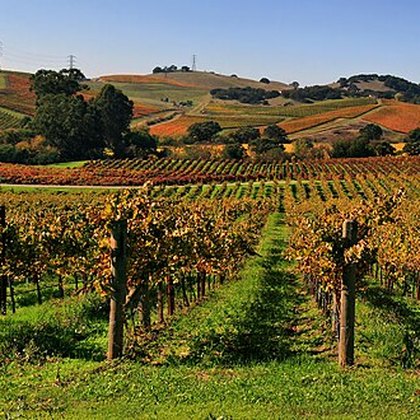
In the Eurasian breeding range, mixed woodland with a share of conifers, woodland edges, scrub, parks, gardens and orchards; it eats seeds, berries and, in spring, the buds of fruit trees. The vagrants in Alaska are found in low coastal scrub, willow thickets and around buildings on the islands, where tall forest is absent.
Where the bird is most often found, arranged by the USNVC — the vegetation classification of the United States and Canada — and CMECS for sea and coast.



Range and movements
The range runs from the British Isles and Iberia across Europe and the taiga belt to Kamchatka and Japan. Southern populations are resident; northern and Siberian birds move south in varying numbers, and it is those movements that occasionally deliver a bird to the American side of the Bering Sea. The first record for the guide area came in January 1867 from the Yukon River at Nulato; later sightings are mainly spring records on the western Aleutians, with a few on the Pribilofs and on mainland Alaska. Outside Alaska the species is not established in North America.
Where and when to look
The chance arises almost only in May on the western Aleutians or on St. Paul, in a year of persistent westerly winds. Listen first: the soft whistled peeu from a willow thicket comes before the view. On a brief sighting, watch for the white rump, since colour and cap pattern are often hidden on a bird diving away.
Conservation
Worldwide the species is listed as Least Concern (LC), with a population in the tens of millions across Europe and Asia. In western Europe numbers fell in the second half of the twentieth century, which has been linked to the loss of scrub and hedgerows in farmland; in parts of the range the decline has since stopped. For North America there is no conservation question: a handful of birds per decade are involved and there is no breeding population.
Scientific name
Pyrrhula pyrrhula | (Linnaeus, 1758)
Linnaeus described the species in 1758 as Loxia Pyrrhula, with Europe as the type area; because it later moved to a genus of its own, author and year stand in parentheses. Pyrrhula goes back to Greek pyrrhoulas, a bird name in Aristotle, from pyrrhos 'flame-coloured' beside pyr 'fire', after the male's red underparts; the word is doubled in the scientific name as both genus and species. English bullfinch refers to the heavy, bull-like shape of head and neck. The Dutch goud- 'gold' does not describe the colour of this bird, which is red, but survives as a prefix in finch names.