All species › Tubenoses › Petrels, shearwaters and diving petrels › Cook's Petrel
Cook's Petrel | Pterodroma cookii
Cooks stormvogel | Petrel de Cook
Cook's Petrel is the smallest tubenose regularly seen off the west coast of the United States, recognisable by its long, thin bill. It breeds only on three islands off New Zealand and was only recognised, after 1985, once reliable at-sea identification criteria had been worked out, as a fixed, annual visitor far off the California coast.
Voice
At the breeding colony a bleating kek-kek-kek or eh-eh-eh fills the air at night, with a lower, growling boor as a ground call; on Little Barrier Island the calling of thousands of birds coming ashore after dark can be almost deafening, while few call once on the ground. Off the American coast, far from the colonies, the species is, like most of its relatives, entirely silent.
Recording: Nathan El — CC BY-NC-SA 4.0 · near Matakana, Auckland, New Zealand · xeno-canto
Identification
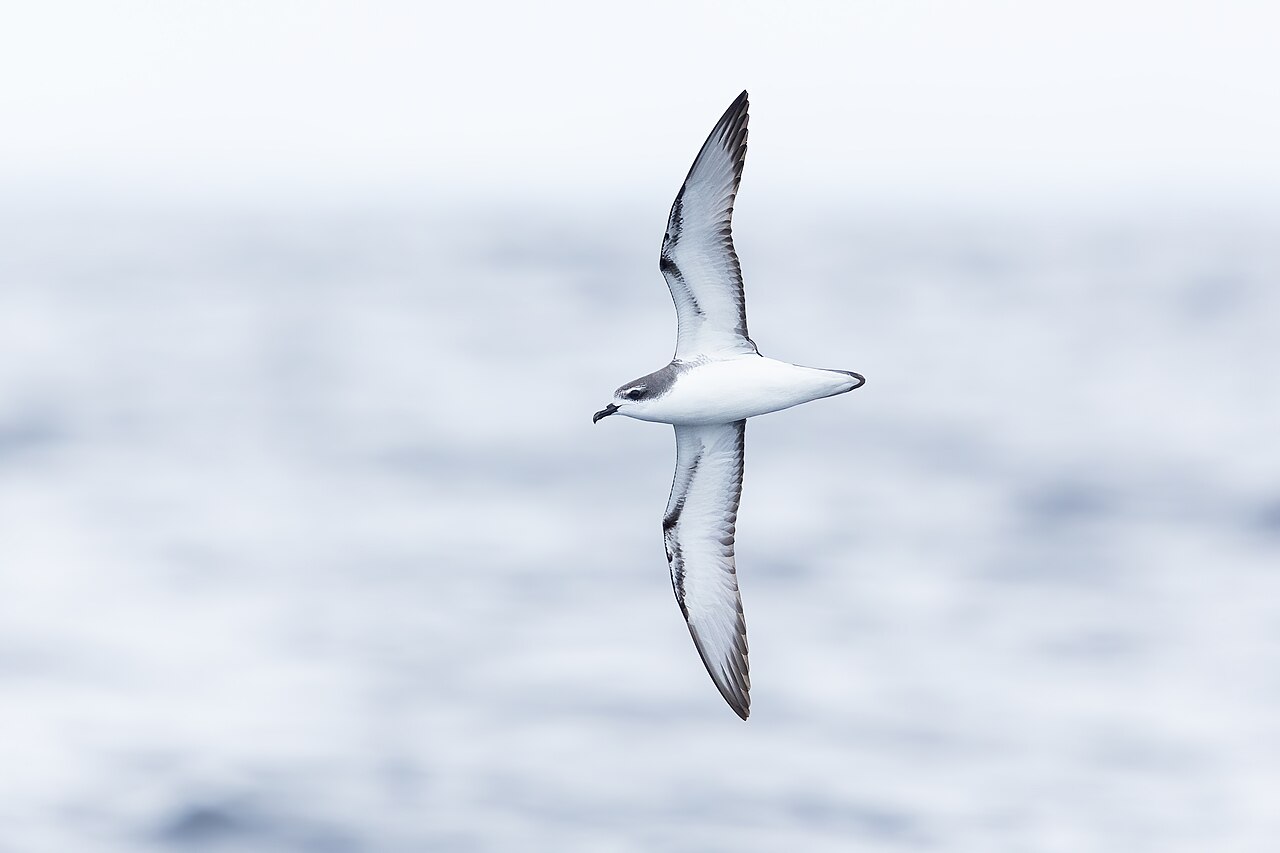
Cook's Petrel is pale grey above, with a broad, dark 'M' band across the back and wings, and has a white forehead finely speckled with dark. The underparts are white, with thin dark tips to the flight feathers and a thin line along the leading edge of the underwing. Distinctive is the long, thin, black bill, more slender than in most other small petrels of the genus. Male, female and juvenile cannot be told apart. Flight is light and fast, with short bursts of wingbeats and high, tumbling banks, quicker and lighter than in most larger tubenoses.
Confusion species
Black-winged Petrel (Pterodroma nigripennis), of similar size and seen in the same waters, has a bold black mark on the underwing and a darker, more uniform grey cap, against the vague, speckled head and narrower wing markings of Cook's Petrel. Confusion with the much larger Sooty Shearwater, seen at the same time of year on the same boat trips, is less likely: that species is entirely dark, without white, and flies straight and steady on stiff wings rather than with the tumbling flight of a Pterodroma petrel. From a distance, the small size and light, weaving flight remain the best first clue.
Habitat
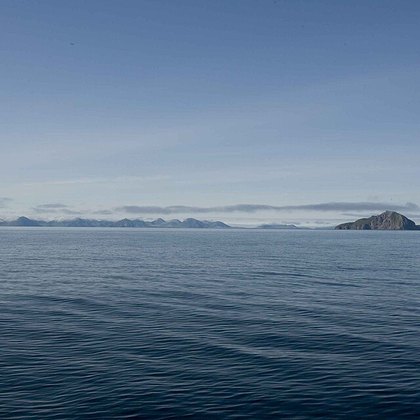
Within this area Cook's Petrel is entirely a bird of open, warm ocean water, usually well offshore at the boundary between the warm North Pacific current and the cooler California Current. It breeds only on forested slopes up to seven hundred metres on its New Zealand islands, in a self-dug burrow; that habitat lies entirely outside the guide area. It therefore never uses land within North America.
Where the bird is most often found, arranged by the USNVC — the vegetation classification of the United States and Canada — and CMECS for sea and coast.
Range and movements
Cook's Petrel breeds only on three islands off New Zealand: Little Barrier, Great Barrier and Codfish Island (Whenua Hou). After breeding, the northern population disperses across the North Pacific to the transition zone between warm and cool water off California, where the species is seen from mid-May to early December with a marked peak in August; the southern population moves to the Humboldt Current off Chile and Peru. Only after 1985, once useful at-sea identification criteria had been established, did it become clear that Cook's Petrel was not a rarity off California but an annual, sometimes numerous visitor — on one occasion in 1992 more than three hundred birds were counted. Smaller numbers also reach the waters around Hawaii.
Where and when to look
The best chance is a pelagic boat trip from Monterey Bay or Southern California in August, well offshore where warm and cool water meet; look for the smallest, palest petrel in the group, with the thin, long bill as the best mark at close range.
Conservation
Cook's Petrel is considered Vulnerable (VU) not because its world population is small, but because it breeds on exactly three islands. After feral cats were removed from Codfish Island in the 1980s, the colony there recovered strongly — a recovery that coincided with the period in which the species was also suddenly recognised as an annual visitor off California. On Little Barrier and Great Barrier, introduced rats still keep numbers low.
Scientific name
Pterodroma cookii | (Gray, 1843)
British zoologist George Robert Gray described the species in 1843 as Procellaria Cookii; because it has since been placed in another genus, author and year stand in parentheses. The genus Pterodroma was introduced in 1856 by Bonaparte, from the Greek for 'wing' and 'runner'. The species name honours Captain James Cook, whose voyages of discovery across the Pacific opened the way for the scientific exploration of New Zealand. The type locality is simply 'New Zealand', without indicating which of the three islands where the species actually breeds.