All species › Waders, gulls and terns › Skimmers, noddies, terns and gulls › Common Tern
Common Tern | Sterna hirundo
Visdief | Charrán común
The Common Tern is the tern that is everywhere: from the sandbars of Long Island to the lakes of Saskatchewan it breeds in noisy colonies on almost any bare patch of ground beside water. It is the yardstick against which every other tern is measured in the field, and at the same time the North American tern that has fallen furthest in the past forty years.
Voice
Over the colony comes a hard, down-slurred KEE-yah, stressed on the first syllable — the alarm every visitor receives. A bird arriving with a fish gives a drawn-out keeur by which its chick knows it. Between these comes a short kip kip kip used as contact between birds. The voice is fuller and lower than the Arctic Tern's, and in a mixed colony that difference is often more use than the plumage.
Recording: Lionel FREDERIC — CC BY-NC-SA 4.0 · Arrondissement de Vannes (near Sarzeau), Morbihan, Bretagne, France · xeno-canto
Identification
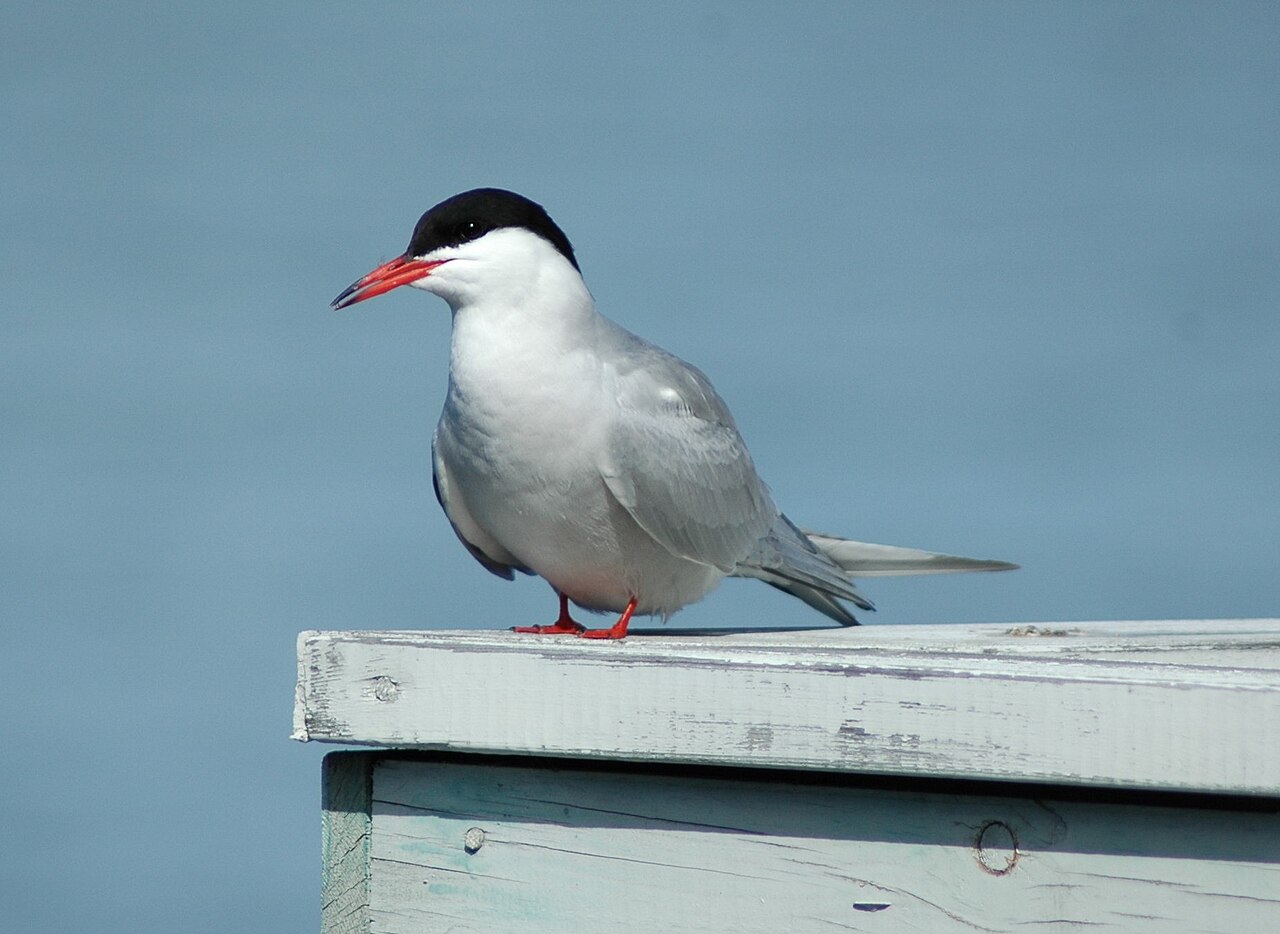
The sexes are alike. In breeding plumage pale grey above and white to greyish below, with a jet-black cap running down onto the nape and an orange-red bill with a black tip. The legs are orange-red and of medium length; the deeply forked tail reaches roughly to the wingtips at rest. As summer wears on the outer primaries wear to a dark wedge in the wingtip, the most useful mark at a distance. In non-breeding plumage the forehead turns white and the bill black, and a dark carpal bar appears on the bend of the wing; juveniles carry that bar too, with a ginger wash across the mantle and a short tail. The flight is strong and angular, with deliberate beats; it fishes by hovering and dropping straight down.
Confusion species
Arctic Tern (Sterna paradisaea) has a blood-red bill without a black tip, much shorter legs, tail streamers projecting beyond the wingtips at rest, and a narrow, sharply drawn black trailing edge to the primaries instead of a dark wedge. Roseate Tern (S. dougallii) is paler, with a long black bill and white tail streamers trailing far beyond the wing. Forster's Tern (S. forsteri) is heavier-built and in winter shows a black eye patch on a white head; its primaries are paler than the rest of the wing, where the Common Tern's grow darker. In doubt, look at the bill tip and the length of the legs: those hold up in poor light.
Compare terns: bill, legs, head and tail side by side
Habitat
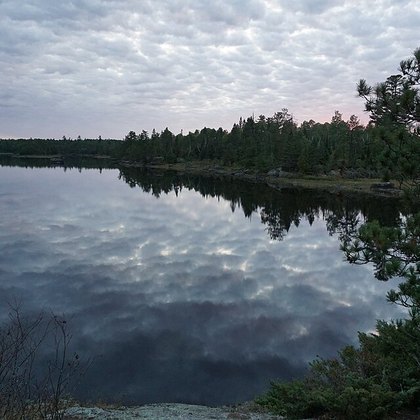
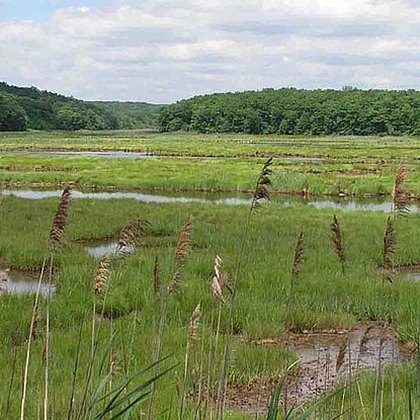
Breeds on bare or sparsely vegetated ground close to water: sand and shell beaches, islands in bays and estuaries, the edges of salt marsh, and inland the shores and islets of large lakes and rivers. It asks little more than a flat patch of sand or gravel free of vegetation and of ground predators, and so readily takes to dredge-spoil islands and to floating rafts. It feeds in shallow water near the colony, usually within fifteen kilometres. What it avoids is dense vegetation, and anywhere a fox or a rat can reach.
Where the bird is most often found, arranged by the USNVC — the vegetation classification of the United States and Canada — and CMECS for sea and coast.



Range and movements
In North America it breeds from Labrador and Newfoundland south along the coast to North Carolina, and inland from the Great Lakes across the prairie provinces to Alberta and the southern Northwest Territories. Beyond the Americas it breeds throughout Europe and temperate Asia — the same species that nests on every harbour raft in the Netherlands. American birds leave in August and September along the coast and across the Caribbean and winter on the coasts of South America from Guyana to Argentina and Peru; within the guide area almost nothing remains in winter. Shot out for the millinery trade in the nineteenth century, the species recovered in the twentieth, but North American numbers have been falling again since the 1970s.
- Resident
- Breeding (summer)
- Winter
- Passage
- dark = core range, pale = thinly spread
Where and when to look
Look for it from May to August from a pier or a jetty where the tide keeps the water moving: that is where it hovers, and where the dark wedge in the wingtip shows against the light. In July and August work through the resting flocks on a sandbar and check bill tips — that is when Common, Arctic and Roseate Terns often stand side by side.
Conservation
Abundant worldwide and listed as Least Concern (LC), with an estimated one and a half to over three million mature birds, but fewer than eighty thousand pairs breed in North America and numbers there have fallen sharply in forty years. The causes lie on the breeding grounds: cleared and reshaped beaches, disturbance, and the spread of large gulls and of rats onto islands. Where colonies are fenced off and kept free of ground predators they recover quickly.
Scientific name
Sterna hirundo | Linnaeus, 1758
Linnaeus described the species in 1758 as Sterna hirundo; because it still stands in the same genus, author and year carry no parentheses. Sterna goes back to Old English stearn, a name for terns already used around the year 1000 in the poem The Seafarer. hirundo is Latin for swallow, after the forked tail and the light flight — the same thought behind the folk name sea swallow. The type locality is Europe, later restricted to Sweden.