All species › Waders, gulls and terns › Sandpipers and allies › Common Greenshank
Common Greenshank | Tringa nebularia
Groenpootruiter | Archibebe claro
On the North American continent this is a bird of the Bering Sea: a grey and white wader with long greenish legs and a long, slightly upturned bill, which reaches the western Aleutians from Asia in spring. It neither breeds nor winters here; the birds seen are ones that have carried too far east on their way north. Away from Alaska the whole continent still holds fewer than ten records.
Voice
The flight call is a clear, far-carrying tew-tew-tew, three even notes that fall away at the end, and it usually comes before the bird itself is in view. Flushed, it turns into a faster and sharper kyu-kyu-kyu-kyu in which the notes run together. Over the bogs where it breeds — far outside this continent — the male hangs on stiff wings with a steady yodelling tloo-wee tloo-wee that carries on for minutes at a time. In Alaska only the flight call is heard in practice, and it is the most usable mark the species has: fuller and more musical than the shriller calling of the yellowlegs.
Recording: Noé Ferrari — CC BY 4.0 · Arrondissement d'Abbeville (near Abbeville), Somme, Hauts-de-France, France · xeno-canto
Identification
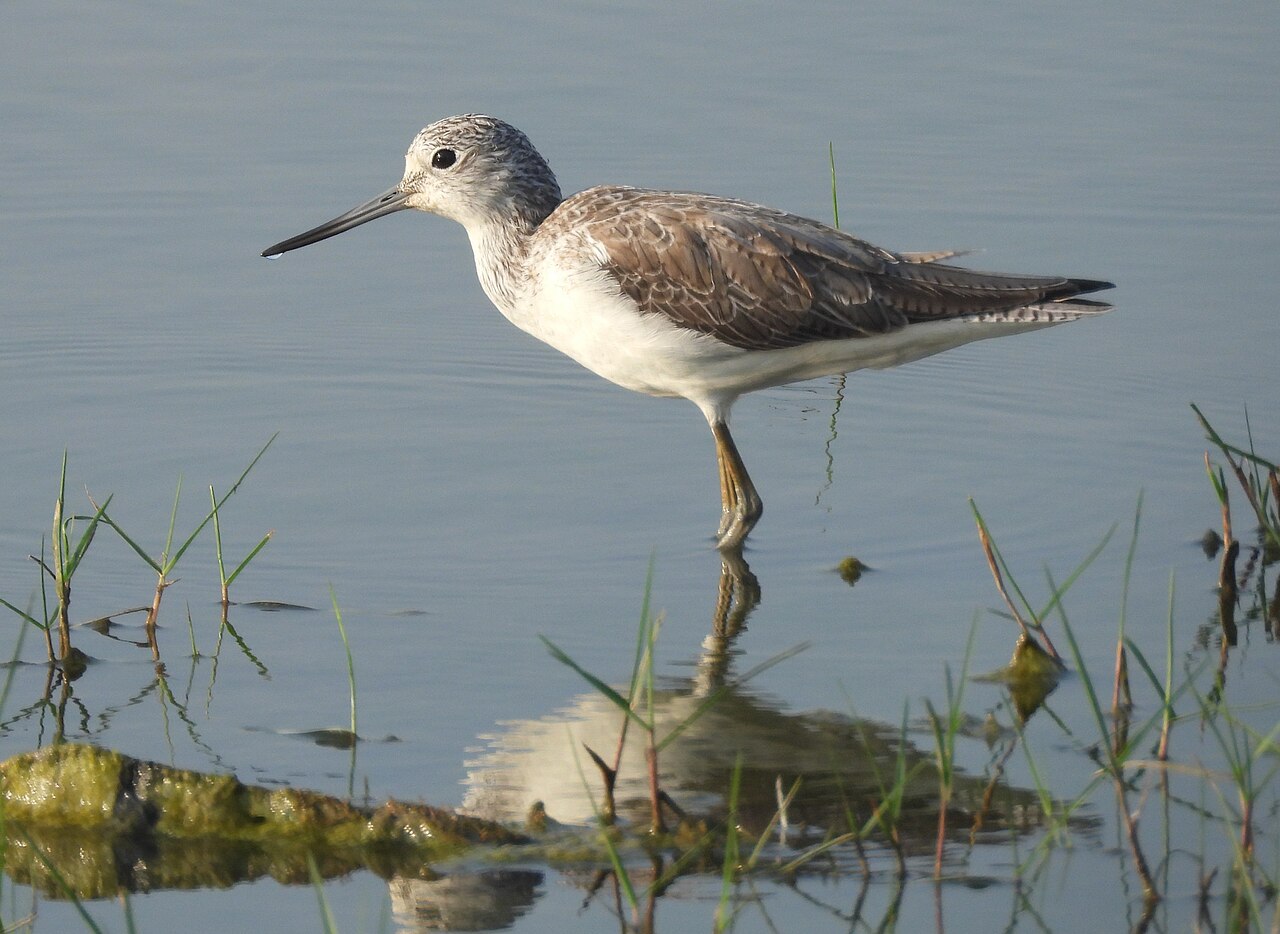
In winter plumage the bird is pale ash grey above with fine white feather edges, and white below far up the flanks, with no breast band; head and neck are so pale that at a distance it looks white. In breeding plumage black feather centres stand out on mantle and scapulars and a fine streaking runs over neck and breast, with loose black chevrons on the flanks. The bill is long — about one and a half times the length of the head — thick at the base, blue-grey with a dark tip, and bends noticeably upward over its last part. The legs are dull green to yellow-green, never bright yellow. In flight a white wedge runs from the rump far up the back, the wing stays wholly dark without a bar, and the toes project just beyond the tail. Juveniles are browner, with warm feather edges and a more heavily streaked neck.
Confusion species
Greater Yellowlegs (Tringa melanoleuca) is the species it is first confused with in Alaska: it has bright yellow legs, a square white rump with no wedge up the back, and more heavily barred flanks. Lesser Yellowlegs (T. flavipes) is smaller and has a straight, short, wholly dark bill. Short-billed Dowitcher (Limnodromus griseus) shows the same white wedge, but has short legs, a long straight bill and feeds with an up-and-down sewing-machine action. Willet (T. semipalmata) is heavier built and shows in flight a broad black-and-white wing pattern that the greenshank lacks.
Habitat
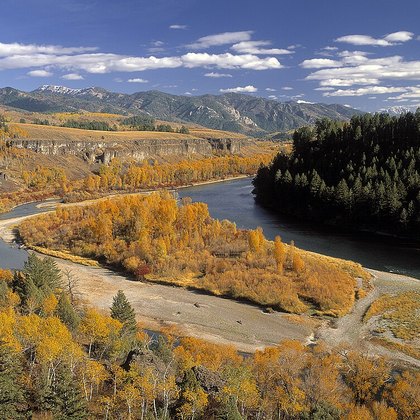
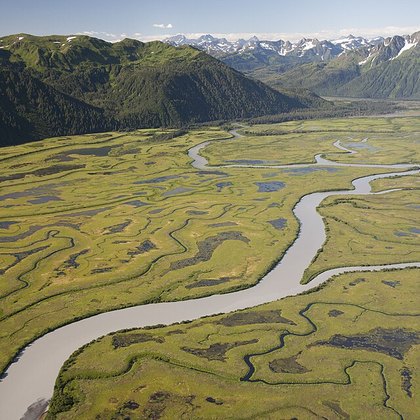
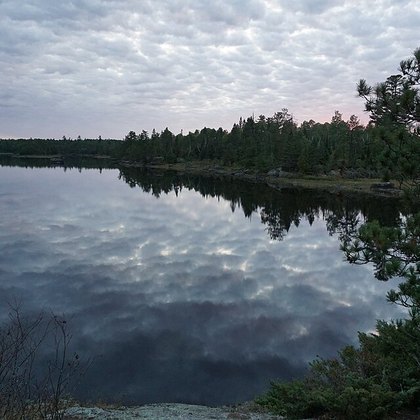
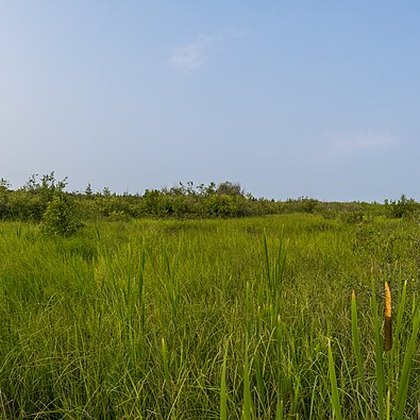
In North America it turns up on the wet edges of the Bering Sea islands: tidal creeks, the muddy margins of lagoons, the shores of pools and the runouts of streams across the beach. It walks there alone or with one companion, wades to the belly and hunts with short sideways lunges through the water after shrimps and small fish. It avoids surf and bare rocky coast, and does not venture out over open sea. On its breeding grounds it is a bird of open bog and boggy clearings in the conifer forest, and that preference for shallow fresh water it keeps on its wanderings.
Where the bird is most often found, arranged by the USNVC — the vegetation classification of the United States and Canada — and CMECS for sea and coast.

Range and movements
The breeding range lies in the taiga from Scotland and Scandinavia east through Russia to Kamchatka; the winter is spent in Africa, southern Asia and Australia. In North America it is a scarce but nearly annual visitor to the western Aleutians, above all in the second half of May, and it appears irregularly on the Pribilofs and on St. Lawrence Island. From the rest of the continent fewer than ten records are known: several from the Atlantic provinces of Canada, one from New Jersey in October 2017, and single birds in British Columbia and California. Bermuda and Barbados each have a record as well. How many are seen in Alaska in a given year depends in part on how many observers are on the islands in May.
Where and when to look
If you want to see one, the second half of May on Attu, Shemya or St. Paul is the only serious chance; walk the edges of the freshwater pools and the tidal creeks and listen for the three-note tew-tew-tew. If a large grey wader gets up, look first at the legs and then at the back: dull green legs with a white wedge up the back settle it, bright yellow legs with a square white rump do not.
Conservation
The Red List holds the species as Least Concern (LC); the world population runs to several hundred thousand birds and the trend is unclear. For North America there is nothing to conserve — the bird neither breeds nor winters here. The birds that can reach Alaska belong to the East Asian population, which depends on the tidal flats around the Yellow Sea, where reclamation has taken away a large part of the mud in a few decades.
Scientific name
Tringa nebularia | (Gunnerus, 1767)
Gunnerus described the species in 1767 as Scolopax nebularia, among the snipes; since it was placed in the genus Tringa, author and year stand in parentheses. Tringa goes back to the Greek trungas, in Aristotle the name of a white-rumped bird of the waterside. nebularia comes from the Latin nebula, 'mist, fog', after the misty marshes where the described specimen was taken. The type locality is the district of Trondheim in Norway. The description stood in a book about the Lapps of Finnmark, their language and their customs, and not in a bird book.