All species › Waterfowl › Ducks, swans and geese › Common Eider
Common Eider | Somateria mollissima
Eider | Éider común
The Common Eider is the largest duck of the Northern Hemisphere: a bulky sea duck with a distinctive wedge-shaped profile running from bill to forehead. Females line their nest with the softest down feather known, harvested for centuries to fill quilts and pillows. Colonies of thousands of breeding pairs on rocky coastal islands make it one of the few sea ducks that also gathers in large groups on land.
Voice
The male courts with a far-carrying, cooing oo-oo, given together by dense groups of displaying males and audible well out over the water. The female answers with a quickly repeated, guttural gog-gog-gog, mainly while feeding and in response to the males' display. Both sexes also give a hoarse, grating kor-korr-korr, heard as an alarm or when the colony is disturbed.
Recording: Stein Ø. Nilsen — CC BY-NC-SA 4.0 · Longyearbyen, Spitsbergen, Norway · xeno-canto
Identification
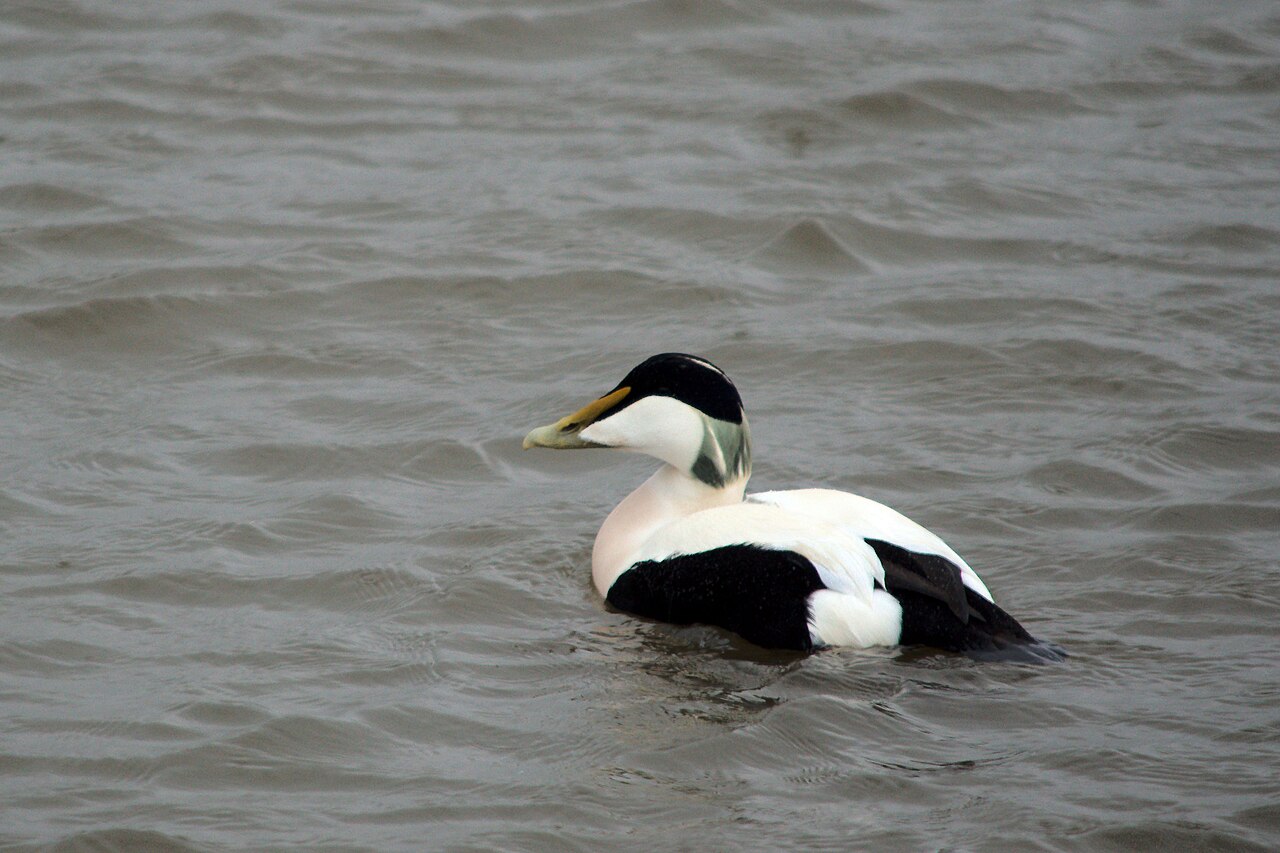
The male in breeding plumage is largely white on the back and breast, with a black belly and flanks, a black crown with a green patch on the nape, and a faint pinkish flush on the breast; the bill is yellowish to greenish and runs in a wedge straight up into the forehead, with no clear line between bill and feathering. The female is dull reddish-brown with fine black barring over the entire body, a pattern that looks almost scaled up close; her silhouette, with the same long, sloping bill and flat forehead, is her best field mark. First-year males pass through a long series of intermediate plumages from brown toward increasing white, and only reach full breeding plumage in their third year. In flight, flocks form long ribbons skimming low over the water, with fast, stiff wingbeats rarely rising more than a few metres above the waves.
Confusion species
King Eider (Somateria spectabilis) breeds farther north and overlaps mainly in winter; the male has a black rather than white back and an orange, swollen forehead shield, while the female is best told by her shorter bill with a clear notch at the forehead, against the eider's long, gradually sloping bill. Spectacled Eider (Somateria fischeri) and the smaller Steller's Eider (Polysticta stelleri) rarely occur outside Alaska and, once seen well, are distinguished by their head patterns — the white 'goggled' mask and the compact, iridescent head. Large mixed flocks of sea ducks along the coast in winter often also hold Black Scoters and Surf Scoters, which are smaller, wholly or largely black, and entirely lack the eider's wedge-shaped bill profile.
Habitat
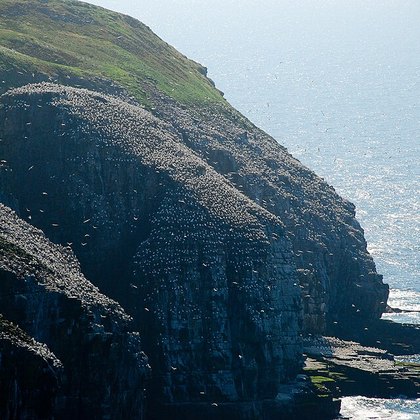
The Common Eider is a true sea duck: it dives for mussels and other shellfish in the tidal zone of rocky and pebbly coasts and rarely leaves salt water. For its nest it chooses small, bare or sparsely vegetated coastal islands free of land predators, often in dense colonies where hundreds of nests almost touch. In the far north part of the population winters not far from the breeding grounds, in open leads and polynyas amid the sea ice where currents keep the water open; farther south it moves to open, sheltered bays and reefs along the Atlantic coast. It avoids thick, tightly packed pack ice, and almost never uses fresh water or the interior.
Where the bird is most often found, arranged by the USNVC — the vegetation classification of the United States and Canada — and CMECS for sea and coast.




Range and movements
Breeds circumpolar around the entire Arctic and subarctic coast, with four subspecies in North America each occupying its own section: dresseri from Maine to Labrador, borealis in the Canadian high Arctic and Greenland, the largely non-migratory sedentaria around Hudson Bay, and v-nigrum in Alaska and the far east of Siberia. Birds from the north move in winter to open water farther south along the coast, as far as New York and New Jersey, while the Hudson Bay population stays close to the breeding grounds year-round as long as open water remains. In Maine the population grew steadily through the twentieth century after protection ended the hunting for down and eggs that had nearly wiped the species out there. At Hudson Bay, tens of thousands of birds died in the 1990s when changing ice conditions cut off access to mussel beds, an event that showed how directly the species depends on open water.
- Resident
- Winter
- Passage
- dark = core range, pale = thinly spread
Where and when to look
Look for the eider along rocky coasts with moderate surf, where it dives for mussel beds just beyond the breakers; binoculars from a pier or headland at sea level work better than a high viewpoint, since the birds stay low over the waves. In late autumn and early winter, hundreds to thousands of birds form dense, noisy display groups just offshore, with the cooing chorus of the males audible from a distance.
Conservation
Globally listed as Near Threatened (NT), with a population still estimated in the millions but declining over recent decades, above all because of the sharp drop in Scandinavian and Baltic breeding grounds. In North America periodic outbreaks of avian cholera threaten the dense breeding colonies, and changing ice conditions at Hudson Bay have already hit the sedentary subspecies more than once. Down harvesting itself has proven sustainable — it happens only after the young have left the nest — and continues on a small scale in Iceland and parts of Canada.
Scientific name
Somateria mollissima | (Linnaeus, 1758)
Linnaeus described the species in 1758 as Anas mollissima, among the ducks; because it was later placed in another genus, author and year stand in parentheses. The genus Somateria was introduced in 1819 by the English zoologist William Leach, originally for the King Eider. The name is Greek: soma means 'body' and erion 'wool', after the downy plumage with which the female lines her nest; mollissima is Latin for 'the softest'. Linnaeus gave the type locality as 'northern Europe', restricted by himself to the island of Gotland in 1761.