All species › Gannets and cormorants › Boobies and gannets › Cocos Booby
Cocos Booby | Sula brewsteri
Cocosgent | Piquero de Cocos
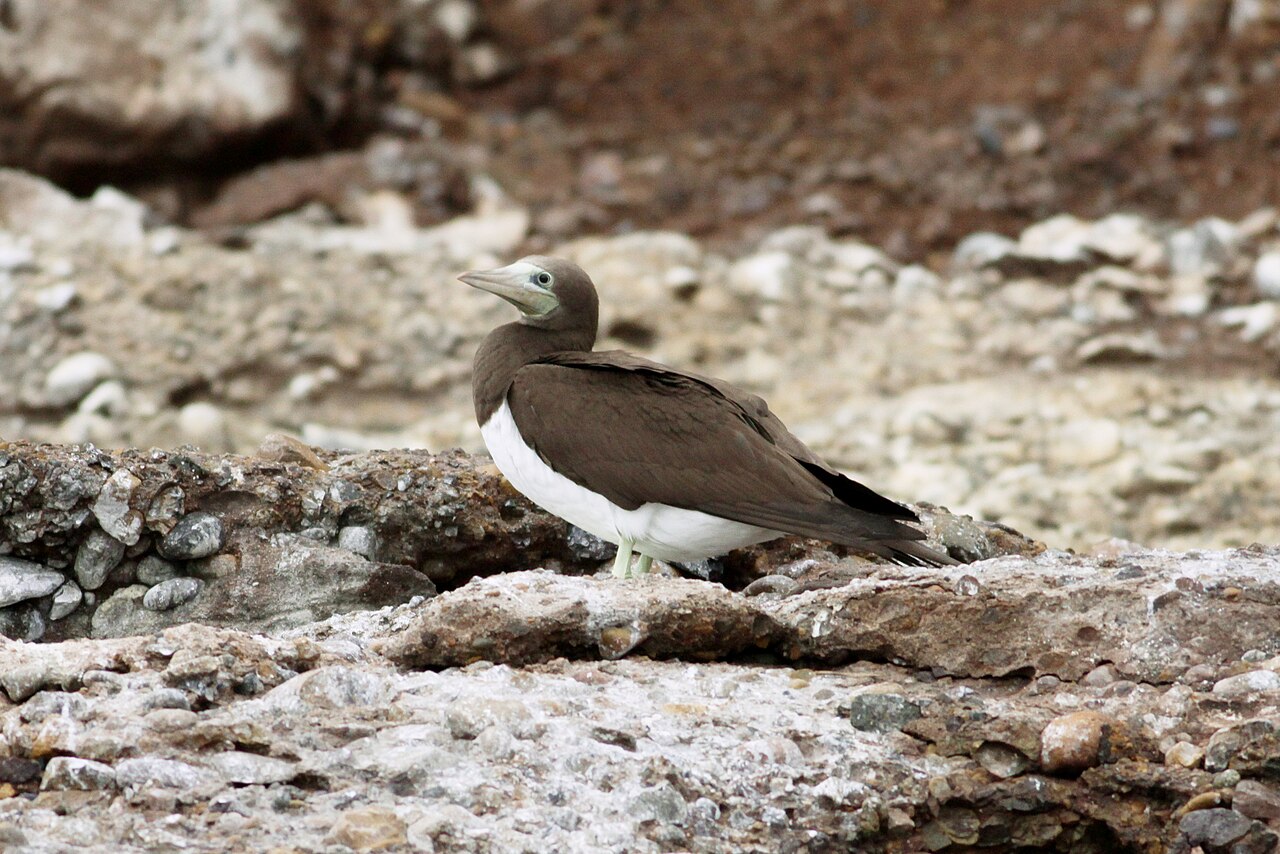
Until recently Cocos Booby was always treated as a subspecies of Brown Booby, and it was only recognised as a full species in 2024. It breeds on rocky islands in the Gulf of California and further south along the Pacific coast of Central America, and the male is recognised by its frosted white head set against a grey bill.
Voice
Like the other boobies it is generally silent at sea. At the nest and during display flight the male gives a thin, sustained whistle, while the female answers with a hoarse, quacking call — the same pattern as in Brown Booby, of which it was long considered a subspecies. In greeting at the colony, partners throw the head back and briefly clatter the bill.
No recording with a suitable Creative Commons licence has been found for this species yet; what to listen for is described below.
Identification
The male has a frosted white head and neck, blue-grey bare facial skin and a grey bill, while the body is dark brown with a sharply defined white belly and white underwing coverts. The female lacks the white head: on her the brown extends down onto the upper breast, with an equally sharp border to the white underparts, and the bill has a pinkish tinge. Both sexes have greyish-yellow to flesh-coloured legs, without the vivid colour of Blue-footed Booby. Young birds are uniformly dark brown, without the adult male's white head patch, and only gain adult plumage after several years.
Confusion species
The greatest risk of confusion is with Brown Booby (Sula leucogaster) itself, of which it was considered a subspecies until 2024: both share the same brown-and-white pattern, and the difference lies mainly in the greyer bill and facial skin of the male and in range, since the two barely overlap. Within the Gulf of California it occurs alongside Blue-footed Booby (Sula nebouxii), which has the same brown-and-white body but is told apart at once by its blue rather than greyish-yellow legs. Young Cocos and Brown Boobies are barely separable in the hand.
Habitat
It breeds on bare, rocky islands with little or no vegetation, laying its egg on the ground among rubble or in a shallow scrape. Outside the breeding season it hunts the productive, food-rich coastal waters of the eastern Pacific, usually within a few dozen kilometres of shore, closer to land than the truly pelagic booby species. It largely avoids open, deep ocean waters far from islands.
Where the bird is most often found, arranged by the USNVC — the vegetation classification of the United States and Canada — and CMECS for sea and coast.


Range and movements
The core range lies in the Gulf of California, with colonies on islands off Sonora, Sinaloa and Baja California Sur, continuing south along the Mexican Pacific coast to Costa Rica, Panama and Colombia. In the southern part of the range it breeds year-round, in the north mainly between October and February. Since around 2017, non-breeding wanderers have turned up increasingly often along the US West Coast, reaching California, Washington and occasionally as far as British Columbia and Japan — a range expansion still under way.
- Resident
- Breeding (summer)
- Winter
- Passage
- dark = core range, pale = thinly spread
Where and when to look
Boat trips from ports on the Gulf of California, such as La Paz or Guaymas, give the best chance of the species near the rocky islands where it breeds. Check the male's head colour against the grey bill to separate it at once from Blue-footed Booby, even before the legs are visible.
Conservation
Because the species was only recognised as distinct in 2024, no separate Red List assessment yet exists; its status is listed as Not Evaluated (NE), and much of the biometric data in the literature still dates from when it was treated as a subspecies of Brown Booby. The known colonies in the Gulf of California are considered large and not at risk, as long as the islands stay free of introduced predators. Less is known about the southern populations, from Costa Rica to Colombia.
Scientific name
Sula brewsteri | Goss, 1888
Goss described the species in 1888 as Sula brewsteri; it has remained in the same genus ever since, so author and year do not stand in parentheses. In 1944 Wetmore placed it as a subspecies of Brown Booby, a treatment only reversed by the American Ornithological Society in 2024. The epithet brewsteri honours the American ornithologist William Brewster, a co-founder of the American Ornithologists' Union. The type locality is San Pedro Mártir, an island in the Gulf of California — the same waters where the species still breeds.