All species › Passerines › New World sparrows › Clay-colored Sparrow
Clay-colored Sparrow | Spizella pallida
Bleke gors | Chimbito pálido
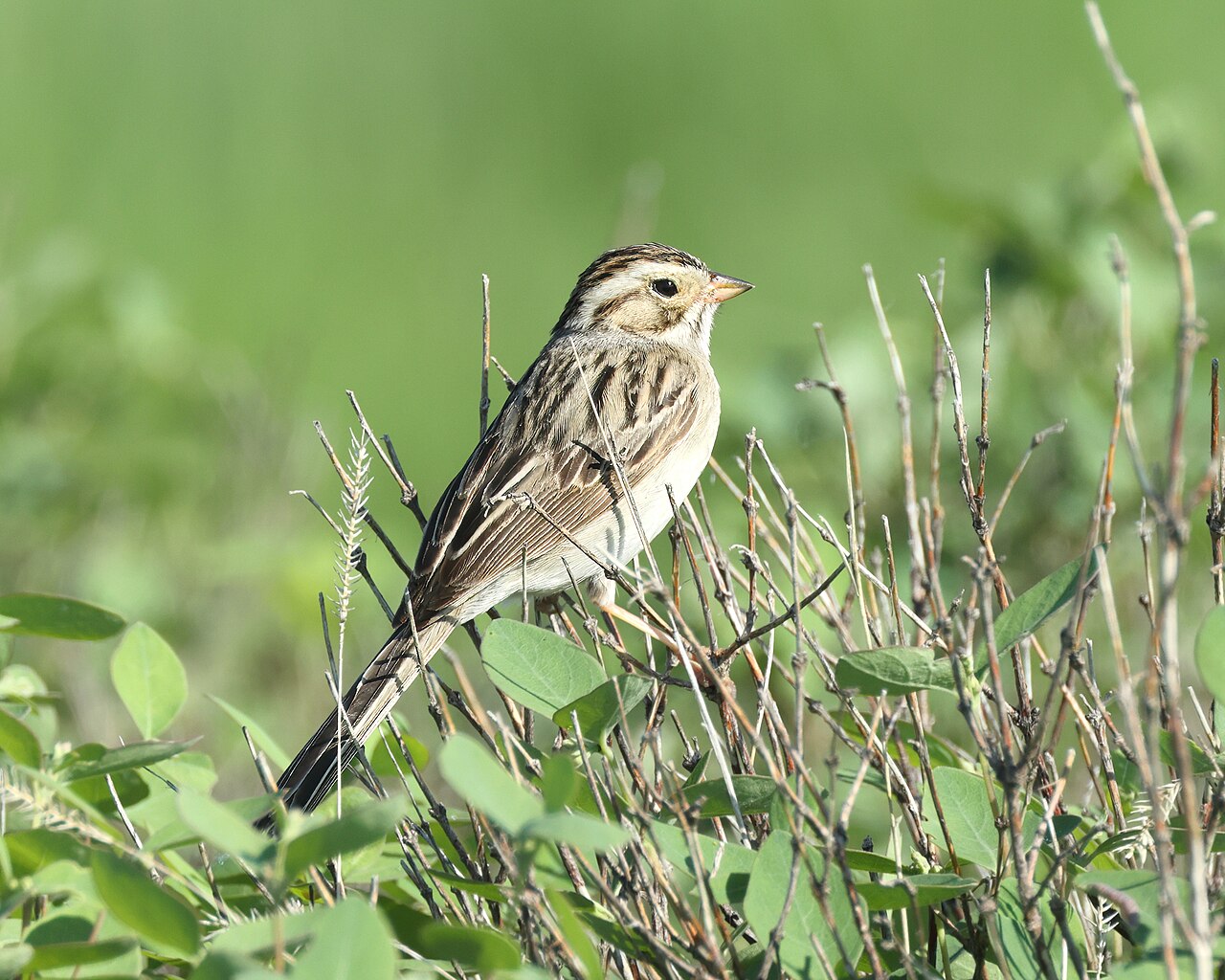
The Clay-colored Sparrow is a small, pale sandy sparrow of the northern prairie shrublands, with a finely streaked crown, a pale median crown stripe and a grey collar. It breeds mainly in central Canada and winters almost entirely in Mexico.
Voice
The song is not a trill but a series of two to five low, insect-like buzzes, usually evenly spaced: bzzzz bzzzz bzzzz. The sound is so dry that it suggests a grasshopper rather than a bird, and carries only moderately far over open scrub. It sings from the top of a low shrub, through the day and at times after dark. The call is a short, soft tsip.
Recording: Stanislas Wroza — CC BY-NC-SA 4.0 · La Haute-Côte-Nord (near Tadoussac), Côte-Nord, Québec, Canada · xeno-canto
Identification
Upperparts are pale sandy brown with dark streaking; the crown is finely streaked and has a pale central stripe. The face shows a broad buff supercilium, a sharply outlined brown ear patch, a pale malar stripe and a pale area in front of the eye. Diagnostic in every plumage is the plain grey collar, contrasting with the streaked back. Underparts are unstreaked buff to white, the rump brown, the bill pale with a dark tip. In autumn the buff tones are warmer.
Confusion species
Chipping Sparrow is the main confusion species: its black eyeline continues in front of the eye, its rump is grey and it has no pale median crown stripe. Brewer's Sparrow is greyer and duller, with a more finely streaked crown and no clear central stripe, and a plainer face with a white eyering. In doubt, the grey collar, the sharply outlined brown ear patch and the pale spot in front of the eye are the most usable marks; in the breeding season the buzzing song settles it at once.
Habitat
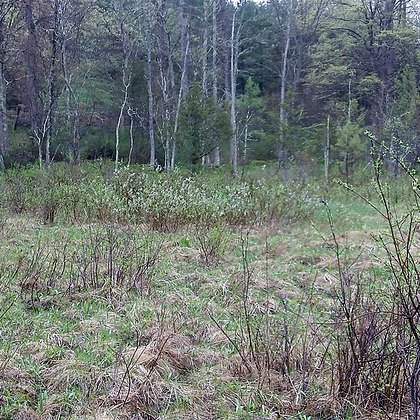
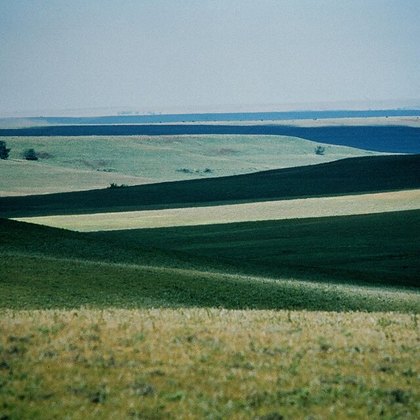
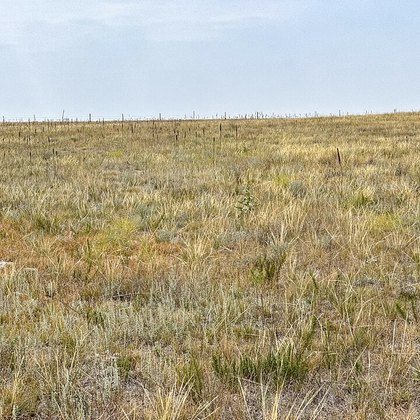
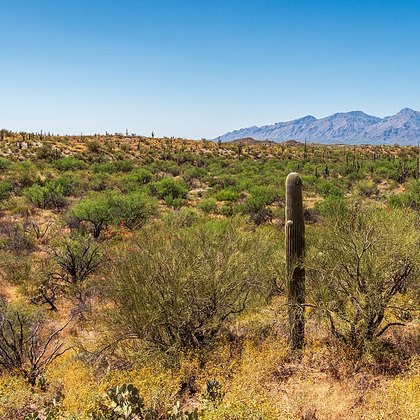
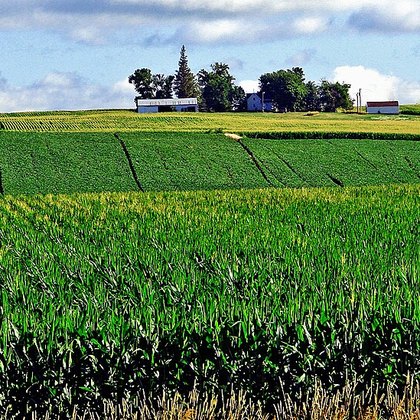
Low shrubland in open country: shrub growth in prairie and aspen parkland, rank field edges, dense hedgerows, young regrowth after fire or logging and the margins of marshes. In the east of the range it also breeds in Christmas tree plantations and grassland with scattered young conifers. In winter it uses desert grassland, thorn scrub, field edges and brushy hillsides, usually in flocks.
Where the bird is most often found, arranged by the USNVC — the vegetation classification of the United States and Canada — and CMECS for sea and coast.
Range and movements
The core of the breeding range lies in central Canada: about 85 per cent breed in Alberta, Saskatchewan and Manitoba, with more in northeastern British Columbia, the southern Northwest Territories and western Ontario, and in the United States in Montana, the Dakotas, Wyoming, Minnesota, Wisconsin and northern Michigan. It is spreading east into logged forest and abandoned farmland. About 92 per cent winter in Mexico, on the northern plateau and in the northwest, with smaller numbers in southern Texas and as far as Guatemala; migration runs through the Great Plains from Nebraska and Kansas to Oklahoma, New Mexico and Texas.
- Resident
- Breeding (summer)
- Winter
- Passage
- dark = core range, pale = thinly spread
Where and when to look
Walk a shrub edge in the aspen parkland of Saskatchewan or North Dakota in June and listen for the series of buzzes; you will then usually find the bird on top of a low shrub. On passage through the Great Plains in September it sits among Chipping Sparrows in the same bush: look for the grey collar and the absence of an eyeline in front of the eye.
Conservation
The world population is put at about 56 million birds and the species is not considered threatened, but survey data indicate a decline of some 51 per cent since 1966. Conversion of prairie shrubland to cropland and heavy grazing are the main causes; at the same time the eastward spread into logged forest and abandoned farmland provides new breeding ground. Because the great majority breeds in Canada and winters in Mexico, the species depends on two countries at once.
Scientific name
Spizella pallida | (Swainson, 1832)
William Swainson described the species in 1832 as Emberiza pallida, from a specimen taken at Carlton House in Saskatchewan; because it was later moved to another genus, author and year stand in parentheses. Pallida is Latin for 'pale', after the washed-out plumage, and reappears in the Dutch and Spanish names. The genus Spizella is a diminutive of Greek spiza 'finch'. The English name, Clay-colored Sparrow, refers to the same colour, that of clay.