All species › Passerines › New World blackbirds, troupials and allies › Chihuahuan Meadowlark
Chihuahuan Meadowlark | Sturnella lilianae
Lilians weidespreeuw | Pradero de Lilian
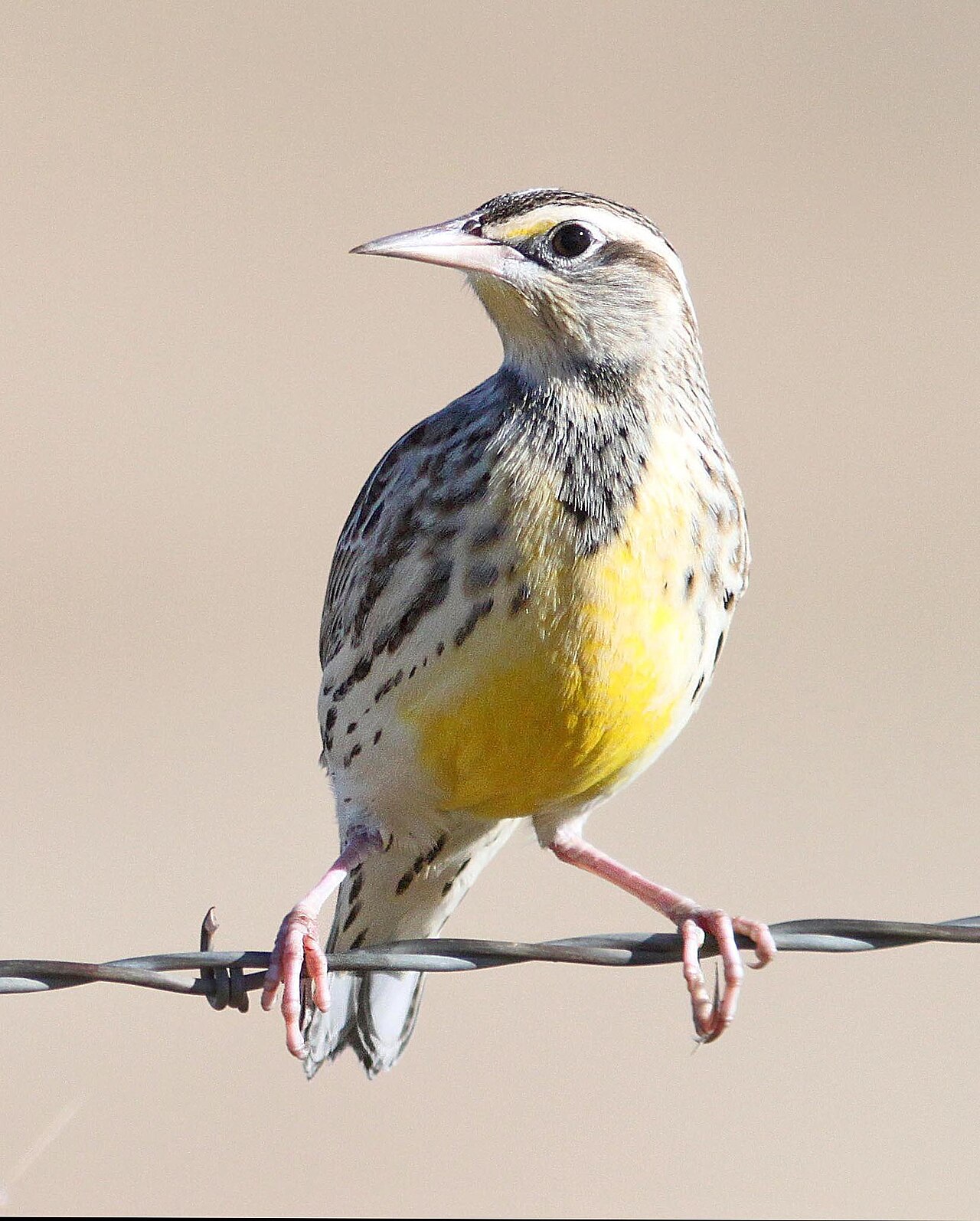
The Chihuahuan Meadowlark is the meadowlark of the desert grasslands of the Chihuahuan Desert and the Mexican highlands. It was described in 1930 as a subspecies of Eastern Meadowlark and only recognised as a separate species in 2022, on the basis of song, plumage and genetic work. From the other two meadowlarks it is separated in the field mainly by song and by the amount of white in the tail.
Voice
The song is a series of three to five descending whistles, often introduced by a short, low note. The notes are higher and thinner than in Eastern Meadowlark, follow one another faster and are usually more numerous; on a sonogram the differences are as large as those between Eastern and Western Meadowlark. Both sexes give a single, explosive call; excited birds chatter. The song carries far over bare grassland and is the most used character in the early morning from March to July.
No recording with a suitable Creative Commons licence has been found for this species yet; what to listen for is described below.
Identification
Same build as the other meadowlarks: compact body, long pointed bill, short tail, yellow underparts with a black V on the breast. It is the palest and greyest above of the three; the black bars on mantle and shoulders stay separate instead of merging into long streaks. The head looks white in the face, with a little-streaked ear covert and a sharply drawn dark eyeline. The yellow of the breast often has an ochre cast. The three outer tail feathers are almost entirely white, so a flushing bird shows a broad white tail edge. The subspecies auropectoralis of west-central Mexico has an orange wash across the breast.
Confusion species
Eastern Meadowlark sings separate, lower-pitched, more slowly descending whistles and is darker and browner above, with bars merging into streaks on the mantle; its tail has a clearly narrower white edge, which shows less as the bird flushes. Western Meadowlark separates at once on its tumbling, gurgling song accelerating at the end, and further because the yellow of the throat runs on into the malar area — in both Chihuahuan and Eastern that malar area stays white. Where Western and Chihuahuan occur together in Arizona and New Mexico, Chihuahuan is the paler of the two, with a whiter face and more white in the tail. Silent birds often cannot be named with certainty.
Habitat
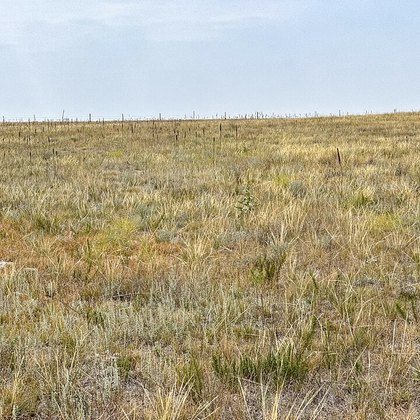
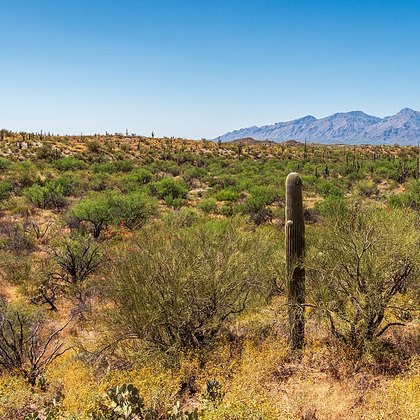
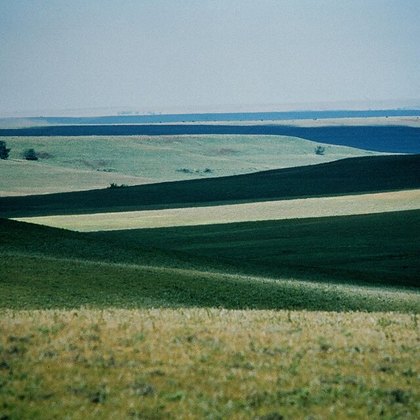
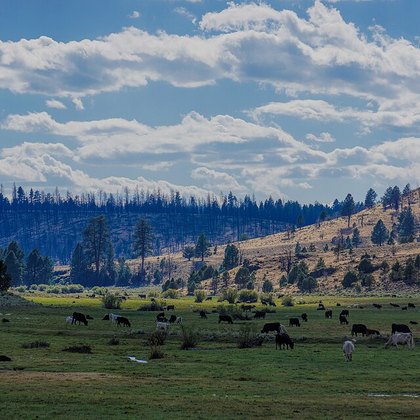
Dry grassland of the desert highlands, roughly between 1100 and 2000 metres, with tall, even, dense grass cover, deep litter and little bare ground. It tolerates scattered mesquite (a thorny pod-bearing shrub of the Southwest that forms dense thickets) or acacia but leaves ground with more than about five per cent woody cover; patches smaller than ten hectares are rarely occupied. In the eastern part of the Mexican range auropectoralis also uses irrigated farmland. The nest is a domed grass cup on the ground.
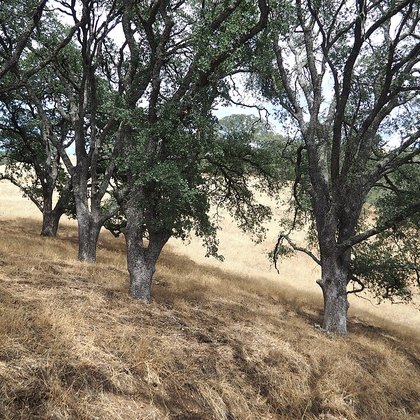
Where the bird is most often found, arranged by the USNVC — the vegetation classification of the United States and Canada — and CMECS for sea and coast.

Range and movements
A resident of the southwestern United States and northern and western Mexico. In the United States it breeds in the grasslands of northern and southeastern Arizona, in New Mexico and in Trans-Pecos Texas; in Arizona the range lies above roughly a thousand metres and runs on to the country between Prescott and the Grand Canyon. In Mexico the nominate form holds Sonora and Chihuahua, and the subspecies auropectoralis the west-central highlands of Sinaloa, Durango, Nayarit, Zacatecas, Jalisco, Michoacán and the state of México. Outside the breeding season it wanders locally to lower grassland; a few records come from Colorado.
- Resident
- Breeding (summer)
- Winter
- Passage
- dark = core range, pale = thinly spread
Where and when to look
Drive the grasslands of the Sonoita Plain or the Sulphur Springs Valley in southeastern Arizona at sunrise in April or May and listen for the high, fast whistled series from a fence post. Record it on your phone if you are unsure: a recording can be judged afterwards better than an impression by ear. On a flushing bird, watch for the broad white tail edges.
Conservation
The IUCN has not yet assessed the species separately since the split (NE). Partners in Flight puts the breeding population at about 3.3 million birds, some 240,000 of them in Arizona. The picture differs by region: numbers are rising in Arizona, while New Mexico loses more than four per cent a year and the Chihuahuan Desert as a whole more than six. The 2025 State of the Birds report placed the species on the list of tipping-point species that have lost more than half their numbers in fifty years. Fragmentation of grassland by development and cultivation, grazing that keeps the grass below ten centimetres, and the spread of mesquite and other woody plants are the main pressures.
Scientific name
Sturnella lilianae | Oberholser, 1930
Oberholser described the form in 1930 as Sturnella magna lilianae; because it stayed in the same genus when raised to species rank, author and year stand without parentheses. The genus Sturnella is a diminutive of Latin sturnus 'starling'. The species name lilianae honours Lilian Hanna Baldwin, wife of the ornithologist Samuel Prentiss Baldwin, who donated the collection from which the type specimen came; that specimen was taken in the Huachuca Mountains of Arizona. The English name refers to the Chihuahuan Desert, the Dutch name to the dedication.