All species › Passerines › Tyrant flycatchers and allies › Cassin's Kingbird
Cassin's Kingbird | Tyrannus vociferans
Cassins koningstiran | Tirano Chibiú
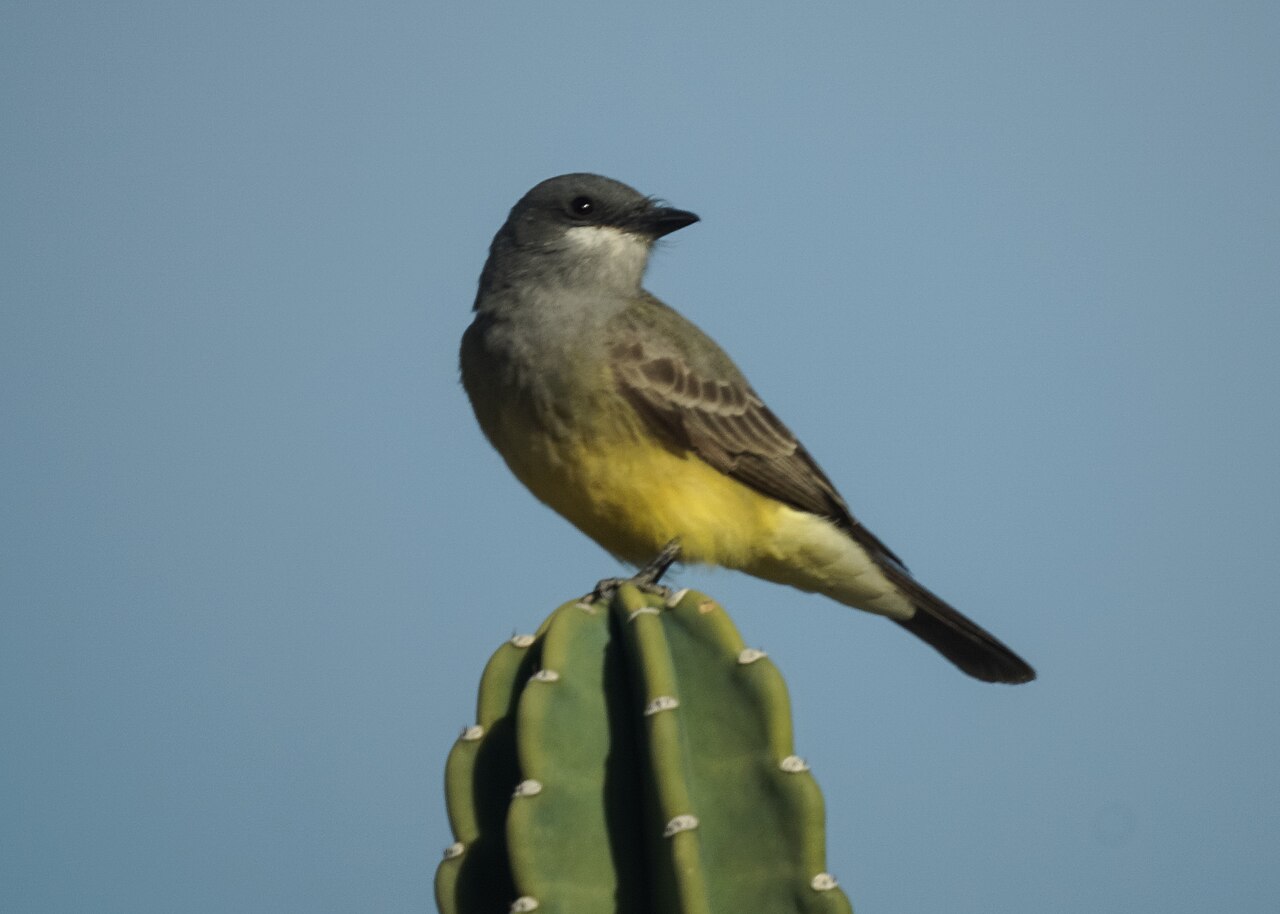
Cassin's Kingbird is the darkest of the yellow kingbirds of the west: dark grey head, back and breast, a sharply defined white chin patch and a black, straight tail with a pale terminal edge. It breeds from southeastern Montana into Central America and occupies open woodland along canyons and streams, often near oak and juniper.
Voice
The usual call is a low, burry chi-beer — a short, high note followed by a longer one dropping in pitch — often repeated in series. There is also a rough, barking queer when disturbed. The male begins his dawn song around three in the morning, calling from a tumbling flight. The sound is lower and rougher than the sharp chattering of Western Kingbird, with which it shares the range over great distances.
Recording: Richard E. Webster — CC BY-NC-SA 4.0 · San Bernardino National Wildlife Refuge, Cochise County, Arizona, United States · xeno-canto
Identification
A bulky flycatcher with a straight, rather heavy bill. Head, neck and breast are dark grey; in the middle of the throat a sharply bounded white patch stands out, which in profile suggests a moustache. The back is dark grey-olive, the belly and undertail coverts deep yellow. The tail is black and squarely cut, without white along the sides, but with a narrow pale or dingy white terminal edge. A red crown patch is concealed. Young birds are browner on the back and show less colour in the crown.
Confusion species
Western Kingbird is the most similar species: it is paler grey on head and breast, paler yellow on the belly, and has white outer tail feathers along the sides of the tail. In Cassin's the white instead forms a narrow edge at the tip of the tail, and the sides are black. Western also lacks the white chin patch and the dark grey that runs well down onto the breast. Tropical and Couch's Kingbird are paler grey on the head, lack the white chin patch, have a notched to forked tail without a pale terminal edge, and a greener back. Thick-billed Kingbird has a brown-black head and a far heavier bill.
Habitat
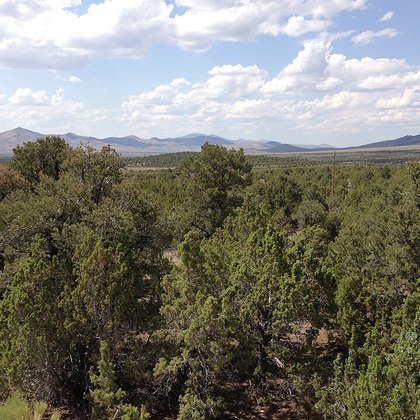
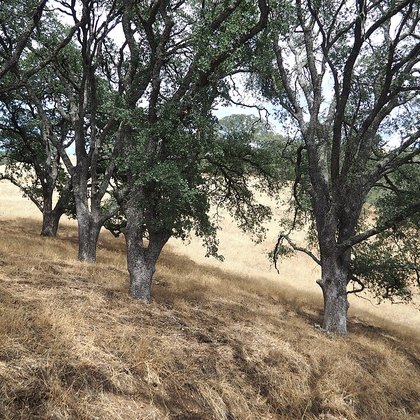
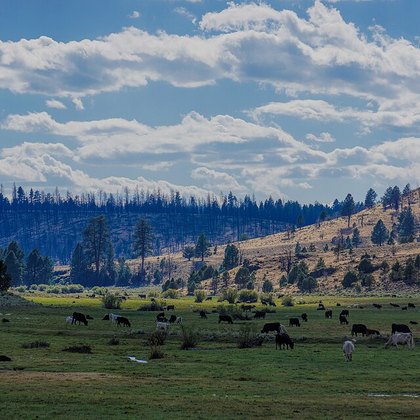
Open woodland and woodland edge along canyons, rivers and streams; also pinyon (a low-growing pine of the dry south-western foothills)-juniper woodland, dry pine forest, open oak woodland and savanna, montane conifer forest along its upper edge, and pasture and ranching country with scattered tall trees. It needs tall trees to nest in and open space to hunt flying insects from those trees. In southern California it also breeds in spacious parks and town edges.
Where the bird is most often found, arranged by the USNVC — the vegetation classification of the United States and Canada — and CMECS for sea and coast.



Range and movements
The breeding range runs from southeastern Montana and Wyoming south through Utah, Colorado, Nevada, Arizona, New Mexico and western Texas into northern Mexico, with a further breeding area in California and northern Baja California. In the highlands of central Mexico it is resident. Northern breeders leave in August and September and winter from southern California and western Mexico to Guatemala and Honduras; the southern California coast and the mountains of central Mexico hold birds all year. In the south the range reaches about as far as Nicaragua.
- Resident
- Breeding (summer)
- Winter
- Passage
- dark = core range, pale = thinly spread
Where and when to look
Look for it from May to August in canyons with oak and juniper in Arizona, New Mexico and southern Colorado, where it often sits alongside Western Kingbird. Watch the tail from behind: a pale edge across the whole rear border means Cassin's, a white stripe along the outer edge means Western. The low chi-beer settles the matter in case of doubt.
Conservation
Partners in Flight puts the world population at about 8.8 million breeding birds, 2.6 million of them in the United States, and scores the species 9 out of 20 on the Continental Concern Score, a low concern category. The trend is stable. The main pressure named is the loss of tall trees: where riparian woodland or isolated trees in pasture are cut, the nesting sites go with them.
Scientific name
Tyrannus vociferans | Swainson, 1826
Swainson described the species in 1826 as Tyrannus vociferans, from a specimen taken at Temascaltepec in the State of Mexico; author and year stand without parentheses because the genus has not changed. Tyrannus is Latin for 'absolute ruler' or 'king'. The species name vociferans means 'calling loudly', after the male's persistent calling. The English and Dutch names refer to John Cassin (1813–1869), a Philadelphia ornithologist who described large parts of the North American bird collections of his day.