All species › Waders, gulls and terns › Auks, puffins and murres › Cassin's Auklet
Cassin's Auklet | Ptychoramphus aleuticus
Cassins alk | Mérgulo sombrío
Cassin's Auklet is a small, plain grey auk of the cold upwelling zones off the west coast, and one of the most numerous seabirds there. In flight it looks like a grey ball with wings. On its breeding island it can only be seen after dark, and in a warm winter tens of thousands can starve at once.
Voice
Out of the burrow comes a repeated, descending screech with a muffled quality, recalling the alarm calls of a tern. Paired birds add soft, cricketlike purring and short guttural notes. Chicks hiss, audible from outside the burrow. A colony of thousands produces a sustained sound after sunset that carries across the whole island; by day, and at sea, the bird is silent.
Recording: Matthew L. Brady — CC BY-NC-SA 4.0 · Southeast Farallon Island, San Francisco County, California, United States · xeno-canto
Identification
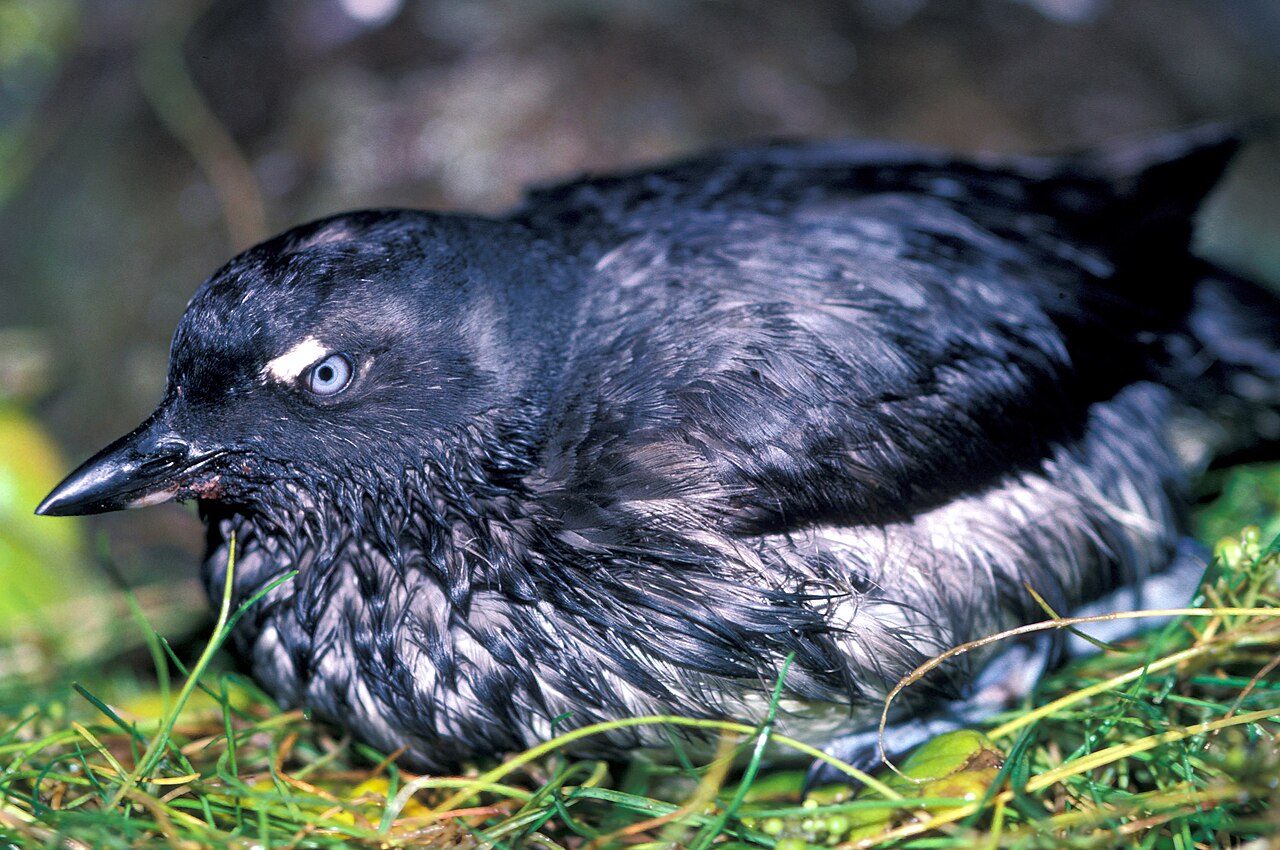
A small, round auk with a domed head, a short neck, short blunt wings and a short tail. Dark grey above and slightly paler grey on the breast, with a white belly and white undertail that light up towards the rear as a sharp border. The eye is pale, with a short white arc above it that reads as an eyebrow; the bill is dark with a pale spot at the base of the lower mandible. The underwing shows a thin white stripe. Juveniles are paler, with a whitish throat and a darker eye and bill. The plumage barely changes through the year; there is no separate breeding dress.
Confusion species
Ancient Murrelet (Synthliboramphus antiquus) has a black cap standing out sharply against the grey back, white underparts reaching up the neck, and a pale bill. Marbled Murrelet (Brachyramphus marmoratus) in winter plumage is far more contrasting, with white scapular stripes and a white collar. Rhinoceros Auklet (Cerorhinca monocerata) is well over twice the weight and has a heavy orange bill. In the Aleutians smaller auklets join in: Least Auklet (Aethia pusilla) has a white, dark-speckled belly and a tiny red bill. With all four the same feature helps: on Cassin's Auklet grey and white run into one another, on the others dark and white stand sharply apart.
Habitat
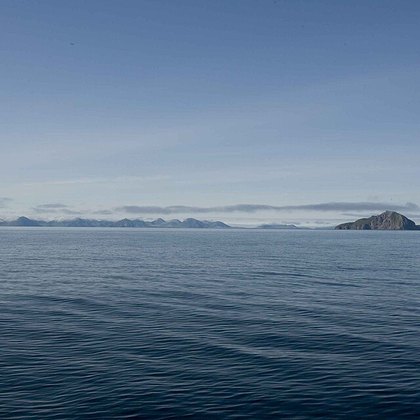
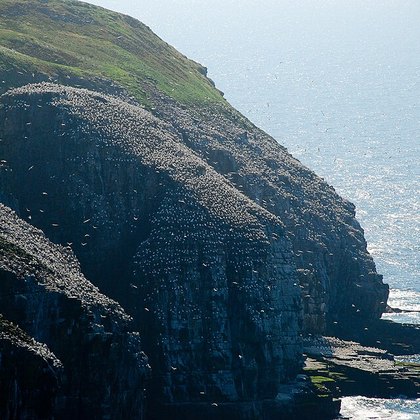
It breeds on predator-free islands, in burrows it digs in the soil itself or in crevices between boulders; islands under closed forest it passes over. At sea it seeks the water over the shelf edge, and above all the cold upwelling zones where krill comes near the surface. That ties it more closely to cold water than the other auks of the west coast. In warm years that water shifts and it disappears from large parts of its usual range.
Where the bird is most often found, arranged by the USNVC — the vegetation classification of the United States and Canada — and CMECS for sea and coast.
Range and movements
It breeds on islands from the Aleutians and southern Alaska through British Columbia, Washington and Oregon to California and the islands off Baja California. The largest colony is on Triangle Island off the northern tip of Vancouver Island; the one on the Farallon Islands has fallen sharply. Northern birds move south in winter to open water off California and Baja California, while the southern birds stay by their island all year — and there, alone among the world's auks, lay two clutches a season. After prolonged storms hundreds of dead birds sometimes wash up on the beaches of Oregon and Washington.
- Resident
- Breeding (summer)
- Winter
- Passage
- dark = core range, pale = thinly spread
Where and when to look
Take a pelagic trip out of Monterey, Bodega Bay or Westport in summer and look low on the water between the shearwaters: small dark birds that flush only at the last moment and then bank away fast and straight. From land it is almost never seen. After an autumn storm a walk along the beach pays off: beached birds show the white belly and the pale arc above the eye at close range.
Conservation
Partners in Flight puts the world population at about 3.6 million birds; the trend over the past forty years is downward and the species is listed as Near Threatened (NT). The heaviest blow comes from warm sea water: in 2014, during an unusually warm North Pacific, an estimated fifty to a hundred thousand birds starved. Introduced predators on breeding islands, drowning in nets, oil and plastic play their part as well.
Scientific name
Ptychoramphus aleuticus | (Pallas, 1811)
Pallas described the species in 1811 as Uria aleutica; because it was later placed in a genus of its own, author and year stand in parentheses. That genus, Ptychoramphus, was introduced by Brandt in 1837; the name means 'fold-bill', from the Greek ptyx (fold, groove) and rhamphos (bill), after the groove in the lower mandible. aleuticus means 'of the Aleutians'. Pallas gave only 'the Russian waters of the eastern ocean' as the type locality, that is, the northern Pacific. The Dutch and English names honour John Cassin, a nineteenth-century ornithologist from Philadelphia.