All species › Passerines › Finches, euphonias and allies › Cassia Crossbill
Cassia Crossbill | Loxia sinesciuris
Idahokruisbek | Piquituerto de Cassia
The Cassia Crossbill has the smallest range of any bird in North America north of Mexico: it lives only in the lodgepole pine forest of the South Hills and the Albion Mountains of southern Idaho, some 70 square kilometres in all. It was split from Red Crossbill in 2017, having long been known as 'call type 9'.
Voice
The flight call is a low, hard, dry chup-chup-chup or dyip-dyip-dyip, clearly lower and flatter than that of any other crossbill in the region; this character is the basis on which the species was recognised. The song strings the same hard notes together with interposed rattles and trills, usually from a dead treetop. Because crossbill calls are hard to calibrate by ear, researchers work from recordings and sonograms.
Recording: Richard E. Webster — CC BY-NC-SA 4.0 · Diamondfield Jack Campground, South Hills, Sawtooth National Forest, Cassia County, Idaho, United States · xeno-canto
Identification
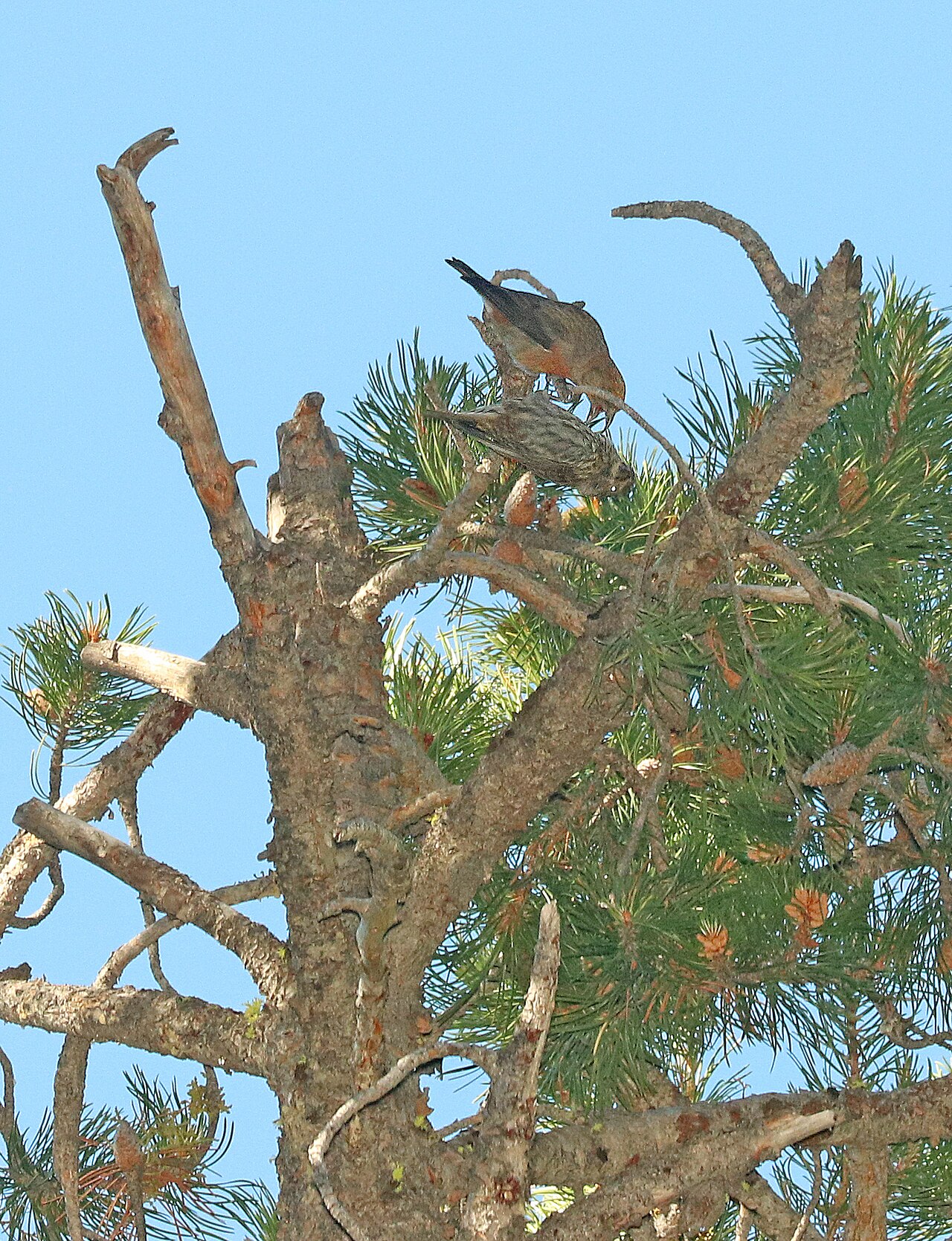
A stocky crossbill with a heavy bill that looks deep and broad, its tips crossed. The male is brick red to red-orange on crown, breast and belly, with dark brown wings and no wingbars; the female is dull green-yellow to olive, juveniles greyish brown and streaked. The bill is heavier than in almost any crossbill occurring in Idaho, but the difference can only be measured in the hand or on a sharp photograph.
Confusion species
Red Crossbill cannot be separated on plumage: the same red in males, the same green-yellow in females. The distinction lies in the bill, deeper and broader in Cassia, and above all in the call, lower and drier than that of the call types passing through the South Hills. White-winged Crossbill is ruled out by the two broad white wingbars and the black wing. Outside the South Hills and the Albion Mountains any crossbill is a different species from the start.
Habitat
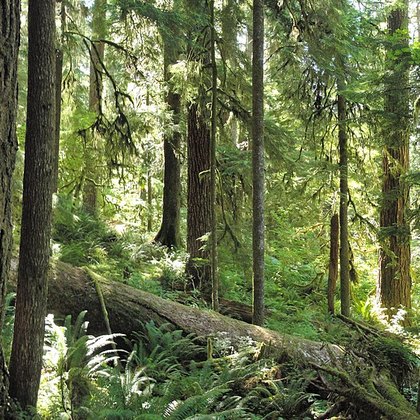
Montane lodgepole pine forest roughly between 1500 and 2400 metres, on two isolated highland islands. These two ranges lack the American red squirrel, the main seed predator of lodgepole pine. Cones therefore stay closed on the tree for years and seed is available all year; at the same time the pine there has evolved thicker cone scales, which demand a heavy bill. The species does not leave this forest type.
Where the bird is most often found, arranged by the USNVC — the vegetation classification of the United States and Canada — and CMECS for sea and coast.
Range and movements
Resident in the South Hills and the Albion Mountains of Twin Falls County and Cassia County, southern Idaho, and nowhere else. Unlike other crossbills it does not wander when the cone crop fails: the birds stay in their two ranges, which is what allows seed to accumulate on the tree. A few records exist away from the area, but there is no sign of a second population. The breeding season runs from late March into July.
- Breeding (summer)
- dark = core range, pale = thinly spread
Where and when to look
The best places lie along the Rock Creek road through the South Hills, at Diamondfield Jack and Porcupine Springs, where lodgepole forest reaches the road. Take a recorder: identification rests on the flight call, and a recording makes the record checkable afterwards. The birds come down to drink and take grit at the roadside, above all early in the morning.
Conservation
The population is put at a few thousand birds; counts around 2003 gave about 5800 and later years lie below that. Extreme heatwaves make the closed cones spring open, after which the seed is gone within a short time, and fire or bark beetle outbreaks could take out much of the forest in a single season. Forest models indicate that lodgepole pine may disappear from both ranges by the end of this century. The IUCN has not yet assessed the species (NE); under Red List criteria the 70-square-kilometre range alone would place it in a high category.
Scientific name
Loxia sinesciuris | Benkman, 2009
Craig Benkman described the species in 2009 as Loxia sinesciuris; author and year stand without parentheses because it remained in the original genus. Loxia is Greek loxos 'slanting, crosswise', after the crossed bill. Sinesciuris is Latin: sine 'without' and sciurus 'squirrel', after the absence of the red squirrel in the two ranges — the fact to which the species owes its existence. The English name refers to Cassia County; the Dutch name refers to the state of Idaho.