All species › Tubenoses › Petrels, shearwaters and diving petrels › Bulwer's Petrel
Bulwer's Petrel | Bulweria bulwerii
Bulwers stormvogel | Petrel de Bulwer
Bulwer's Petrel is a small, entirely dark tubenose with a long, pointed tail, whose main breeding grounds lie far outside the area this map covers: its largest colonies are on uninhabited islands and atolls in the northwestern Hawaiian Islands. Within North America it occurs almost solely as a breeding bird of that island chain; on the Atlantic side it is an extremely rare vagrant.
Voice
At the breeding colony Bulwer's Petrel is active at night and is heard most then: from the burrows and crevices where it nests comes a repeated, hoarse barking sound, often rendered in Hawaii as 'ou — the name by which the species is known there. By day, at sea, it is silent, hunting low over the water. Nothing is known of any call from the vagrants that occasionally turn up off the Atlantic coast of the United States: those are always seen by day, silently, from a boat.
Recording: Marcel Gil Velasco — CC BY-NC-SA 4.0 · La Graciosa, Las Palmas, Canarias, Spain · xeno-canto
Identification
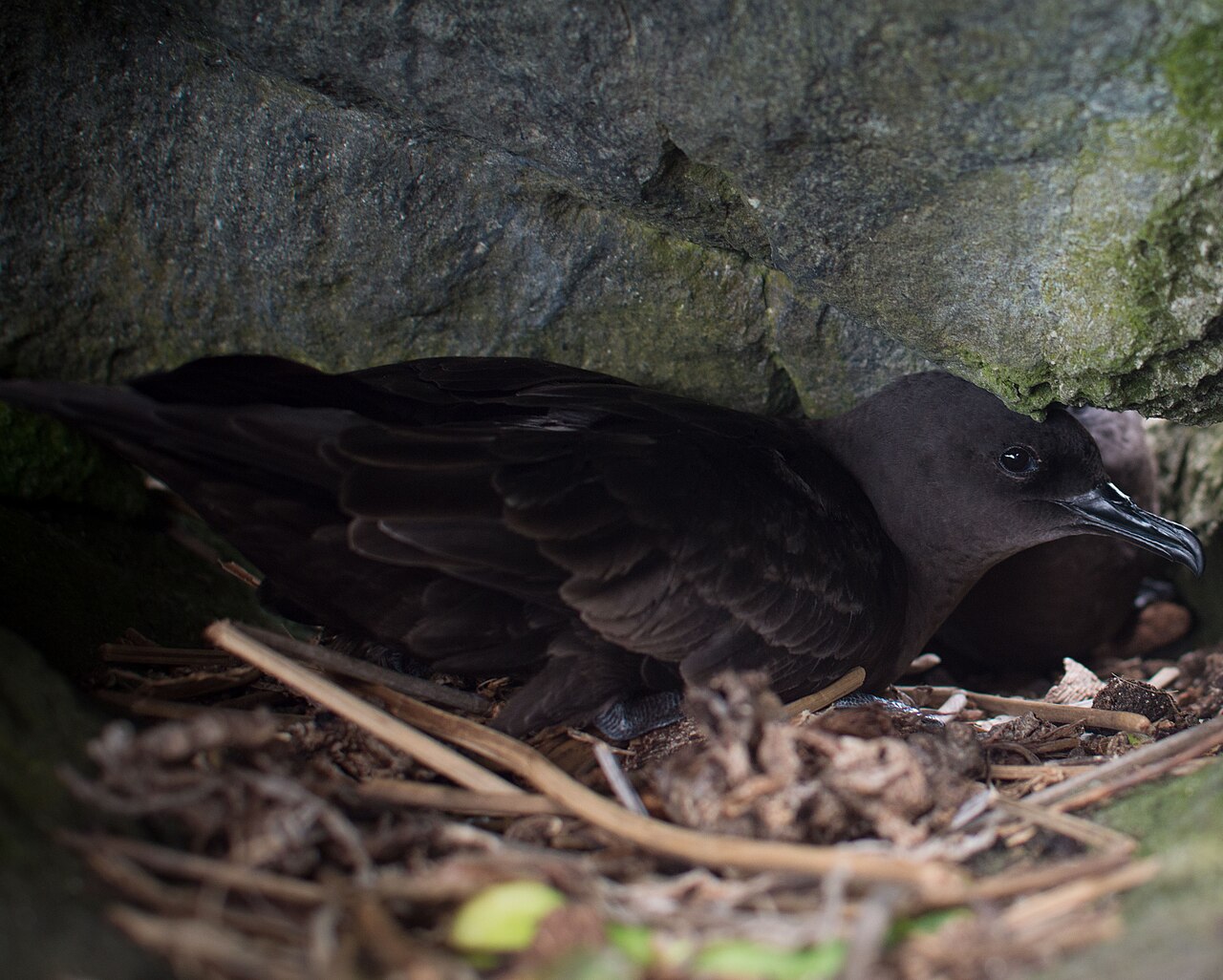
A small tubenose, entirely sooty brown to black, with a pale, indistinct bar across the upperwing and a long, tapering tail carried wedge-shaped in flight. Bill and legs are dark, the legs short, so the bird sits low on the water. Male, female and juvenile look alike. Flight is low over the water, with short, quick wingbeats broken by long, wavering glides that change direction — unlike the straight passage of a shearwater.
Confusion species
The long, pointed tail and entirely dark plumage set Bulwer's Petrel apart from almost every other tubenose in the same waters: storm-petrels are much smaller with a short, straight or forked tail, and most show a pale rump. Black Shearwater is considerably larger, with a short, fan-shaped tail and a straighter, more powerful flight. Larger, likewise dark gadfly petrels of the genus Pterodroma have a shorter tail and a heavier, shorter bill. At sea it is above all the low, weaving, direction-changing flight that gives the species away.
Habitat
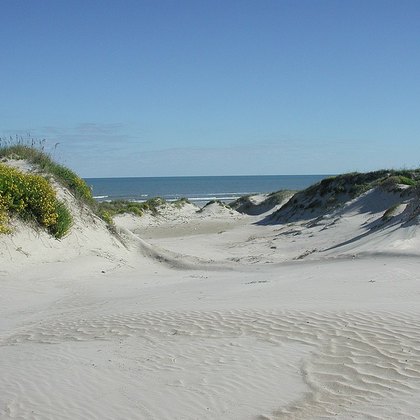
At sea Bulwer's Petrel is a bird of warm, open water far from shore; it forages alone, low over the surface, on small fish, squid and crustaceans. For breeding it seeks low, often vegetated islands and atolls, nesting in a crevice, a hollow under a rock or a self-dug burrow. It does not occur on the North American mainland or along the coast; it also largely avoids inhabited islands as a breeding site, though small numbers nest on islets off the inhabited main Hawaiian Islands as well.
Where the bird is most often found, arranged by the USNVC — the vegetation classification of the United States and Canada — and CMECS for sea and coast.

Range and movements
Bulwer's Petrel breeds widely across the subtropics: from the Azores to the Cape Verde Islands in the Atlantic, in parts of the Indian Ocean, and in the Pacific off Japan, off islands near the Chinese coast, and across numerous island groups of the tropical Pacific. Within this guide its only established breeding ground lies in the northwestern Hawaiian Islands, where Nihoa holds the largest known colony in the world, with tens of thousands of pairs; smaller numbers also breed on islets off the inhabited main Hawaiian Islands. Outside the breeding season it disperses widely across tropical and subtropical oceans; on the Atlantic coast of the United States, including off North Carolina and Virginia, it is a vagrant known from a handful of records.
- Breeding (summer)
Where and when to look
The best chance of Bulwer's Petrel within this area is a boat trip to the breeding islands of the northwestern Hawaiian chain, between mid-May and early October; outside those islands it cannot be reliably found anywhere. Watch for the long, pointed tail and weaving flight, since at a distance the bird looks more like a large, dark storm-petrel than the tubenose it actually is.
Conservation
The world population is large and not threatened, with between seventy-five and a hundred thousand breeding pairs on Nihoa alone. Introduced rats and feral cats are the main threat to the colonies, as is the invasive big-headed ant, which kills chicks; because the great majority of birds breed on a single island, a hurricane or a newly introduced predator could strike the species hard in a short time.
Scientific name
Bulweria bulwerii | (Jardine; Selby, 1828)
William Jardine and Prideaux John Selby described the species in 1828 as Procellaria bulwerii, named after the English collector James Bulwer, who gathered the type material on Madeira; because it has since been moved to another genus, author and year stand in parentheses. The genus Bulweria was introduced in 1843 by Bonaparte, honouring the same Bulwer. The type locality is Madeira, in the Atlantic Ocean.