All species › Gannets and cormorants › Cormorants and shags › Brandt's Cormorant
Brandt's Cormorant | Urile penicillatus
Brandts aalscholver | Cormorán Sargento
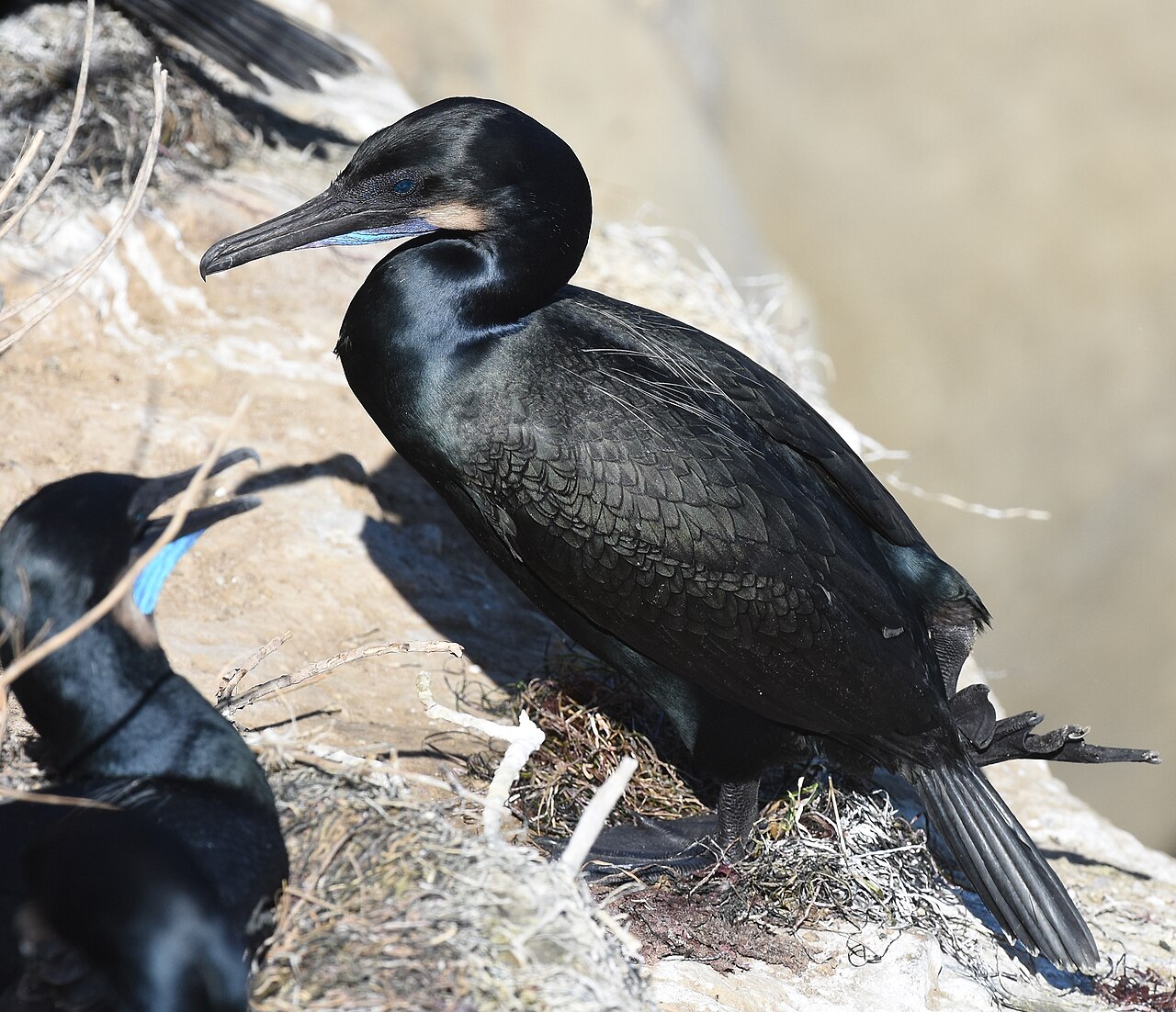
Brandt's Cormorant nests in dense colonies on rocky islands and cliffs along the Pacific coast, from British Columbia to Baja California. In breeding dress it shows a vivid blue throat patch and wispy white plumes on the head and neck, and it feeds almost entirely within the cold, nutrient-rich California Current.
Voice
At the colony it gives low, harsh croaking and grunting sounds, often in short bursts during courtship and nest relief. On open water the species is essentially silent. Chicks in the nest give a distinct, higher-pitched begging call quite different from the calls of adults. Away from the colony a Brandt's Cormorant is seldom heard at all.
Recording: Paul Marvin — CC BY-NC-SA 4.0 · La Jolla Cove, San Diego County, California, United States · xeno-canto
Identification
In breeding plumage the bird is entirely black with a purplish sheen, with a blue throat pouch bordered by a buffy band and thin white plumes on the head, neck and shoulders. Outside the breeding season it is uniformly dark and lacks the blue throat patch. Juveniles are dull brown with a paler throat, easily confused with young birds of other cormorants. The heavy body, long neck and slightly downcurved bill tip also help in silhouette.
Confusion species
The far more numerous Double-crested Cormorant shares its cliffs and breakwaters but shows an orange-yellow throat patch rather than blue, a slimmer build, and often visible crests. Pelagic Cormorant is smaller and slenderer, with a red rather than blue facial patch and white flank patches that Brandt's Cormorant lacks. In flight, Brandt's Cormorant's straight neck posture separates it from Pelagic Cormorant.
Habitat
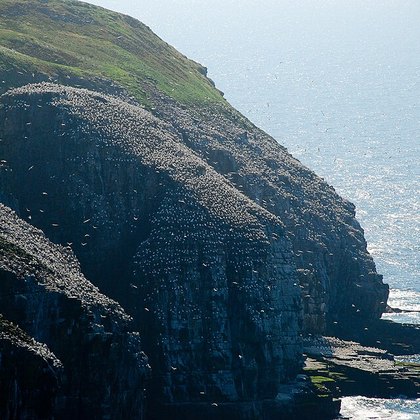
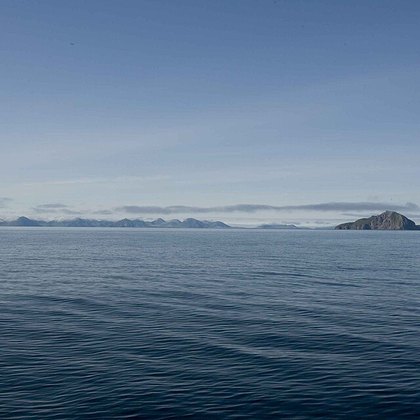
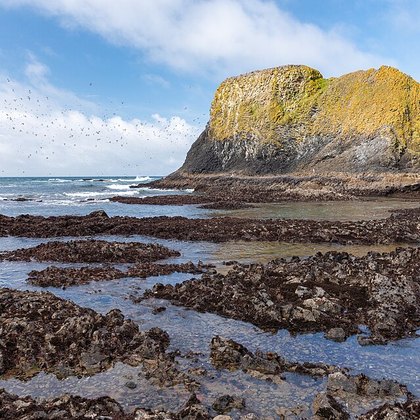
It nests on bare rocky islands and cliffs, often in dense colonies of hundreds of pairs alongside other seabirds. For food it stays within a few kilometres of shore, over the upwelling zones where cold, nutrient-rich water rises to the surface. It occasionally visits estuaries and lagoons. It largely avoids open ocean far from land and fresh inland water.
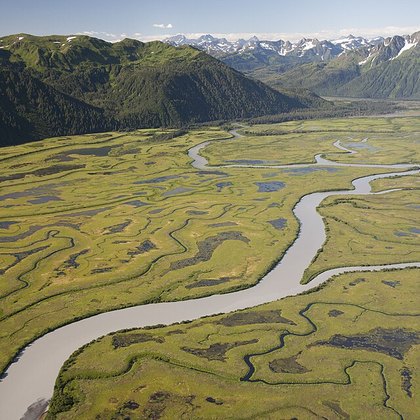
Where the bird is most often found, arranged by the USNVC — the vegetation classification of the United States and Canada — and CMECS for sea and coast.
Range and movements
Resident along the Pacific coast from British Columbia to Baja California and the Gulf of California, with its main colonies on islands such as Año Nuevo and the Farallones. Birds from the northern part of the range move south in winter, while small numbers reach as far north as southern Alaska in summer. Numbers fluctuate locally with food supply but the species has remained stable overall.
- Resident
- Breeding (summer)
- Winter
- Passage
- dark = core range, pale = thinly spread
Where and when to look
Look for colonies in spring and early summer on rocky islands and undisturbed cliffs, where the blue throat patch shows well in sunlight and pairs greet each other by throwing the head back. At sea, look for groups of low-flying birds following the waves in a line.
Conservation
Not threatened, with a world population of roughly 150,000 that fluctuates locally but has stayed stable overall. Oil spills and entanglement in fishing nets are the main risks, along with disturbance at colonies. Because almost the entire population breeds on a limited number of islands, it is sensitive to changes in the productivity of the California Current, such as during El Niño years.
Scientific name
Urile penicillatus | (Brandt, 1837)
Brandt described the species in 1837 as Carbo penicillatus; because it has since been moved to another genus, author and year stand in parentheses. The Dutch and English common names honor Brandt as its describer, but the scientific species name itself is not named after him: penicillatus is Latin for 'brush-like', referring to the thin white plumes of the breeding plumage. It spent most of the twentieth century in Phalacrocorax, until molecular research in 2014 showed that three Pacific cormorant species form their own branch; once that was accepted (2021) they were placed in Urile, a genus Bonaparte had already established in 1856 but which had long gone unused. No type locality has ever been designated.