All species › Swifts › Hummingbirds › Blue-throated Mountain-gem
Blue-throated Mountain-gem | Lampornis clemenciae
Blauwkeeljuweelkolibrie | Colibrí gorjiazul
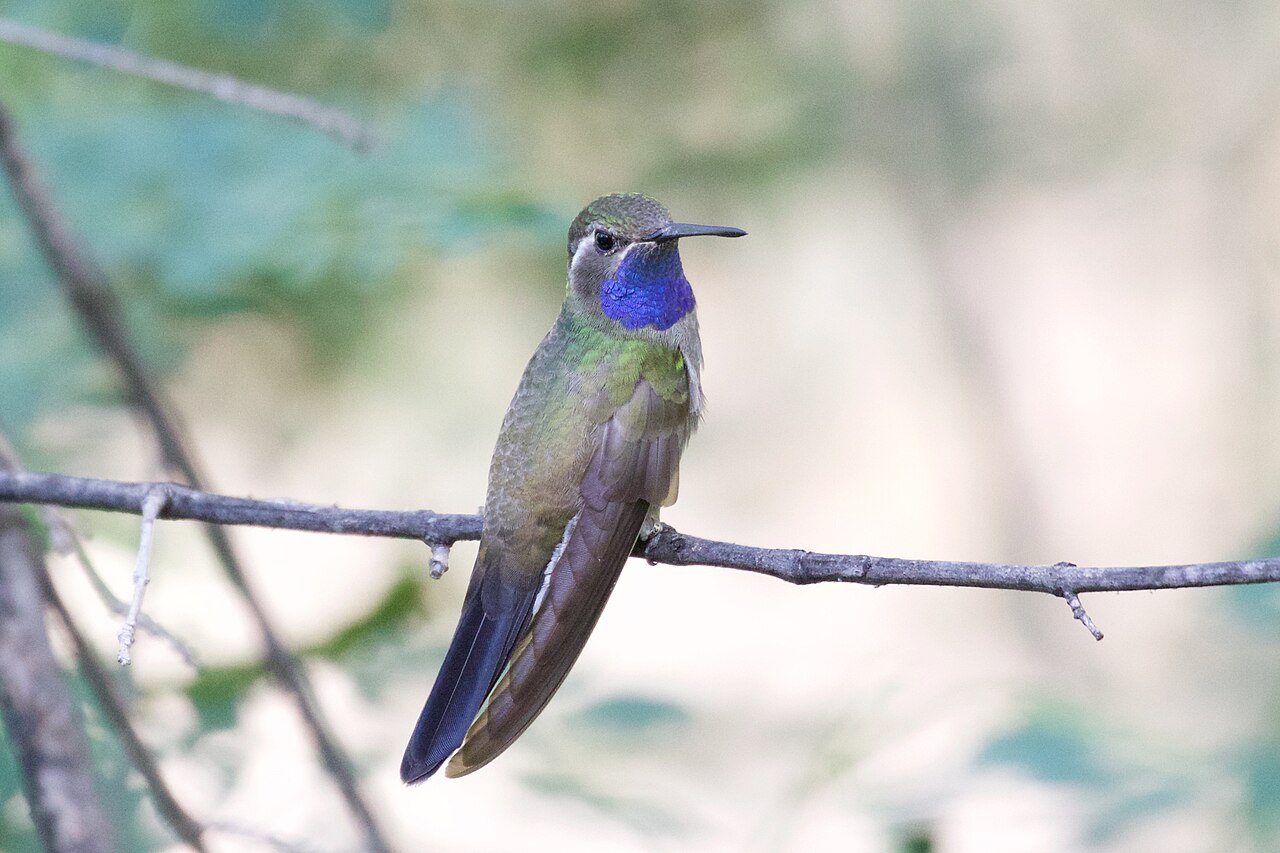
The Blue-throated Mountain-gem is the largest hummingbird that breeds in the United States, a heavily built bird of wooded mountain canyons with, in the male, a sapphire-blue throat that flares in the sun. Unusually for a hummingbird, the female sings too, with a song of her own that most hummingbirds never produce.
Voice
The male sings a simple, somewhat squeaky song about a second long, repeated from a fixed, high perch, along with a quieter but far more intricate 'whisper song' lasting up to eight seconds. The call is a loud, sweet chip repeated every one to two seconds, audible from a distance in shady canyons. Uniquely among hummingbirds, pairs sometimes sing together as a duet during courtship.
Recording: Manuel Grosselet — CC BY-NC-SA 4.0 · Tierra Colorada, Santa Catarina Ixtepeji, Oaxaca, Mexico · xeno-canto
Identification
It is a large, heavily built hummingbird with a double white facial stripe and grey underparts. The male carries a brilliant sapphire-blue throat patch and greenish-bronze upperparts; the female lacks the blue throat and is plain grey below. Its wingbeat, at about twenty-three beats per second, is noticeably slower than that of smaller hummingbirds, giving a lower, deeper hum. The tail is long and broad, with a wide white band at the tip of the outer feathers.
Confusion species
The same southwestern canyons hold Rivoli's Hummingbird, likewise large but with a green rather than blue throat in the male, a purple crown, and only a single white stripe behind the eye. The much smaller Broad-billed Hummingbird shares the same scrub but has a red bill and weighs less than two-thirds as much. Females of the two large species are more alike; look for the double facial stripe, which is more distinct on the Blue-throated Mountain-gem than on Rivoli's Hummingbird.
Habitat
It favours moist mountain forest: streamside vegetation along creeks, mixed pine-oak woodland and conifer forest in 'sky island' mountain ranges, generally not below about 1,300 metres. Running water lined with flowering shrubs is almost always nearby, and in Arizona's mountain towns it also visits gardens with feeders.
Where the bird is most often found, arranged by the USNVC — the vegetation classification of the United States and Canada — and CMECS for sea and coast.




Range and movements
It breeds from northern Mexico to the extreme southeastern corner of Arizona and, as a separate subspecies, in the Chisos Mountains of West Texas. A few birds overwinter at feeding stations in southeastern Arizona, but most northern birds withdraw in winter to unknown destinations further south in Mexico. Further south, on the Mexican highlands, the species is resident.
- Resident
- Breeding (summer)
- Winter
- Passage
- dark = core range, pale = thinly spread
Where and when to look
Look for it along a shaded mountain stream in southeastern Arizona, for instance in one of the well-known canyon systems, where it often sings from a favourite branch above the water. In winter a feeder at a mountain lodge is the best chance of finding an overwintering bird.
Conservation
Not threatened, with a fairly stable population of around two million mature individuals. It tolerates human presence well, but within its limited US breeding range, damage to streamside vegetation along mountain creeks can genuinely affect local populations.
Scientific name
Lampornis clemenciae | (Lesson, 1830)
Lesson described the species in 1830 as Ornismya Clemenciae; it has since been placed in several other genera, including briefly its own genus Cyanolaemus, before settling in Lampornis in the mid-twentieth century — hence the parentheses. The genus was introduced by Swainson in 1827, from Greek lampe (torch, light) and ornis (bird). The species name honours a woman named Clemencia (Clémence); exactly who she was is not reliably recorded. The type locality is simply given as Mexico.