All species › Gannets and cormorants › Boobies and gannets › Blue-footed Booby
Blue-footed Booby | Sula nebouxii
Blauwvoetgent | Piquero Patiazul
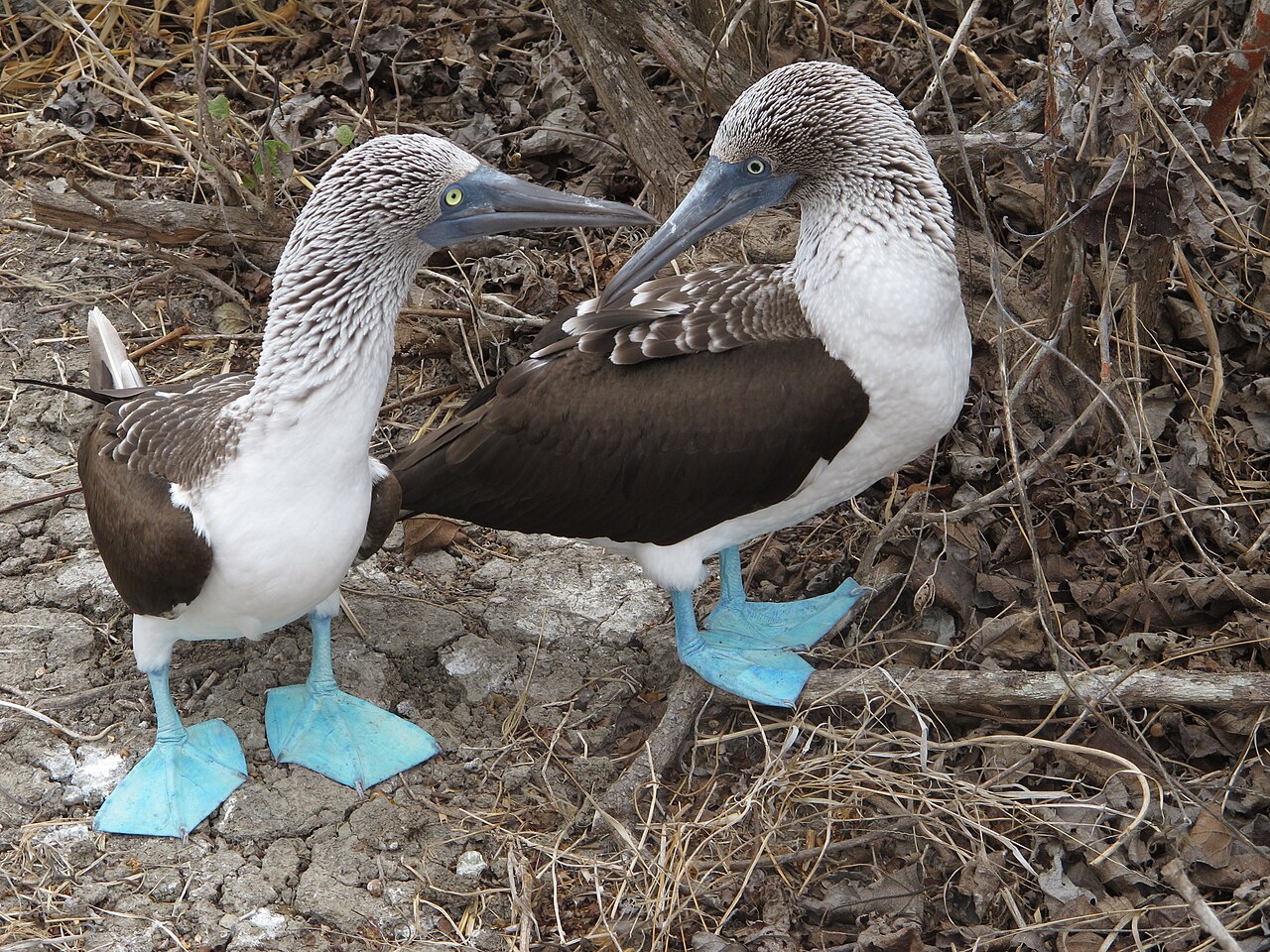
Blue-footed Booby owes its name to the blue feet that the male shows off to his partner, lifted high, during courtship. It breeds in the thousands on the bare islands of the Gulf of California, and within the United States and Canada it is nothing more than a great rarity.
Voice
In this species too the voice differs sharply between the sexes: the male gives a thin, whistling call, the female a loud, barking quack. During the courtship dance, in which both partners take turns lifting the blue feet and pointing the bill skyward, they trade these calls back and forth continuously. At sea, far from the colony, the species is almost silent.
Recording: Barry Edmonston — CC BY-NC-SA 4.0 · Santa Rosa (near Seymour), Santa Cruz, Islas Galápagos, Ecuador · xeno-canto
Identification
The head and neck are pale brown with fine dark streaking, the upperparts dark brown with a pale diagonal band, and the rump and underparts pure white — a pattern that at first glance resembles Brown Booby. The distinctive feature is the feet: a dull grey-blue in young birds, ranging to a bright, powdery turquoise in well-fed adults. The female is slightly larger than the male and has a larger, dark eye-ring around an iris that looks smaller, a subtle but usable difference between the sexes. Young birds are uniformly grey-brown with grey rather than blue feet, which only gradually gain their colour. In flight the species shows long, pointed wings and a relatively long, pointed tail.
Confusion species
Brown Booby (Sula leucogaster) has almost the same brown-and-white body, but yellowish rather than blue feet and a sharper border between the brown chest and white belly. Where it overlaps with Cocos Booby (Sula brewsteri) in the Gulf of California the same holds: that species likewise has greyish-yellow legs, never blue. Young Blue-footed Boobies, still grey-footed, most resemble young birds of the other brown boobies, and are then recognised mainly by the streaked pattern on the head.
Habitat
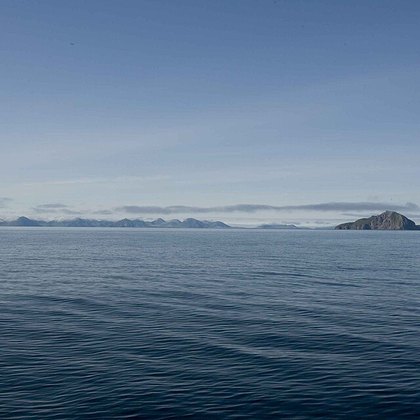
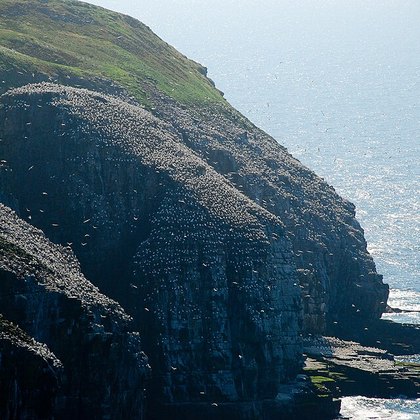
Breeding colonies sit on bare, rocky or lightly vegetated islands in dry, subtropical waters, where the birds cope with little shade and little fresh water. Outside breeding it hunts within a few dozen kilometres of the coast, closer to land than most other boobies, and is a familiar sight on piers and boats. It makes less use of far open ocean water than, for example, Nazca or Masked Booby.
Where the bird is most often found, arranged by the USNVC — the vegetation classification of the United States and Canada — and CMECS for sea and coast.
Range and movements
The core range lies in the Gulf of California, with large colonies on, among others, Isla Isabel (Nayarit), San Pedro Mártir (Sonora) and Los Islotes near La Paz (Baja California Sur), continuing south along the Pacific coast to Peru and the Galápagos Islands, outside the guide area. It occasionally reaches southern California and the Salton Sea, with an influx of dozens of birds in 2013 that was seen as far as Arizona and Texas. Such influxes stem from years with many young birds and little food nearer the colonies, not from a lasting range expansion.
- Resident
- Breeding (summer)
- Winter
- Passage
- dark = core range, pale = thinly spread
Where and when to look
Boat trips from La Paz to Los Islotes, where the colony sits right at the waterline, give the most reliable view of the courtship dance within this area. In southern California, after a warm, fish-poor summer, look for a wandering bird at the Salton Sea or along the coast, but do not count on it.
Conservation
Worldwide the species is considered not threatened, with the largest, stable colonies in the Gulf of California. On the Galápagos Islands, outside this area, strong El Niño years have repeatedly cut breeding success sharply, as the sardines the birds hunt disappear at such times. Within the United States and Canada it remains a great rarity without an established population.
Scientific name
Sula nebouxii | Milne-Edwards, 1882
Milne-Edwards described the species in 1882 as Sula Nebouxii; it has remained in the same genus, so author and year do not stand in parentheses, and the capital letter in the original epithet is merely an old-fashioned spelling. The epithet nebouxii honours Adolphe-Simon Neboux, a French naval surgeon and naturalist who sailed on expedition along the Pacific coast of the Americas in the 1830s. The type locality is given as the Pacific coast of America, with Chile the presumed source of the type material.