All species › Swifts › Hummingbirds › Black-chinned Hummingbird
Black-chinned Hummingbird | Archilochus alexandri
Zwartkinkolibrie | Colibrí gorjinegro
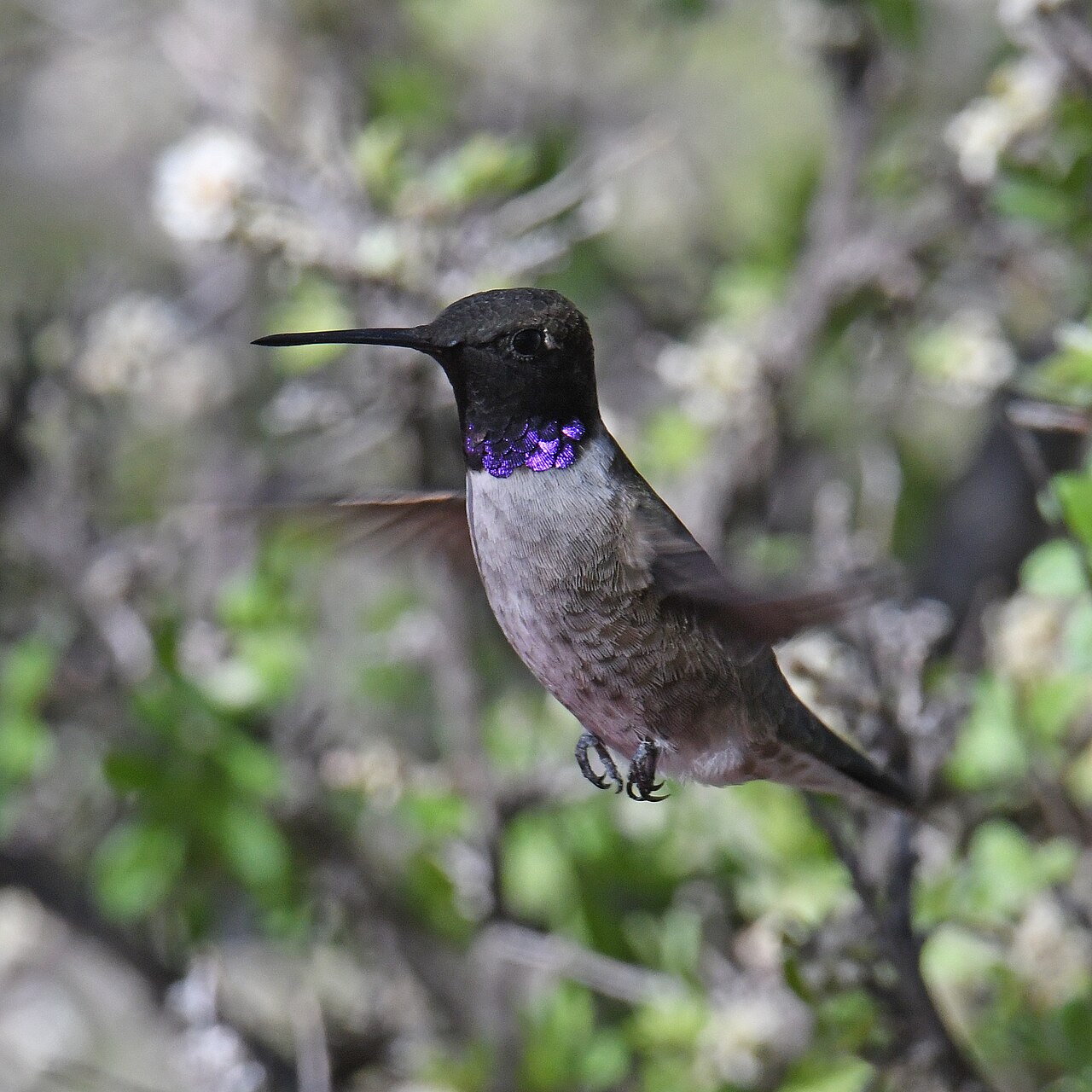
The Black-chinned Hummingbird is the commonest hummingbird of the American West and also the least particular: it breeds from desert washes to mountain forest and from cottonwood bottomlands to the gardens of Phoenix. Its throat is black and looks colourless until a narrow violet band along the lower edge briefly catches the light.
Click a thumbnail to switch the photo above.
Voice
The song is a soft, thin warble, so high that it sounds like whistling through the teeth and fades within a few metres. Beyond it the bird has at least five different high chip and tick notes, combined to suit the situation; around a feeder that ticking is the first sign one is present. In ordinary flight the wings hum low. In the display dive, twenty to thirty metres down in a tight arc, they sound higher and sharper, with an almost bell-like overtone never heard from a perched bird.
Recording: Thomas G. Graves — CC BY-NC-SA 4.0 · Embudo Trail, Albuquerque, Bernalillo County, New Mexico, United States · xeno-canto
Identification
The male is dull metallic green above and greyish white below, with green flanks and a velvet-black throat. Along its lower edge lies a thin violet band; that colour is in the structure of the feather rather than in a pigment, so it lights up only in the right light and the throat otherwise looks entirely black. The bill is straight and black, the tail slightly forked. The female has a pale, unmarked throat and broad white tips to the outer tail feathers. A good flight mark: while hovering at a flower it pumps its tail continuously.
Confusion species
Ruby-throated Hummingbird is its near-twin; the ranges meet in central Texas, and females there often cannot be separated with certainty. Males can: a black throat with a violet edge against an entirely ruby throat. A female Anna's Hummingbird is larger and greyer and usually shows a few red flecks in the centre of the throat. A female Costa's Hummingbird has a shorter bill and a far shorter tail, and Lucifer Hummingbird is told by its curved bill.
Habitat
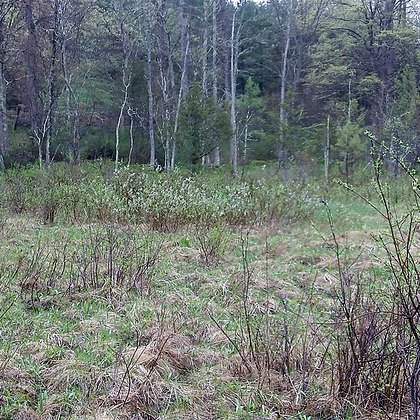
Half-open, semi-arid country with tall trees and flowering shrubs: canyons with sycamore (American plane tree of stream and river valleys) and oak, riverside woods of cottonwood and willow, thorn scrub along desert washes and mountain forest to well over two thousand metres. Water is almost always nearby; open desert without trees it avoids. It tolerates people well and breeds into the middle of cities, as long as there are high bare twigs to watch from. Birds wintering on the Gulf Coast often sit in the shade of live oaks.
Where the bird is most often found, arranged by the USNVC — the vegetation classification of the United States and Canada — and CMECS for sea and coast.




Range and movements
A breeding bird of the dry West, from southern British Columbia through the interior to California, Texas and northern Mexico. Almost the whole population moves to western and southern Mexico in autumn; a small but steady number winters on the Gulf Coast of Texas and Louisiana, where those birds have been banded systematically since the 1980s. Migration is early: by August most breeding areas are empty. In cities with feeders and planted flowers numbers have grown over recent decades.
- Resident
- Breeding (summer)
- Winter
- Passage
- dark = core range, pale = thinly spread
Where and when to look
Do not watch the throat, watch the tail: the constant pumping while the bird hovers identifies this species even when the colours refuse to co-operate. Then scan the high bare twigs above a garden or a riverside wood — after every feeding round it sits on the same lookout for minutes. To see the violet throat band, stand so that the sun comes over your shoulder onto the bird.
Conservation
Numerous and slightly increasing: breeding bird surveys show a rise of about 0.3 per cent per year between 1966 and 2019, and Partners in Flight puts the breeding population at 8.8 million birds. The species counts as Least Concern (LC). Gardens with feeders add to the increase, but most breeding birds sit in the riverside woodlands of the arid West, and keeping those intact remains the basis of its distribution.
Scientific name
Archilochus alexandri | (Bourcier; Mulsant, 1846)
Bourcier and Mulsant described the species in 1846 as Trochilus Alexandri; because it was later moved to another genus, authors and year stand in parentheses. The genus Archilochus was introduced in 1854 by Ludwig Reichenbach and refers to Archilochus, a Greek poet of the island of Paros who lived in the seventh century BC. The species name alexandri honours Dr Alexandre, a physician working in Mexico who sent bird skins to Paris. The specimen described came from the Sierra Madre in Mexico.