All species › Tubenoses › Northern storm petrels › Band-rumped Storm-Petrel
Band-rumped Storm-Petrel | Hydrobates castro
Madeirastormvogeltje | Paíño de Madeira
Band-rumped Storm-Petrel is one of the few tubenoses that breeds in both the Pacific and the Atlantic, with colonies from Japan to Hawaii and from the Azores to the Galápagos. In the United States it breeds only high on the volcanoes of Hawaii, while non-breeding birds from the Atlantic population are regularly seen off North Carolina in summer.
Voice
At the colony it is strictly nocturnal and falls silent as soon as it grows light; on bright moonlit nights it stays away entirely to avoid predators. At night a soft, rattling purr comes from the burrows, with a slightly different tone between different breeding populations — a difference that has led researchers to suspect more than one species hides behind the single name. On the open sea, where nearly all American records come from, it is silent.
Recording: Ben Porter — CC BY-NC-SA 4.0 · Praia, Açores, Portugal · xeno-canto
Identification
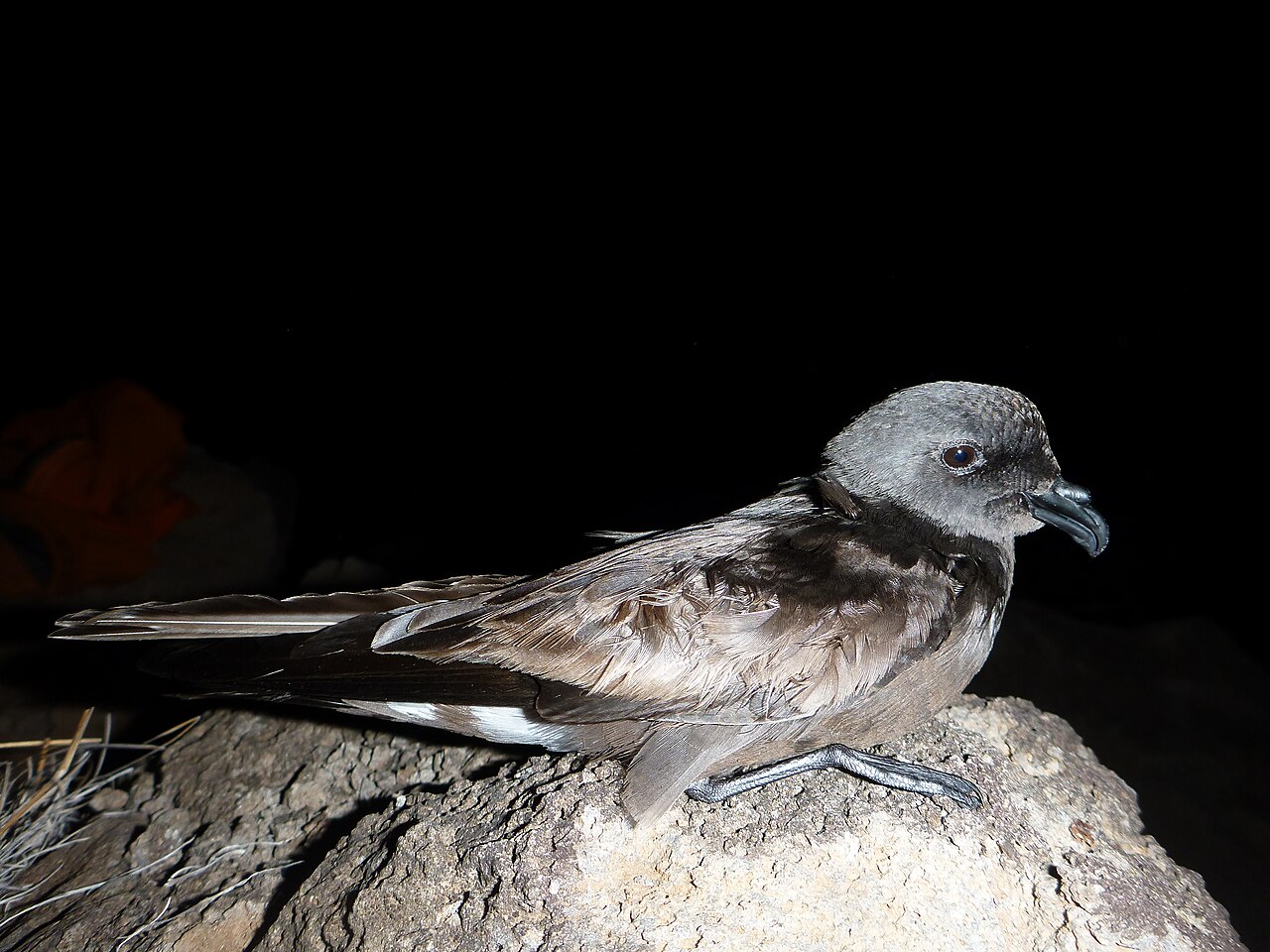
The plumage is sooty blackish-brown, with a broad, evenly white rump band wider than that of Leach's Storm-Petrel. The tail is only shallowly forked, clearly less deep than in that species, and the wings are relatively long and angular. Male, female and juvenile look alike. The flight is steady: shallow wingbeats alternating with stiff glides, rather than the bounding, erratic flight of related species.
Confusion species
Leach's Storm-Petrel (Hydrobates leucorhous) is the species it is most often confused with: that has a more deeply forked tail, a rump band often divided in two, and a bounding, erratic flight against the steady, stiff-winged flight of Band-rumped Storm-Petrel. Wilson's Storm-Petrel (Oceanites oceanicus) is smaller, has longer legs with yellow-webbed feet that project beyond the tail, and actively patters its feet on the water, which Band-rumped Storm-Petrel does not do. At a distance the flight style is the more reliable clue, more so than the exact shape of the rump band.
Habitat
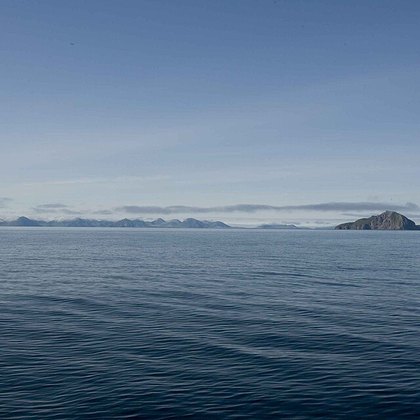
Outside the breeding season it lives scattered across open, warm to temperate ocean waters, picking small squid, crustaceans and occasional carrion from the surface. The Hawaiian breeding birds nest not on the coast but high on bare, lava-formed mountain slopes, between 2,000 and 3,350 metres, far from their feeding grounds at sea. The Atlantic population, by contrast, breeds on low, rocky islands; in the waters off North Carolina where it is seen here, it occurs only as a non-breeding summer visitor, well offshore over the Gulf Stream.
Where the bird is most often found, arranged by the USNVC — the vegetation classification of the United States and Canada — and CMECS for sea and coast.

Range and movements
Colonies are scattered across the Azores, Madeira (with the Desertas Islets as the type locality), the Berlengas off Portugal and the Canary Islands in the Atlantic, and across islands off Japan, Hawaii and the Galápagos in the Pacific. Within this guide's area it breeds only in Hawaii, from May to September; the Atlantic population visits the Gulf Stream off North Carolina in those same months as a non-breeding visitor, a pattern only recognised as regular in the late 1970s after earlier scattered records had been considered accidental. Recent research into differences between breeding populations on the same island in different seasons suggests that the species as currently defined may consist of several barely distinguishable species.
- Resident
- Breeding (summer)
- dark = core range, pale = thinly spread
Where and when to look
Off North Carolina, a pelagic boat trip well into the Gulf Stream between late May and late August is the most reliable way to see it; it is reported on roughly two-thirds of such trips during the season. Watch for the steady, stiff-winged flight: it distinguishes it at once from the more restlessly fluttering Leach's Storm-Petrel beside it.
Conservation
Worldwide the species is listed as Least Concern (LC), with large, fairly stable colonies in the Atlantic. The small Hawaiian breeding population is separately vulnerable, however: since 2016 it has been legally protected as endangered in the United States, chiefly because of introduced cats and rats at the nests and disturbance from artificial light disorienting fledglings.
Scientific name
Hydrobates castro | (Harcourt, 1851)
Harcourt described the species in 1851 as Thalassidroma castro, from specimens taken on the Desertas Islets off Madeira, which remain the type locality; because it has since been moved to another genus, author and year stand in parentheses. For a long time it stood in the genus Oceanodroma; recent molecular work returned it, along with most other northern storm-petrels, to the older genus Hydrobates. Exactly what the species name castro means has not been established with certainty.