All species › Tubenoses › Northern storm petrels › Ashy Storm-Petrel
Ashy Storm-Petrel | Hydrobates homochroa
Californisch stormvogeltje | Paíño ceniciento
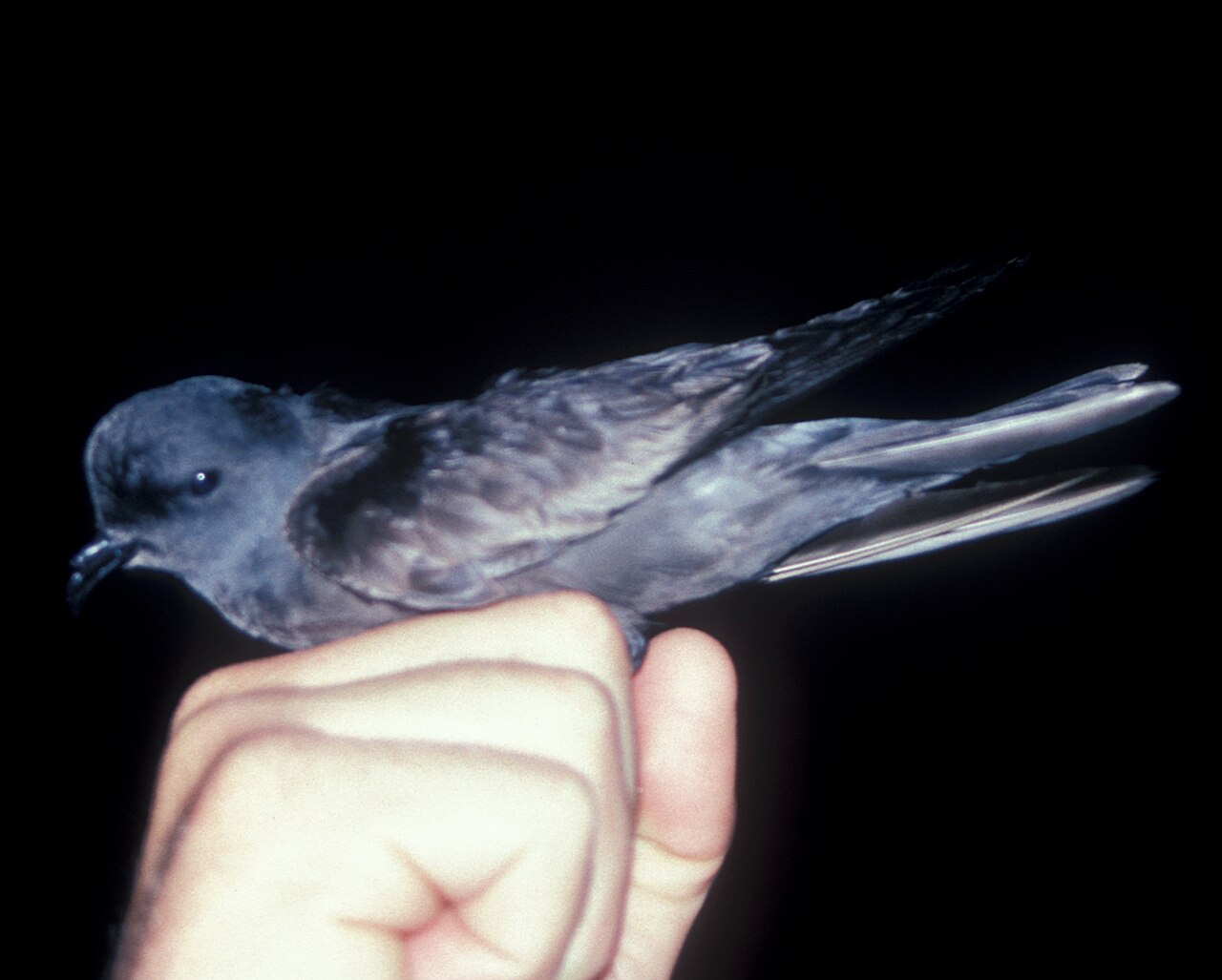
Ashy Storm-Petrel is North America's most threatened storm-petrel: a small, uniformly sooty-brown bird that spends nearly its whole life around a handful of islands off the California coast. Half the world population breeds on the Farallon Islands near San Francisco. Unlike most relatives it does not move away after breeding.
Voice
At the colony, which like all storm-petrels it visits only at night, soft, hoarse croaking and gurgling sounds come from the nesting burrow. At sea it is silent. By day its presence at sea betrays itself at most through a single startled bird fluttering away from an approaching boat; most hunting activity happens at night.
Recording: Matthew L. Brady — CC BY-NC-SA 4.0 · Southeast Farallon Island, San Francisco County, California, United States · xeno-canto
Identification
A small, uniformly dark brown storm-petrel without pale rump or wing markings, with a moderately forked tail. The flight is light and fluttering, with a shallow, hesitant upstroke that sets it apart from the firmer wingbeat of larger relatives. Male and female look alike, and juveniles closely resemble adults.
Confusion species
Black Storm-Petrel is clearly larger, with a more deeply forked tail and a slow, deep wingbeat. Least Storm-Petrel is smaller and has a short, wedge-shaped rather than forked tail and a faster, lower-skimming flight. Leach's Storm-Petrel has a white rump that Ashy Storm-Petrel entirely lacks.
Habitat
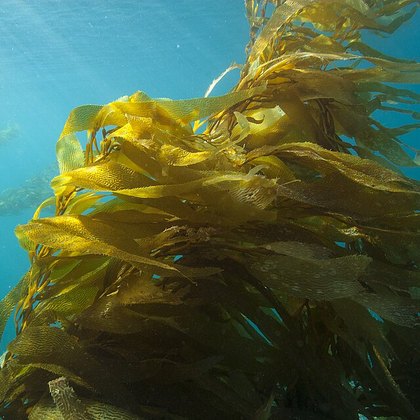
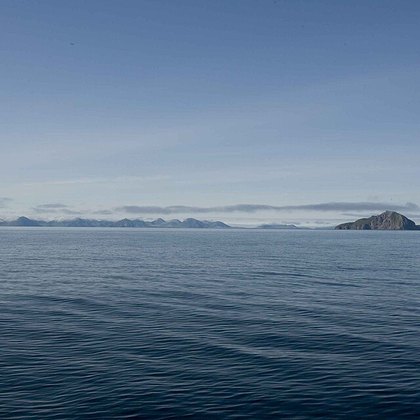
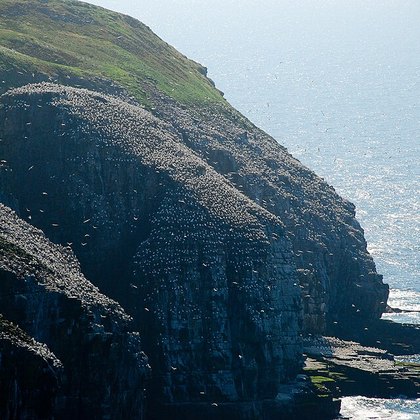
It stays near its breeding islands year-round, over the productive shallow seabed and kelp forests of the California Current, where squid and deep-sea fish such as lanternfish rise to the surface at night. For breeding it uses rock crevices, caves and small burrows on uninhabited islands; a known nesting site is a sea cave on Santa Cruz Island. Unlike Black Storm-Petrel, it avoids long distances over the open ocean.
Where the bird is most often found, arranged by the USNVC — the vegetation classification of the United States and Canada — and CMECS for sea and coast.
Range and movements
It breeds on seventeen islands off the California coast, with the main colonies on the Farallon Islands and Santa Cruz Island; a few small, possibly no longer active colonies lay on islands off northern Baja California. Outside the breeding season it undertakes no real migration and stays within the California Current, from central California to roughly the Mexican border.
- Resident
- Breeding (summer)
- Passage
- dark = core range, pale = thinly spread
Where and when to look
Pelagic boat trips out of Half Moon Bay or Santa Cruz offer the best chance, though Ashy Storm-Petrel's nocturnal habits make it less visible by day at sea than its relatives; watch for the uniformly dark plumage with no rump patch and the light, hesitant wingbeat.
Conservation
The IUCN lists Ashy Storm-Petrel as Endangered (EN); the world population is estimated at around ten thousand birds. On the breeding islands, Western Gulls and Burrowing Owls are significant natural predators, while fishing-boat lights disorient birds at sea and oil pollution remains a risk. With its colonies concentrated in so few places, the species is also vulnerable to changes in sea temperature and prey availability driven by climate change.
Scientific name
Hydrobates homochroa | (Coues, 1864)
Coues described the species in 1864 as Cymochorea homochroa; it has since been placed in another genus, hence the parentheses around author and year. It now belongs to Hydrobates. homochroa is Greek for 'of uniform colour', after the plain, unmarked plumage lacking the pale rump of many relatives. The type locality is the Farallon Islands, California.