All species › Passerines › Leaf warblers › Arctic Warbler
Arctic Warbler | Phylloscopus borealis
Noordse boszanger | Mosquitero boreal
The Arctic Warbler is the only leaf warbler that breeds regularly in North America, and it does so only in western and central Alaska. It arrives late, rattles for six weeks in the willow scrub and is gone again in August — westward across the Bering Sea, and not south as nearly every other Alaskan songbird goes. Anyone who wants to see it has to come in June.
Voice
The song is a fast, dry rattle on one pitch, two to four seconds long, suggesting an insect or a sewing machine rather than a songbird. It comes from the top of a willow, after which the bird drops straight back into the bush. The call is a hard, short dzik, like a spark jumping, and that sound betrays it more often than the song does. Nothing else in Alaskan scrub sounds like it: the Ruby-crowned Kinglet, the only other singer there that is as loud, sings in tumbling melodic phrases instead.
Recording: Anne McCormack — CC BY-NC-SA 4.0 · Nome, Nome Census Area, Alaska, United States · xeno-canto
Identification
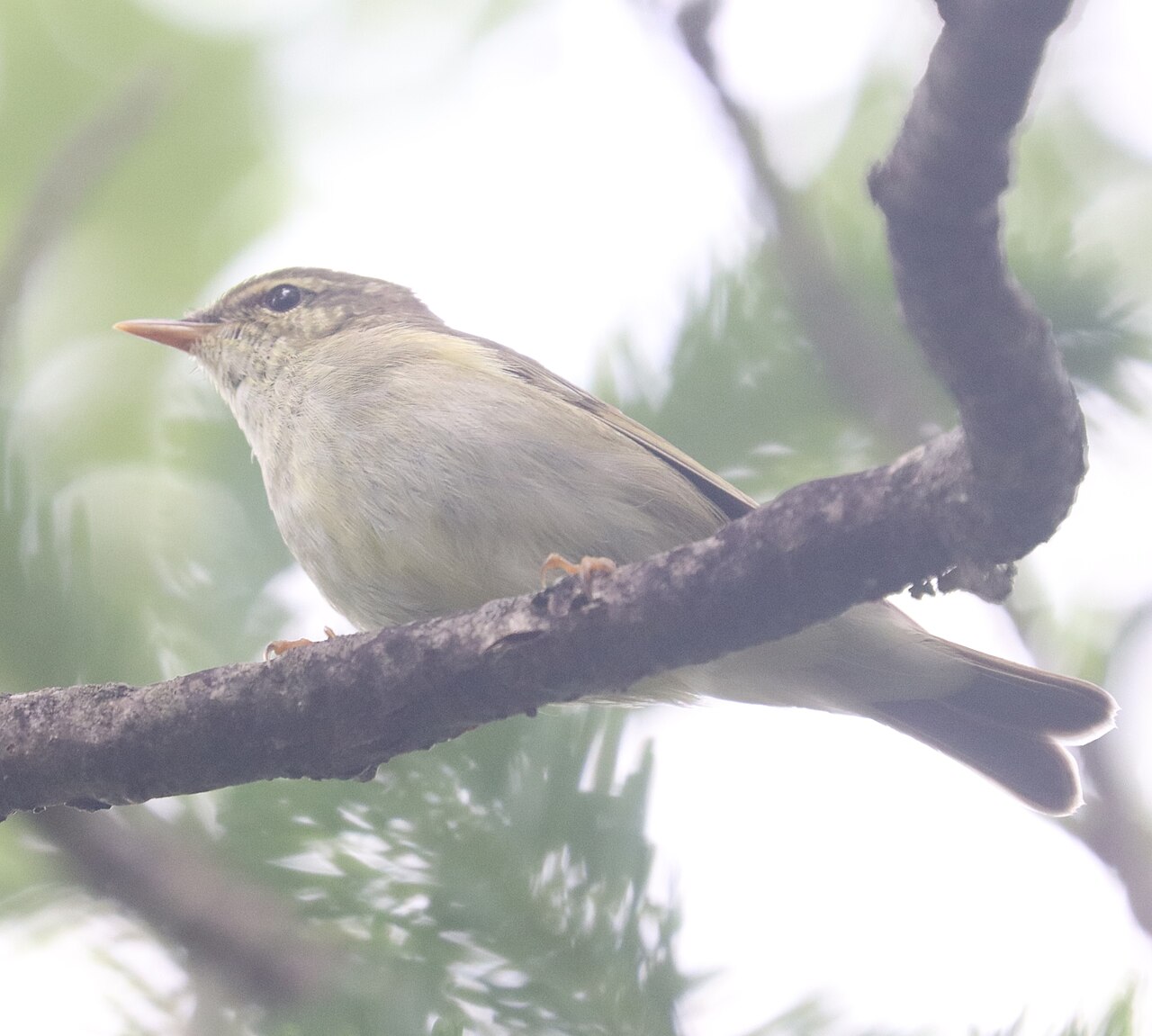
Eleven to thirteen centimetres, and sturdily built for a leaf warbler: a large head, a broad-based bill and a short tail. It is olive-grey above and dirty white below with a greyish wash on the flanks. The face decides it: a long yellowish-white eyebrow stripe running from the bill to well behind the eye, often curling up slightly at the end, with a dark eyestripe beneath it. There is usually one narrow, faint wingbar, which wears away as the summer goes on. The lower mandible is orangey with a dark tip and the legs are pale brownish pink; male and female look the same.
Confusion species
In Alaska the mistake is nearly always the Orange-crowned Warbler (Leiothlypis celata): yellower, with yellow undertail coverts, a thin pointed bill and never a wingbar, and its face lacks the sharply drawn eyebrow stripe. The Ruby-crowned Kinglet has a bold white eye-ring, a broad white wingbar with a black bar behind it, and a minute bill. On the Bering Sea islands the Kamchatka Leaf Warbler (Phylloscopus examinandus) may turn up, counted as the same species until 2015; it is known by its slower, lower song and its slightly longer bill. All three cases are settled by sound in a second and sometimes not by sight in ten minutes.
Habitat
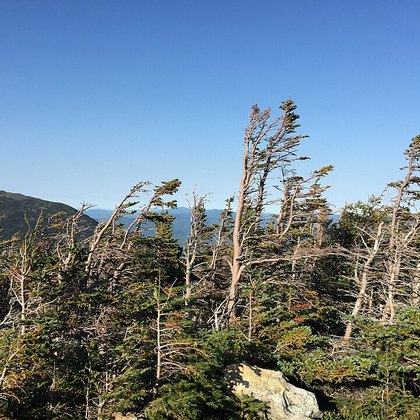
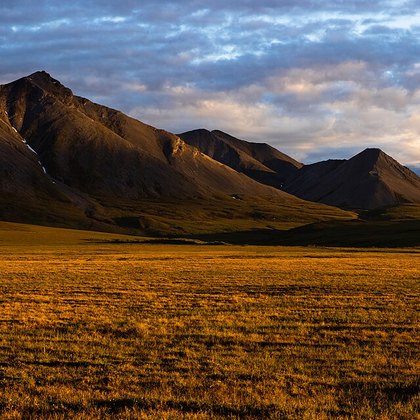
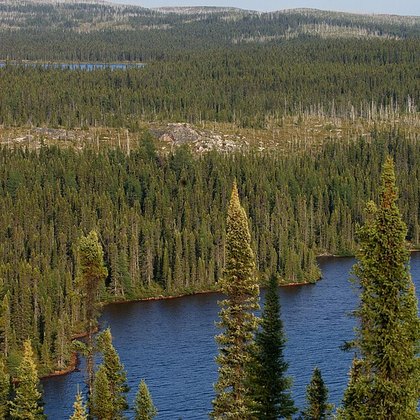
Dense willow and dwarf birch scrub along creeks, lake edges and wet hollows, and the shrubby transition to scattered, stunted spruce. It needs shrubs of head height: bare tundra it passes by, and closed forest as well. The scrub must also be damp; on dry slopes it is absent. In the wintering areas of Southeast Asia it keeps to forest, forest edge and old second growth, from the coast to high in the mountains.
Where the bird is most often found, arranged by the USNVC — the vegetation classification of the United States and Canada — and CMECS for sea and coast.


Range and movements
It breeds in western and central Alaska — the Seward Peninsula, the lower Yukon and Kuskokwim, and the foothills of the Alaska Range and the Brooks Range — and beyond that across northern Eurasia from Scandinavia to Kamchatka. In August it leaves westward across the Bering Strait and then travels through eastern Asia to the Philippines, Indonesia and mainland Southeast Asia. Those wintering grounds lie outside this map; the map therefore shows only its breeding range in Alaska. In the rest of North America it does not appear, apart from the odd autumn record on the coast of California — it shares with the Northern Wheatear the trait of leaving the continent in the wrong direction.
- Breeding (summer)
- Passage
- dark = core range, pale = thinly spread
Where and when to look
The last week of June on the Seward Peninsula, along the roads that run inland from Nome: stop at every willow thicket beside a creek and listen for the rattle. Before about 5 June it is not there yet; it is one of the last birds to arrive in Alaska, and by late July it sings little. After the first song, wait: the singer comes briefly to the top of a willow every few minutes, and that is the moment for the eyebrow stripe.
Conservation
Least Concern (LC): worldwide this is a matter of more than eighty million birds, of which an estimated 2.5 million breed in Alaska. The Alaskan population has nonetheless fallen steeply over the past thirty years — enough to place the species on the list of common birds in steep decline. The causes are sought above all in the wintering areas, where forest in Southeast Asia is disappearing fast; what warming is doing to its Alaskan scrub has not yet been worked out.
Scientific name
Phylloscopus borealis | (Blasius, 1858)
Blasius described the species in 1858 as Phyllopneuste borealis, from a bird taken in the Sea of Okhotsk; because it was later placed in another genus, author and year stand in parentheses. The genus Phylloscopus was introduced by Boie in 1826, from Greek phullon, 'leaf', and skopos, 'searcher': the bird that searches the leaves. borealis is Latin for 'northern'. The type locality is not a place but a position at sea — 59°38' north, 147°30' east — because the first specimen was collected aboard a ship.