All species › Flamingos › Flamingos › American Flamingo
American Flamingo | Phoenicopterus ruber
Rode flamingo | Flamenco del Caribe
The American Flamingo is the most intensely coloured of all flamingos: vermilion to deep pink, with black flight feathers that show only in the air. It is the only flamingo occurring wild in North America, with breeding colonies in Yucatán, Cuba and the Bahamas. In Florida it has returned after a century's absence, and it is there that the question of which birds are wild and which have escaped is sharpest.
Voice
A colony sounds like a field full of geese: a continuous nasal clamour from hundreds of birds at once, carrying for kilometres. In flight, parties call to each other with a low two-syllable ka-hah, by which parents and young find each other again in the crush. Feeding birds growl softly and steadily as they draw the bill through the mud. From a distance the sound is often the first sign that a flock is standing behind a belt of mangrove.
Recording: FREDERIC Lionel — CC BY-NC-SA 4.0 · Parque Nacional de Cayo Guillermo, Ciego de Ávila, Cuba · xeno-canto
Identification
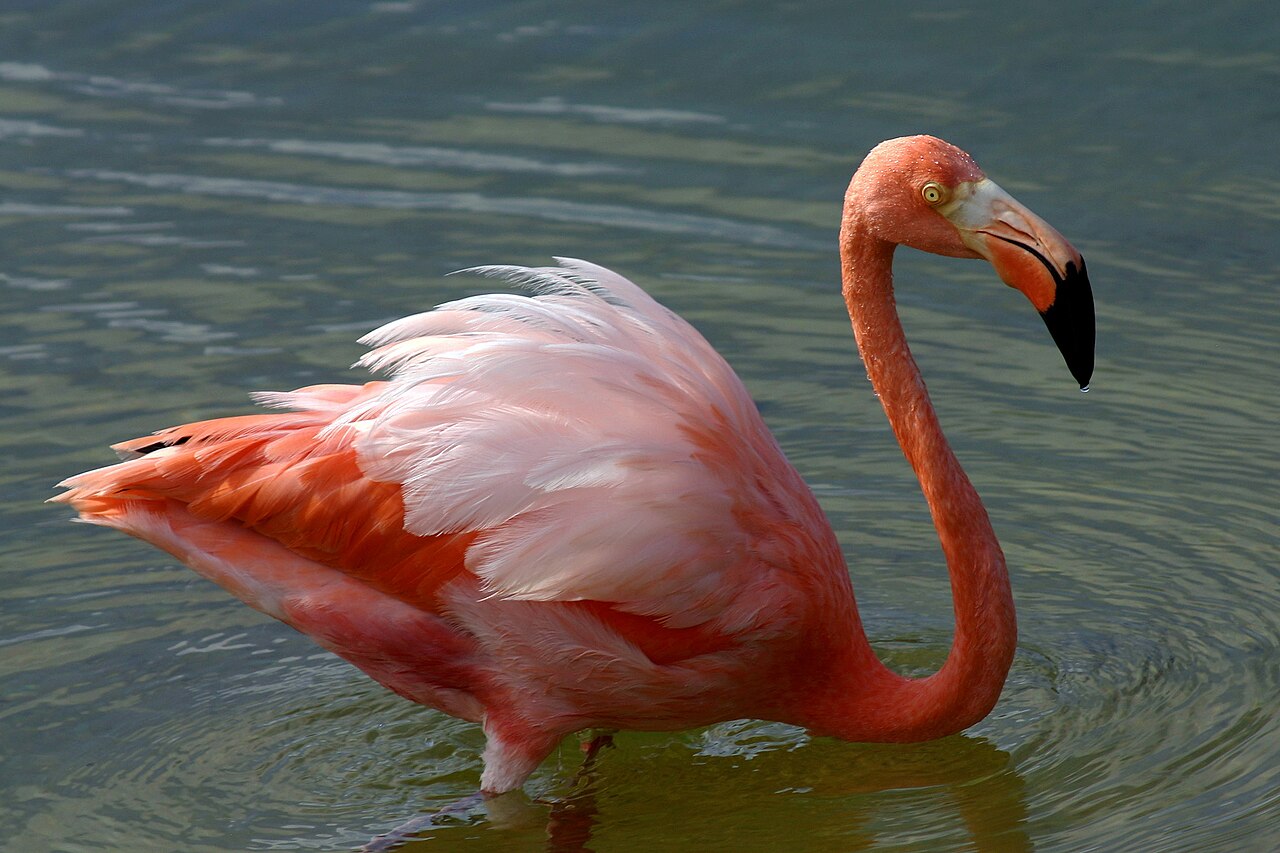
Adults are pink to vermilion over the whole body, with blood-red wing coverts and black flight feathers that show only on the open wing. The bill is pink and white with a black tip and looks broken in the middle; legs and webbed feet are pink. Juveniles are grey-brown and dirty white with a grey bill and dark legs, and take two to three years to reach the colour of their parents; the pigments come from the crustaceans and algae they eat. In flight the shape is distinctive: neck and legs fully stretched, the neck drooping a little, on fast beats without gliding, in long lines or ragged Vs. Feeding, the bird walks slowly with its head upside down under water, so that the upper mandible is underneath, and sieves the mud through the lamellae along the edge of the bill.
Confusion species
The parks and zoos of North America hold mainly two other species, so a bird loose on a pond is more likely to be one of those than a vagrant: Greater Flamingo (Phoenicopterus roseus) is larger and much paler, whitish pink with a pale pink bill, and Chilean Flamingo has grey legs with red joints and a bill that is black for more than half its length. Roseate Spoonbill is the commonest mistake in Florida: as pink, but far smaller, short-necked and with a flat spatulate bill. Then look at the legs: a ring, a colour mark or clipped flight feathers point to a bird from a collection.
Habitat
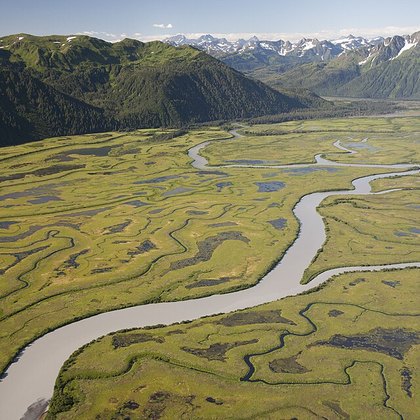
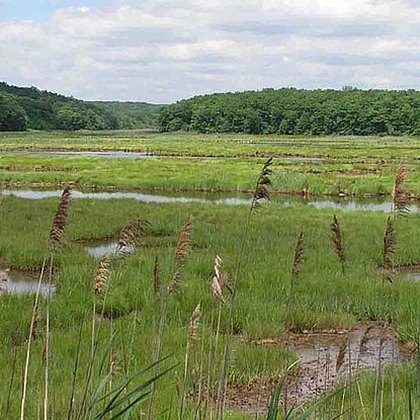
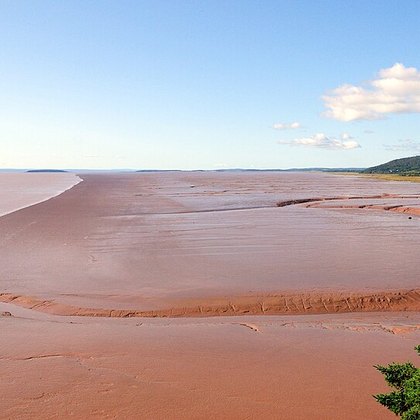
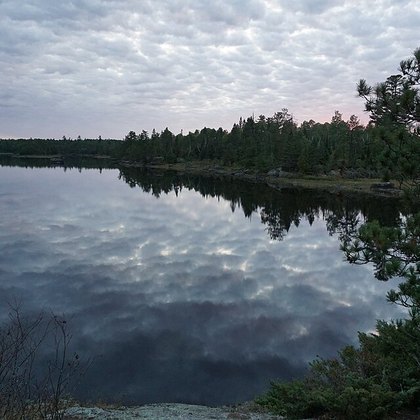
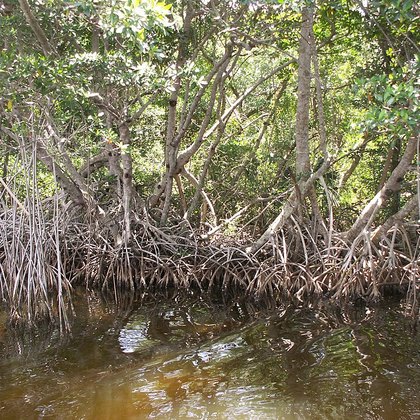
Shallow, very saline or brackish water: lagoons, salt pans, tidal flats, bays behind mangrove and the margins of salt lakes. It needs water it can wade in that is densely stocked with small crustaceans, worms, molluscs and algae. It breeds on bare mud banks and islets out of reach of predators, in dense colonies that can run to tens of thousands of pairs, each on a flattened cone of mud holding a single egg. It does not use deep or flowing water, nor dense vegetation.
Where the bird is most often found, arranged by the USNVC — the vegetation classification of the United States and Canada — and CMECS for sea and coast.
Range and movements
The breeding range lies in the Caribbean: the large colonies are in Yucatán at Ría Lagartos and Celestún, in Cuba, on Great Inagua in the Bahamas, on Bonaire and along the coast of Venezuela, with a small isolated stock in the Galápagos. Non-breeding birds stay all year in the Turks and Caicos Islands, where more than 5,300 have been counted, and also on Hispaniola, Curaçao and in south Florida. Florida Bay held thousands of birds in the nineteenth century; the plume trade had cleared them out by about 1900, and only from the 1990s did flocks of a few dozen return. That these birds are wild rather than escaped is shown by a banded bird from Ría Lagartos that appeared in Florida in 2002, and by work published in 2018 which found that the assumption 'they must be park birds' rested on almost no evidence. They do not yet breed in Florida.
- Resident
- Breeding (summer)
- Winter
- Passage
- dark = core range, pale = thinly spread
Where and when to look
In Florida, Florida Bay and the mudflats at Snake Bight are the reliable spot; watch from the shore with a telescope or from a boat, because the birds stand far out. Judge behaviour and company rather than colour: a flock feeding in shallow salt water that flies off together in the evening is almost always wild, while a single bird on an inland pond has often come from a collection. To be sure, scan the legs for rings — and in Yucatán or on Great Inagua the species can be watched in thousands, where the question does not arise at all.
Conservation
The species is listed as Least Concern (LC); the world population is put at 260,000 to 330,000 mature birds and is increasing. The blow came from the plume trade, which wiped out whole colonies in the nineteenth century; the protection that took effect in the United States after 1918, and later elsewhere, made recovery possible. What matters now is peace at the colonies: disturbance, salt works and coastal building, and hurricanes crossing a breeding colony at the wrong moment. After Hurricane Idalia in August 2023, 300 to 400 birds were blown as far as Wisconsin and Pennsylvania; some stayed on in Florida, and in July 2025 a flock of 125 stood in Florida Bay.
Scientific name
Phoenicopterus ruber | Linnaeus, 1758
Linnaeus described the species in 1758 as Phoenicopterus ruber; author and year stand without parentheses, because it remains in the genus he made for it in the same work. Phoenicopterus comes from Greek phoinikopteros, 'crimson-winged', from phoinix, 'purple-red', and pteron, 'wing'. ruber is Latin for 'red'. Linnaeus gave the locality as 'Africa, America, rarius in Europa', because he still took the flamingos of the Old and New World for one species; the type locality was later restricted to the West Indies.