All species › Parrots › Old World parrots
Old World parrots | Psittaculidae
Halsbandparkieten | Cotorras
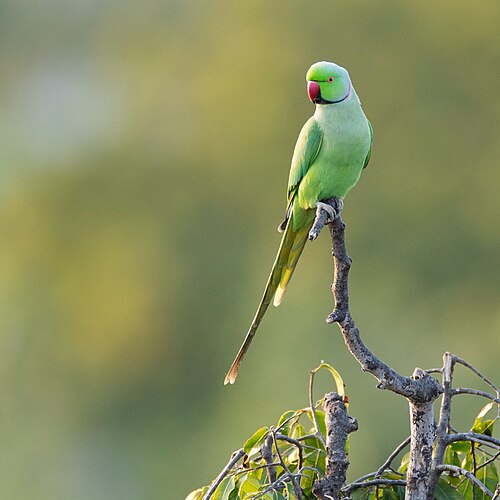
The family does not occur here naturally: every bird living wild in the region goes back to escaped or released cage birds, and they hold on in cities, parks and farmland in the warmer parts and on the Pacific islands. Characteristic is the long, tapering tail, in many species longer than the body. Unlike the parrots of the Americas, a large part of this family shows a visible difference in colour between male and female: a neck ring, a different head colour, or even an entirely different plumage. Some members have a tongue with a brush-like tip for licking nectar and pollen out of flowers; the rest live on seeds, buds, blossom and fruit. A fruit is often given a single bite before the remainder is dropped, so that more lies on the ground under a visited tree than has been eaten. Nesting is in tree hollows and old woodpecker holes, and in towns also in niches and crevices of buildings. Towards evening the birds gather with loud calling in a few fixed, tall roost trees, coming in to them pair by pair.
Introduced species 2 species
Species that do not occur here by nature but were brought in or escaped and have held on since. They follow the sequence of the list, not the genera.