All species › Passerines › Honeyeaters › Yellow-tinted Honeyeater
Yellow-tinted Honeyeater | Ptilotula flavescens
Gouden honingeter | Mielero amarillento
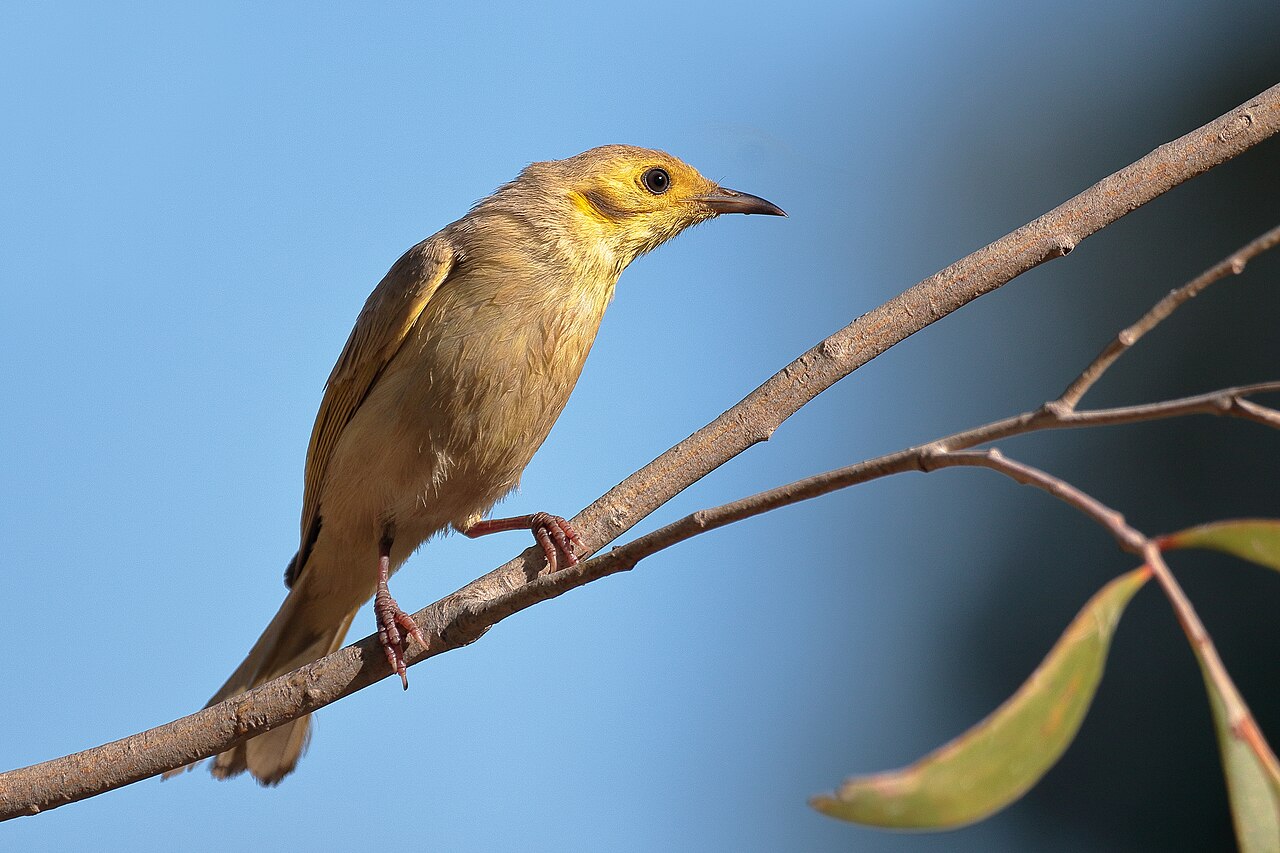
The Yellow-tinted Honeyeater is the northern counterpart of Fuscous Honeyeater (Ptilotula fusca): the same unremarkable build, but washed with a warm yellow tint that in low morning light seems to lie over the whole plumage. It belongs to the ribbons of trees along the creeks of tropical Australia and to the open savanna eucalypts behind them, and is often the commonest small honeyeater there. It is also the only Ptilotula that occurs outside Australia: across Torres Strait it has reached southern New Guinea.
Voice
Remarkably little has been put on paper about this species' voice. What has been described corresponds closely to Ptilotula fusca: a persistent, sharp chip as the contact call within the party, together with a rolling, rather rattling song phrase with clear whistles in it, most active in the first hour after sunrise. In the dry season, when birds gather around the last waterholes, the noise of a dozen foraging birds at once is often the first thing to strike you. No reliable way of separating the species from its relatives by ear has been described.
Recording: Iain Woxvold — CC BY-NC-SA 4.0 · Airways Hotel, National Capital District, Papua New Guinea · xeno-canto
Identification
A small to medium honeyeater of thirteen to sixteen centimetres, slimly built, with a gently curved black bill. The whole plumage is suffused with yellow: olive-yellow on crown and upperparts, yellowish white to pale yellow below, with faint, fine streaking on breast and flanks. The lores — the stripe between bill and eye — are grey-yellow rather than black, which gives the face an open, mild expression. Behind the ear coverts runs a narrow yellow plume, clearer than that of Ptilotula fusca but far narrower than that of Grey-fronted Honeyeater. The sexes are alike; young birds show yellow at the bill base.
Confusion species
Fuscous Honeyeater (Ptilotula fusca) is the nearest relative and is treated by some sources as its partner within a single superspecies: that bird is duller brown without the yellow wash, has black lores and a dark eye-ring, and holds the eastern, subtropical part of the continent, while Yellow-tinted Honeyeater has the tropical north. In the Queensland Gulf country the two come closest and range alone is no longer a conclusive argument. Grey-fronted Honeyeater (Ptilotula plumula) overlaps in the northwest and is the hardest: it has a small grey forehead, a much broader yellow ear plume and whiter, less yellow underparts. Grey-headed Honeyeater (Ptilotula keartlandi) has a clearly grey crown with a dark mask and sits in rocky gorges rather than creek woodland. White-plumed Honeyeater (Ptilotula penicillata) shares the riverine woodland in the Northern Territory but carries a white rather than a yellow plume.
Habitat
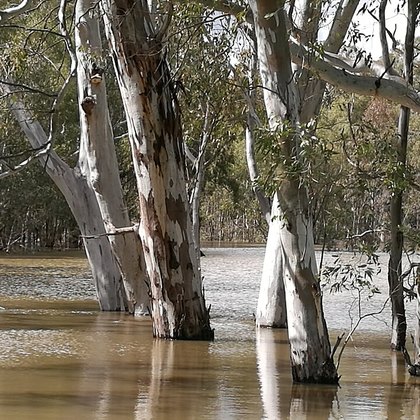
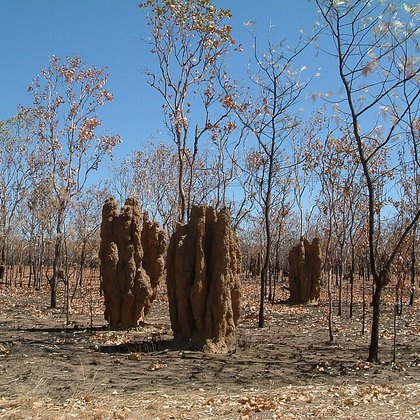
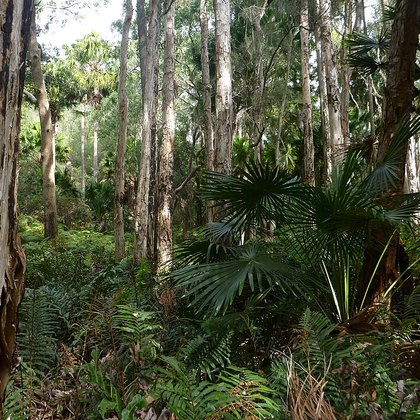
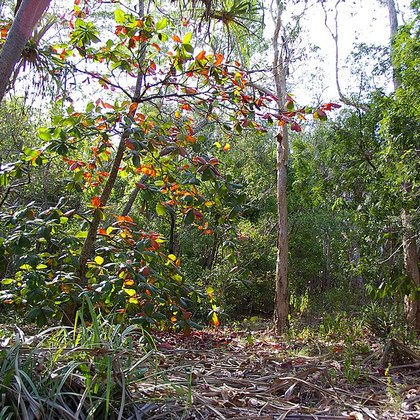
The ribbon of trees along creeks and rivers is its core country: riparian woodland of eucalypt and paperbark with a closed canopy, where water is near all year. Beyond that it uses open eucalypt savanna, monsoon forest and the landward edge of mangrove. It takes nectar from flowering eucalypts, grevilleas and melaleucas, supplemented with insects gleaned from foliage and bark, and with small fruits. It is resident and not migratory, and forages in pairs or loose parties in the outer canopy. The clutch is small, averaging one and a half eggs, as is usual for a tropical honeyeater; birds first breed at a little over a year old.
Where the bird is most often found, arranged by main group and formation.
Range and movements
Tropical northern Australia, from the Kimberley in Western Australia through the Top End of the Northern Territory into the Gulf country of northwestern Queensland. Beyond that the species occurs in southern New Guinea, in the Trans-Fly plains of Papua New Guinea and the adjoining Indonesian part — the only member of Ptilotula living outside Australia. It is absent from the arid interior, from the south of the continent, from Tasmania and from New Zealand.
- Resident
- Winter
- dark = core range, pale = thinly spread
Where and when to look
Look along water. In the north the creek and river woodland is nearly always the place: walk a strip of paperbark beside a permanent pool at first light and watch for small, yellow-tinted honeyeaters working the outer twigs. The decisive detail is in the lores: grey-yellow rather than black, so that the eye does not look darkly ringed. Anyone hesitating between this species and Grey-fronted Honeyeater should judge the width of the ear plume — narrow and inconspicuous here, broad and bright in plumula — and the substrate, since Grey-fronted sits in mulga (acacia scrub of the dry interior, dominated by Acacia aneura) and dry woodland rather than in creek timber.
Conservation
Least Concern (LC) and common over much of tropical Australia. Its habitat has come under less pressure than that of the southern honeyeaters, since the northern savannas have barely been cleared. The riparian woodland the species leans on is nonetheless affected by altered fire regimes, by trampling and grazing from cattle and feral water buffalo along the creek banks, and by the spread of introduced grasses such as gamba grass, which drive fires hotter than the native vegetation tolerates.
Scientific name
Ptilotula flavescens | (Gould, 1840)
John Gould described the species in 1840 as Ptilotis flavescens; author and year stand in parentheses, because it later moved first to Lichenostomus and then, after the 2011 molecular work showed that genus to be polyphyletic, to Ptilotula. That generic name, proposed by Gregory Mathews in 1912, is built from Greek ptilon, 'feather', and ous, 'ear', with a diminutive ending — the small ear plume of these birds. The epithet flavescens is Latin for 'becoming yellow' or 'yellowish' and describes the yellow wash over the plumage. The English name Yellow-tinted Honeyeater, the Dutch gouden honingeter and the Spanish mielero amarillento all three follow that epithet.