All species › Pelicans, herons and ibises › Ibises and spoonbills › Yellow-billed Spoonbill
Yellow-billed Spoonbill | Platalea flavipes
Geelsnavellepelaar | Espátula de pico amarillo
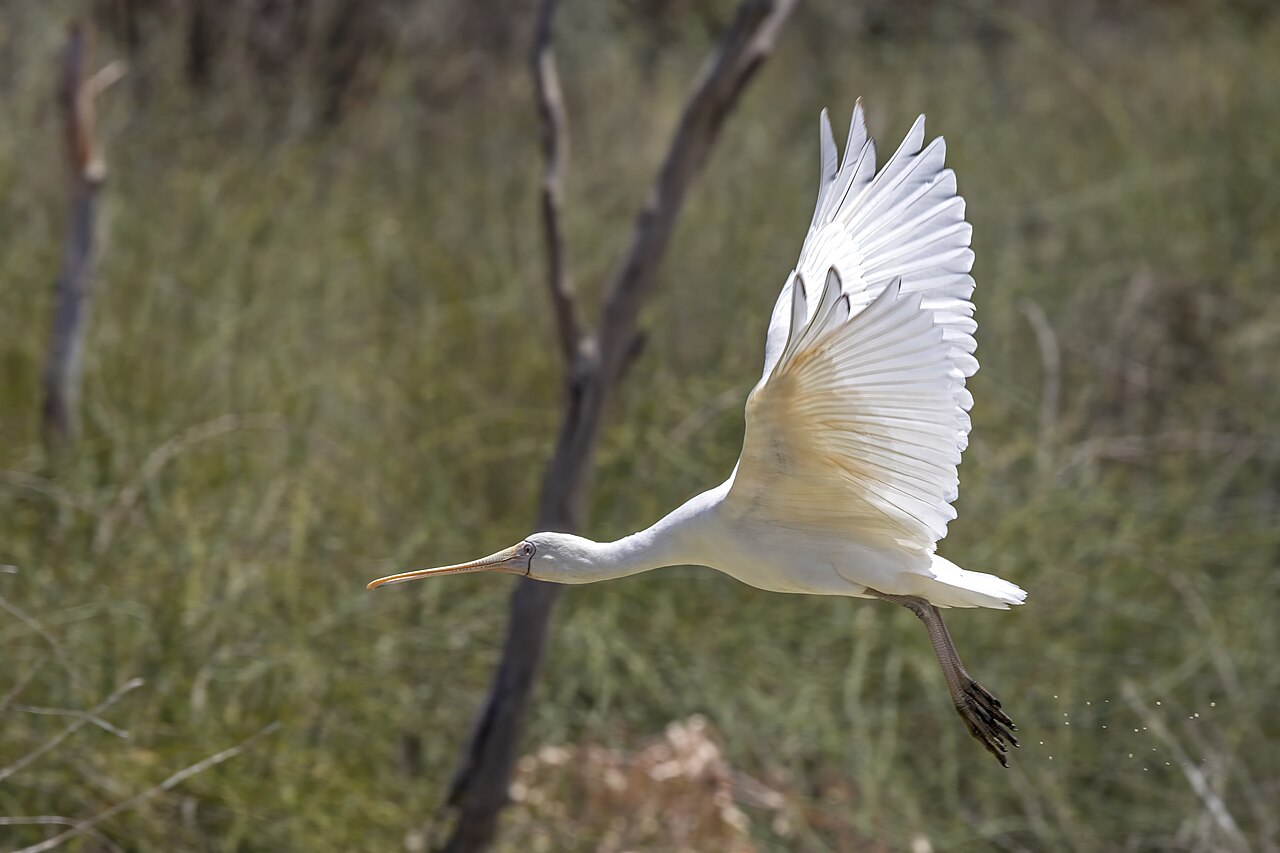
The Yellow-billed Spoonbill is the pale, inland spoonbill of Australia and occurs nowhere else in the world. Everything about its head is yellow: the bare facial skin, the long spatulate bill and the legs, and that alone sets it beside its black-billed cousin at a glance. It sweeps its bill through shallow water in search of aquatic insects.
Voice
Almost a mute bird. What one hears is a feeble, hoarse grunting at the nest or among feeding birds, barely audible beyond a few metres, and a dry clapping of the bill in greeting and in dispute — so the loudest sound it makes is not a voice at all. Young on the nest beg with a rasping squeal. An observer watching it in the field usually hears nothing.
Recording: nick talbot — CC BY-NC-SA 4.0 · Epsom, Greater Bendigo City, Victoria, Australia · xeno-canto
Identification
A large, all-white wading bird averaging just over eighty centimetres, with a long neck and legs and a long straight bill widened at the tip into a broad spoon. Bill, bare facial skin and legs are pale yellow to horn-yellow — the mark everything hangs on. In breeding plumage a fine black line surrounds the facial skin, long hanging plumes grow on the shoulders and the outer flight feathers are black-tipped. Out of breeding these markings fade or vanish. Young birds resemble adults but carry black markings on the inner flight feathers. In flight it stretches neck and legs and alternates flapping with glides, often in line or in V formation.
Confusion species
Royal Spoonbill (Platalea regia) is the only other spoonbill in the region and the distinction is simple, at range and even in silhouette: in that species the bill, facial skin and legs are black rather than yellow, and in the breeding season it carries a long white nuchal crest that Yellow-billed lacks. Royal Spoonbill is also slightly smaller and does use tidal flats and salt water, where Yellow-billed keeps almost entirely to fresh. Australian White Ibis (Threskiornis molucca) is as white and as large but has a bare black head and a downcurved bill with which it probes the mud rather than sweeping.
Habitat
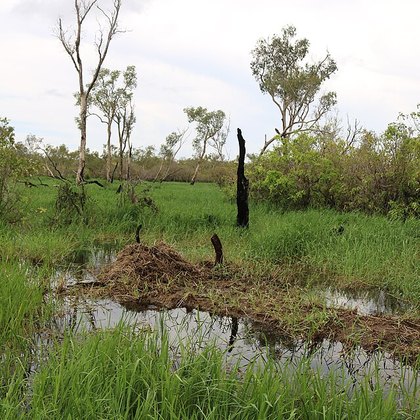
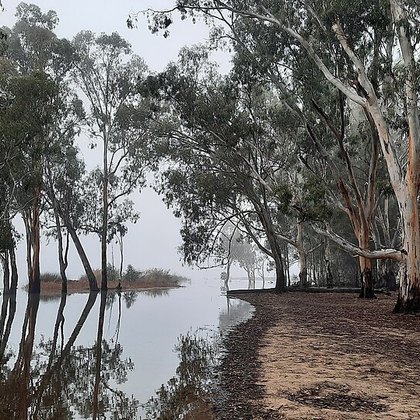
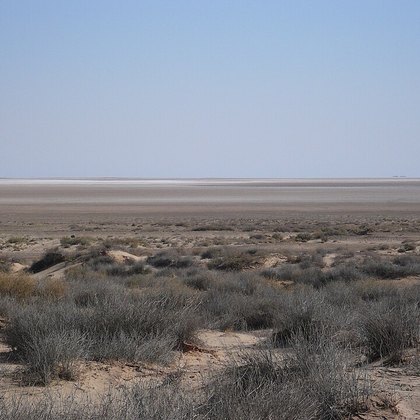
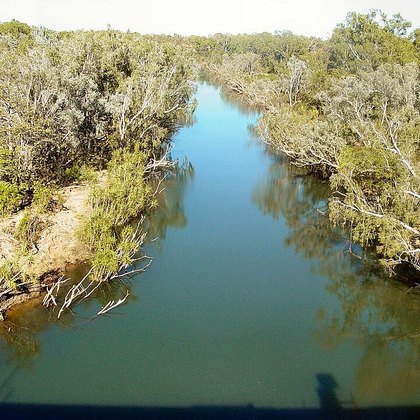
Shallow fresh water: swamps, lagoons, farm dams, claypans, ditches and lake margins, and after rain dry pasture as well. It needs less water than Royal Spoonbill and will settle for smaller pools; salt and tidal water it avoids almost entirely. It breeds in colonies with other waterbirds, on a loose stick platform in a tree fork over water or in a reedbed.
Where the bird is most often found, arranged by main group and formation.
Range and movements
Australia only, from the south-west and the north to the east; it is absent from Tasmania, and in the dry heart of the continent it depends on temporary water. It is commonest in the well-watered inland, along the rivers of the Murray-Darling Basin, and on the coast it is less common than Royal Spoonbill. It wanders: after good rain it spreads far inland, and in dry years it withdraws to the permanent waters. Very occasionally it reaches Lord Howe Island or New Zealand, where it remains a vagrant.
- Resident
- dark = core range, pale = thinly spread
Where and when to look
Look at the colour of the head, not the shape of the bird — in a mixed party of spoonbills the yellow stands out even against the light. Find it at the shallow edge of an inland dam or lagoon, walking slowly forward with sideways sweeps of the bill; that scything motion is recognisable at long range and betrays a spoonbill before the bill shape is visible. Open tidal mudflats will usually produce its black-billed cousin instead.
Conservation
Least Concern (LC), widespread across Australia and numerous enough to give no immediate cause for concern. Its fortunes nonetheless hang on the inland swamps: colonies fail when the water drops too early, and the extraction and regulation of water in the Murray-Darling Basin make the good years rarer. Because, unlike Royal Spoonbill, it hardly falls back on the coast and on artificial waters, that weighs more heavily on it.
Scientific name
Platalea flavipes | Gould, 1838
Gould described the species in 1838 as Platalea flavipes, and it has stayed in that genus, so author and year carry no parentheses. The genus Platalea goes back to Linnaeus in 1758 and is the Latin word for spoonbill, related to Greek platys, 'broad, flat', after the bill. flavipes is built from flavus, 'yellow', and pes, 'foot', hence 'yellow-footed' — though in this bird it is the yellow bill that strikes one first. The type locality is New South Wales; the description appeared in the appendix to Gould's A synopsis of the birds of Australia.