All species › Tubenoses › Petrels, shearwaters and diving petrels › White-necked Petrel
White-necked Petrel | Pterodroma cervicalis
Kermadec-witnekstormvogel | Petrel de cuello blanco
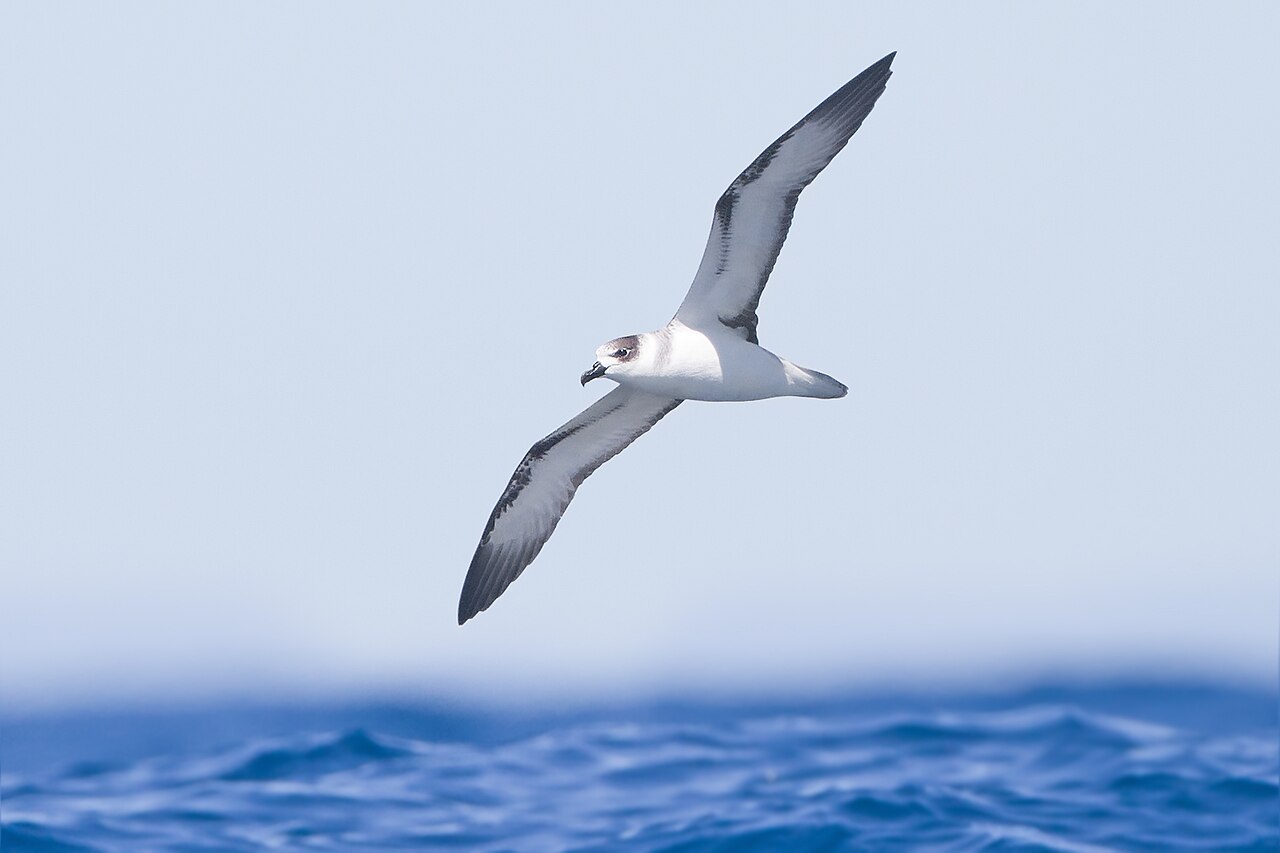
The White-necked Petrel is one of the largest gadfly petrels of this region, and the only one with a broad white band across the hindneck separating the black cap from the grey back. It breeds almost entirely on a single island of the Kermadec group.
Voice
Silent at sea; noisy over the colony. In flight it gives a loud ooo kek-kek-kek-kek-kek, and from the ground a monotonously repeated eh eh eh. On Macauley that sound carries across the whole island by night.
No recording with a suitable Creative Commons licence has been found for this species yet; what to listen for is described below.
Identification
A solid petrel of forty-three centimetres with a black cap, a white forehead and — decisively — a broad white band across the hindcrown and hindneck, lying like a collar between cap and mantle. Back and wings are grey with a blackish M from wingtip to wingtip and a dark rump. The underparts are white, with at most a smudged grey patch on the side of the neck and a short, narrow black line at the centre of the leading edge of the underwing; otherwise that underwing is strikingly clean white. The bill is long and black, the legs pink with the outer half of the webs black. Worn plumage looks noticeably darker than fresh, which can cause doubt at sea.
Confusion species
The chief pitfall is Juan Fernandez Petrel (Pterodroma externa), which can turn up in these waters as a vagrant but is not treated in this guide: it has a grey rather than white hindneck, so that the cap shades into the mantle instead of being cut off by a sharp white band. Do not confuse it with Kermadec Petrel (Pterodroma neglecta), a quite different bird named after the islands where this species breeds too: that species is stockier, with a short wedge tail, white shafts on the upper primaries, and pale, intermediate and dark morphs, with no sharp cap. White-headed Petrel (Pterodroma lessonii) has an all-white head with no black cap. Buller's Shearwater (Ardenna bulleri) has an almost pure white underwing and the long thin bill of a shearwater, and lacks the white hindneck; Great Shearwater (Ardenna gravis) has a dark belly patch and a white rump band. At sea the broad white neck band remains the key to this species.
Habitat
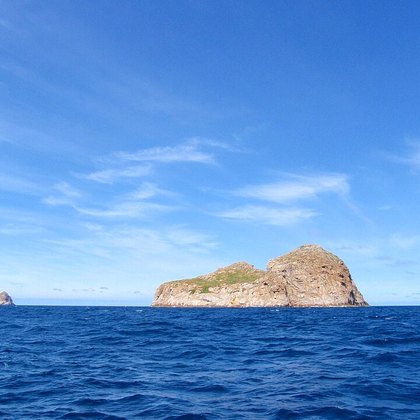
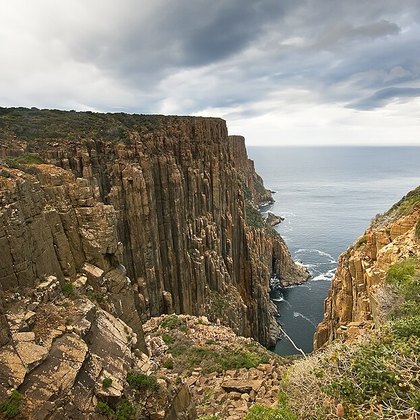
Open warm to subtropical ocean over deep water. It breeds in burrows dug into the soft, fern- and scrub-covered soil of volcanic islands, on a plateau above the sea cliff.
Where the bird is most often found, arranged by main group and formation.
Range and movements
Within this region it breeds only on Macauley Island in the Kermadec group, which holds about fifty thousand pairs; since 1992 a small number of ten to a hundred pairs has also held on at Phillip Island off Norfolk. On Raoul Island it was wiped out by introduced cats and rats. During the breeding season, September to June, it stays in the wider Kermadec area and reaches northern New Zealand waters; from May to November most birds move north, chiefly to the sea south-east of Japan. Off eastern Australia it is a scarce visitor.
- Breeding (summer)
- dark = core range, pale = thinly spread
Where and when to look
The best chance is a multi-day pelagic trip to the Kermadecs or, closer to home, a trip well beyond the shelf out of northern New Zealand between November and April. Look for a large, strongly contrasting gadfly petrel arcing high and wide, and judge the neck first: a sharp white band between black cap and grey mantle settles it. Only distant birds in worn plumage call for a photograph.
Conservation
Vulnerable (VU). The entire world population hangs on essentially one island, and that is the heart of the problem: one introduced predator, one severe storm or one eruption could take a large share of the species. On Raoul Island the breeding birds were already lost to feral cats and rats; predators were removed there between 2002 and 2006, so recolonisation is now possible. On Macauley itself the removal of goats let the vegetation, and with it the burrow ground, recover. At sea longline bycatch and plastic in the food are the familiar risks, harder to measure.
Scientific name
Pterodroma cervicalis | (Salvin, 1891)
The British ornithologist Osbert Salvin described the species in 1891 as Oestrelata cervicalis; because it has since moved to another genus, author and year go in parentheses. The genus Pterodroma was introduced by Bonaparte in 1856, from the Greek for 'wing' and 'runner'. cervicalis is Latin for 'of the neck', after the broad white band that divides cap from back — precisely the feature on which the bird is identified. The type locality is the Kermadec Islands, where Macauley remains its stronghold; the Dutch guide name adds that island group to the white neck.