All species › Passerines › Woodswallows, bellmagpies and allies › White-browed Woodswallow
White-browed Woodswallow | Artamus superciliosus
Wenkbrauwspitsvogel | Artamo cejiblanco
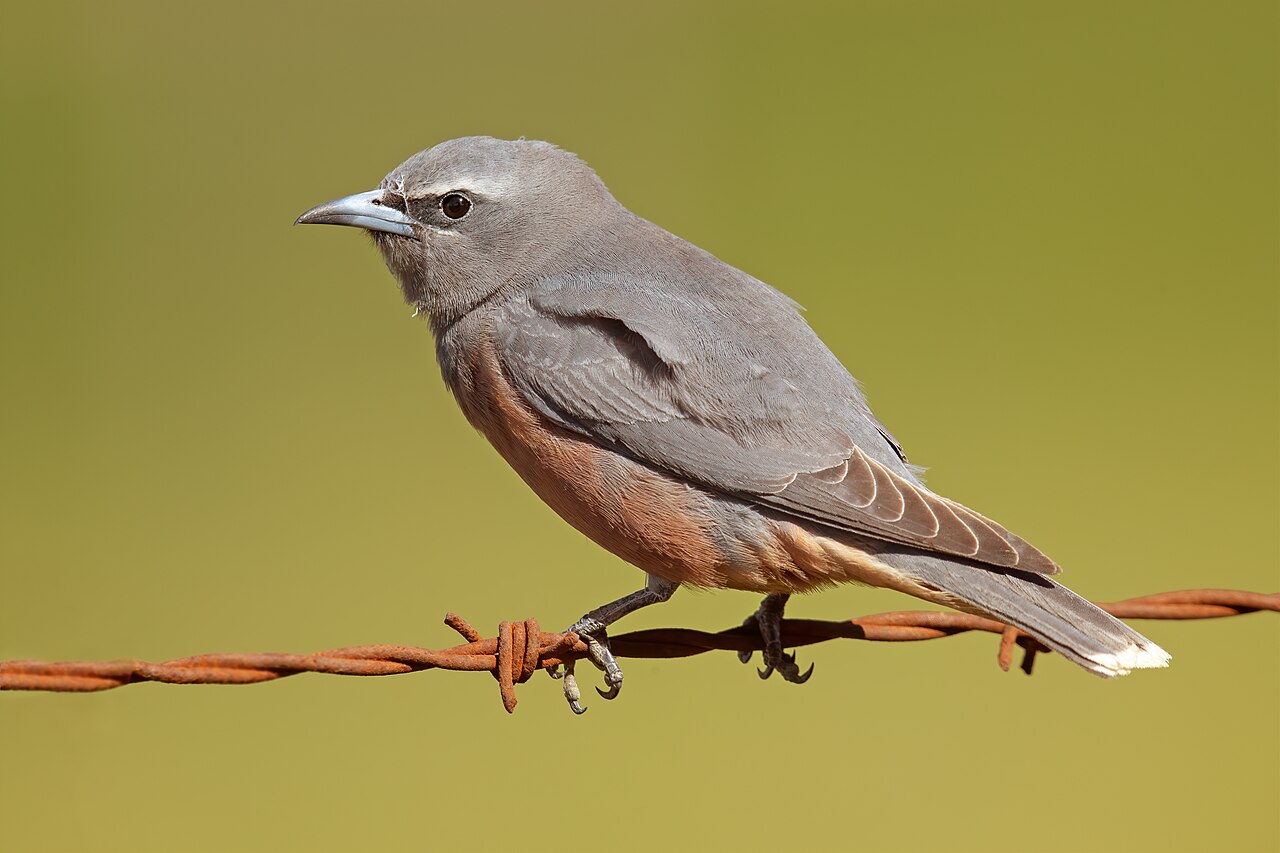
The White-browed Woodswallow is the most striking of the genus and the only one that poses no identification problem at all once a male is involved: slate-blue above, with a dark face over which lies a broad, pure white brow, and deep chestnut from the breast down. It is also the most migratory species — breeding in the south-east and wintering in the interior and the north — and it travels almost always together with the Masked Woodswallow.
Voice
A soft, nasal chap-chap or vit as a contact note, which comes down from a high-passing flock as a continual thin murmur. The song is a soft, running chatter of scratchy, squeaky and twittering notes, often kept up for long stretches from a branch or even while soaring, and regularly carrying imitations. The alarm at the nest is a sharp rattle. In practice the call cannot be separated from that of the Masked Woodswallow, so the ear gives no verdict on a mixed flock.
Recording: Greg McLachlan — CC BY-NC-SA 4.0 · Euabalong, Cobar Shire Council, New South Wales, Australia · xeno-canto
Identification
The male is one of the most boldly marked songbirds of the interior. Head, neck and upperparts are deep slate-blue to dark blue-grey; the lore and the area around the eye are blackish, and above them runs a broad, sharply drawn, pure white brow from the base of the bill to behind the eye. From the lower breast the underparts are deep chestnut to rufous, giving a very strong contrast with the blue-grey above. The wings are dark blue-grey with black primaries, the tail black with a narrow white tip, the bill blue-grey with a black tip. The female is much duller: grey-brown above with a faint, narrow pale brow or none at all, and pale cinnamon below instead of chestnut. Both sexes show the triangular, sharply tapering wing and soar with the tail spread.
Confusion species
In the male the head settles it at a glance: the broad white brow occurs in no other woodswallow. Masked Woodswallow (Artamus personatus) has a closed black face mask without a brow and is pale grey below instead of chestnut. Black-faced Woodswallow (Artamus cinereus) has only a black loral patch and a vaguely bounded grey cap. Dusky Woodswallow (Artamus cyanopterus) is brown with a white wing edge. The real difficulty lies with the females: a female of this species and a female Masked are both dull, drab brown birds, and the only usable difference is that the underparts here are a warmer cinnamon against pale grey in the Masked — at soaring height, against the sky, usually impossible to judge. Since both species travel in the same flock, and such a flock may number thousands of birds, the observer must accept that part of it cannot be put to species; count the recognisable males and leave the rest unassigned.
Habitat
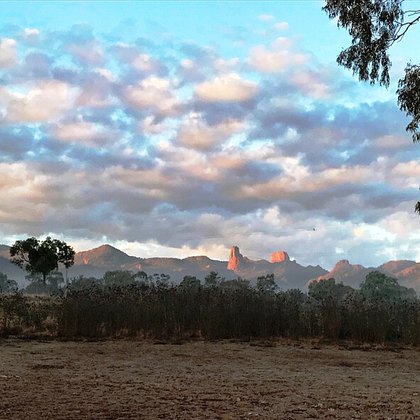
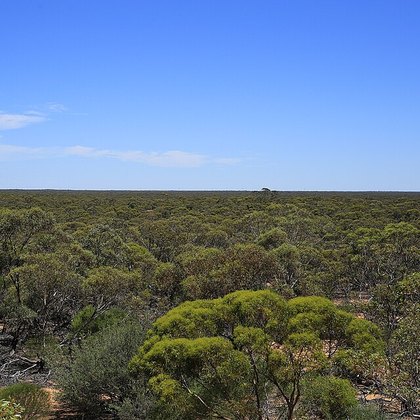
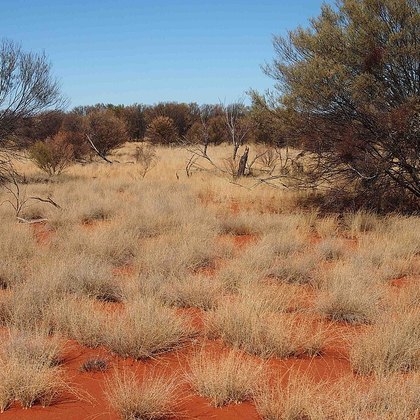
Dry and semi-arid open country: dry eucalypt forest and woodland, mallee (low, multi-stemmed eucalypt scrub of dry southern Australia), mulga (acacia scrub of the dry interior, dominated by Acacia aneura) and acacia scrub and savanna with scattered eucalypts, and in irruption years also cropland, pasture and shelterbelts close to the coast. The bird hunts flying insects soaring high and drops in dense parties where food is abundant. The nest is a flimsy cup of twigs in a fork, a shrub, a stump or a post, often with dozens of pairs fairly close together; breeding areas shift from year to year with the rainfall.
Where the bird is most often found, arranged by main group and formation.
Range and movements
Breeds in south-eastern Australia, roughly from south-eastern Queensland through inland New South Wales and Victoria to south-eastern South Australia, and winters in central Australia to northern Queensland. By Australian standards that is an unusually regular migration pattern, although within it the species remains unpredictable: in one spring it arrives in tens of thousands in a district where it was absent the year before. It reaches Tasmania only as a vagrant.
- Resident
- Breeding (summer)
- dark = core range, pale = thinly spread
Where and when to look
In spring watch the sky above dry inland country and listen for the thin, persistent contact calls. In the flock find the males first: white above the eye and rufous on the belly is this species, without qualification. Use them as the key to the flock and expect Masked Woodswallows alongside; the dull brown birds among them are females of both species and need not be forced to a name.
Conservation
The species is listed as Least Concern (LC) and the range covers almost the whole mainland. Because of the wandering, weather-driven way of life, local numbers are so variable that they say little about the population; a district may hold thousands of birds one year and none the next with nothing amiss. A reliable long-term trend is therefore lacking. The main concern for the future is that the open woodlands in which the species breeds in the south-east have contracted sharply over the past century.
Scientific name
Artamus superciliosus | (Gould, 1837)
John Gould described the bird in 1837 as Ocypterus superciliosus, from material from the 'interior of New South Wales', in practice the Hunter River; the species now sits in Artamus, so author and year stand in parentheses. The epithet superciliosus is Latin for 'with eyebrows', from supercilium, 'brow', and so names precisely the character that makes the male unmistakable. The Dutch wenkbrauwspitsvogel, the English White-browed Woodswallow and the Spanish artamo cejiblanco all say the same. The genus name Artamus goes back to Greek artamos, 'butcher', after the kinship with the butcherbirds; the Dutch spitsvogel refers to the pointed, triangular wing.