All species › Passerines › Cuckooshrikes › White-bellied Cuckooshrike
White-bellied Cuckooshrike | Coracina papuensis
Papoearupsvogel | Oruguero papúa
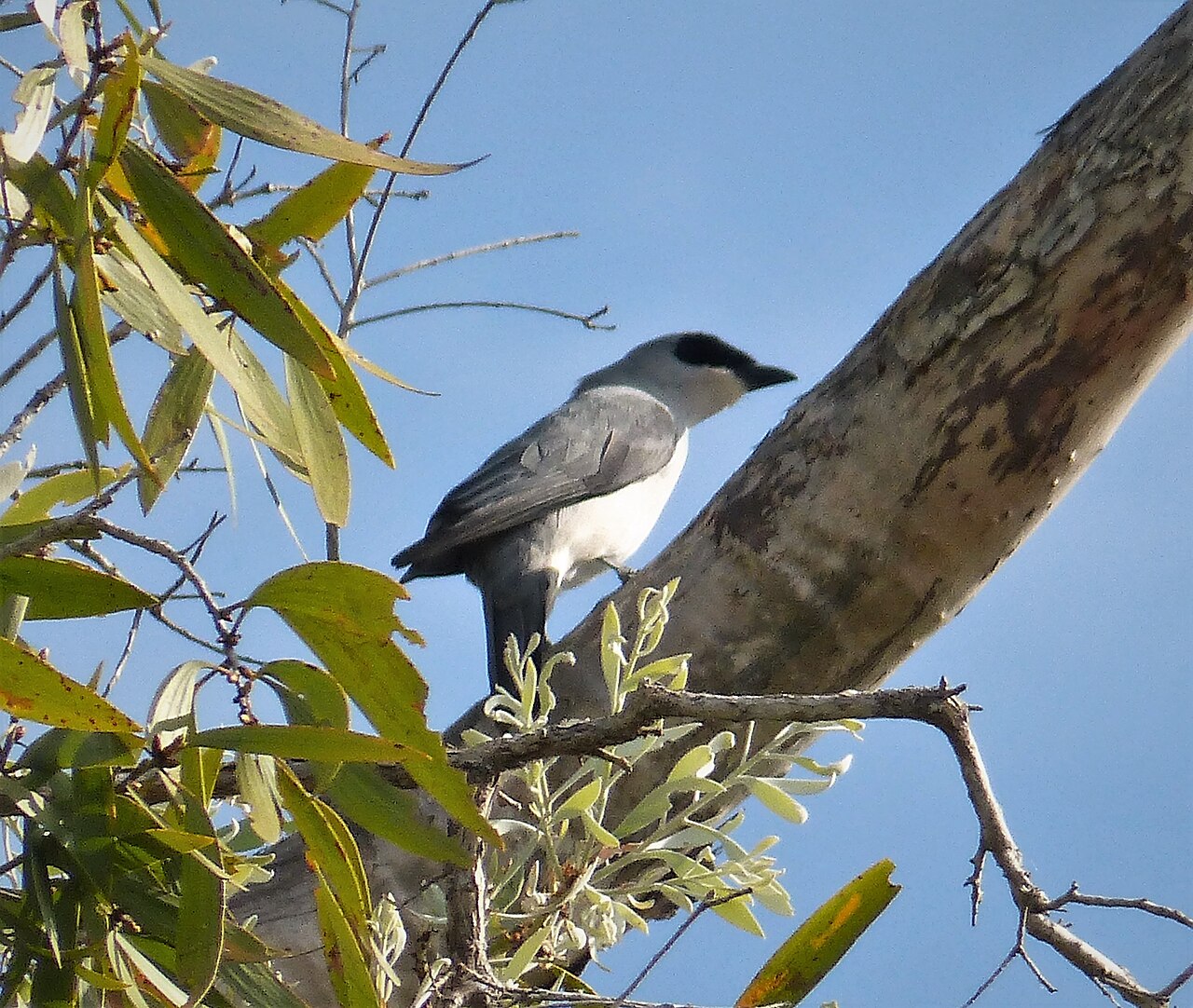
The White-bellied Cuckooshrike is the palest and most open-country of the Australian cuckooshrikes: a pale grey bird with a clean white belly, perched on a bare branch above the savanna or at the edge of a mangrove and giving a soft rolling call. Across northern and eastern Australia it is a familiar bird of woodland, roadsides and even towns and parks. The engaging thing about it is that the amount of black on its face varies from region to region: in the south-east no more than dark lores, in parts of the north a hood running down over the throat.
Voice
A rolling, slightly churring 'kee-seek' or 'chirreep', often repeated two or three times and given from a bare branch or in flight. It is more musical and softer than the grating rattle of the Black-faced Cuckooshrike (Coracina novaehollandiae), with a distinctly rolled, almost trilling r in it. Pairs call to one another across a good stretch of open woodland, so that in the early morning the sound is present almost everywhere in the background of the savanna. There is also a higher, sharper alarm note used against raptors and around the nest tree.
Recording: Eddy Smith — CC BY-NC-SA 4.0 · Maddock Fauna Park (near Joanna), Naracoorte Lucindale Council, South Australia, Australia · xeno-canto
Identification
A medium-large cuckooshrike of about twenty-four to twenty-eight centimetres with a long tail, long pointed wings and a fairly heavy black bill. The upperparts are pale blue-grey, much paler than in the other cuckooshrikes in this guide, and the underparts are clean white from the breast down — that contrast between pale grey above and white below is the quickest mark. The iris is dark, not yellow. A black mask crosses the face, but its extent varies strongly between forms: in eastern and south-eastern birds it is confined to the lores and a narrow line through the eye, while in parts of tropical Australia and New Guinea there are birds in which the black covers the whole chin, throat and upper breast, with every intermediate in between. Male and female are all but identical. Like the other cuckooshrikes, the bird shuffles its wings a few times emphatically after landing.
Confusion species
The Black-faced Cuckooshrike (Coracina novaehollandiae) is the main problem, above all against the dark-throated northern forms. That species is, however, noticeably larger and darker grey both above and below — the belly is grey, not white — and its black mask always takes in the whole throat and runs back behind the eye in a broad, sharply defined band. If you see a crisp boundary between grey breast and white belly, it is this species. The Barred Cuckooshrike (Coracina lineata) has a yellow iris and finely barred white underparts, and sits in rainforest rather than open woodland. The male Sahul Cicadabird (Edolisoma tenuirostre) is uniformly dark slate-grey with no white belly at all and has a far finer bill. Finally, the Grey Butcherbird (Cracticus torquatus) recalls this species at a distance through the same grey-and-white division, but has a heavy blue-grey hooked bill with a black tip and an entirely different, fluting song.
Habitat
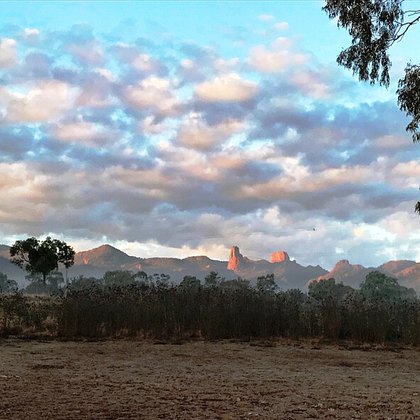
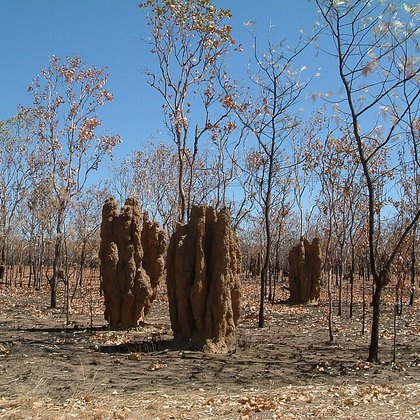
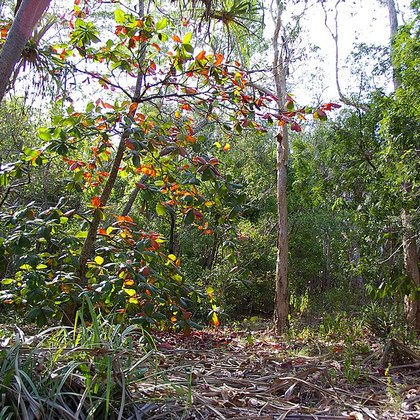
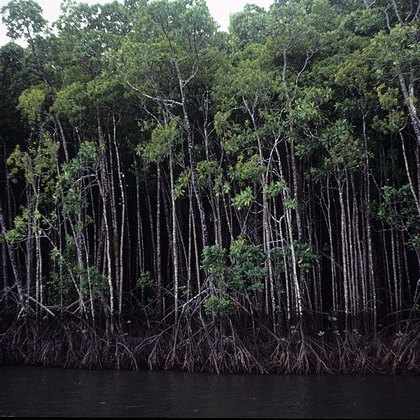
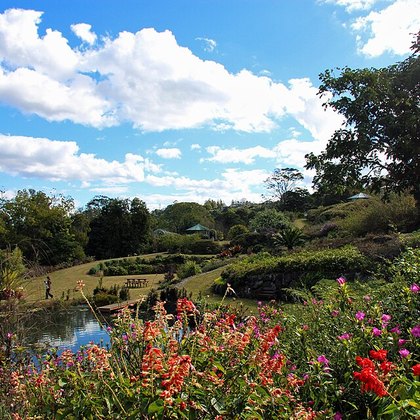
Open eucalypt forest and woodland, tropical eucalypt savanna, creek-line woodland, monsoon vine forest and vine thicket, mangrove and the woodland behind it, and beyond that gardens, parks, plantations and lines of trees along roads and around homesteads. The species avoids closed rainforest and truly barren desert, but occurs in almost everything in between, as long as there are tall trees with bare branches to hunt from. The food is largely insects and caterpillars, gleaned from leaves and bark or taken in a short sally in the air; seeds and soft fruit are eaten as well. The nest is a small, shallow saucer of bark, twigs and grass bound with cobweb on a horizontal branch high in a tree, so small that the sitting bird overhangs it on every side.
Where the bird is most often found, arranged by main group and formation.
Range and movements
Widespread across northern and eastern Australia: from the Kimberley in the north-west through the Top End and the Gulf Country to Cape York, and along the east coast and adjoining inland south into New South Wales, with irregular records further south again. It is absent from the arid interior, the south-west and Tasmania. Beyond Australia it occurs on New Guinea and its surrounding islands, in the Moluccas, in the Bismarck Archipelago and in the Solomon Islands — a large island region across which a series of forms is recognised, differing in size and in the extent of black on head and throat. The species does not occur in New Zealand.
- Resident
- dark = core range, pale = thinly spread
Where and when to look
Look high and bare. This cuckooshrike prefers a dead branch or the crown of a tree at the edge of a clearing, and stays there a long time before moving on to the next lookout with slow, undulating wingbeats. Watch for the wing-shuffle on landing: that gesture tells you at once that you have a cuckooshrike and not a butcherbird or a woodswallow. Then establish the boundary between grey and white on the underside — crisp and high on the breast means this species — and note, especially in the north, how far the black runs down the throat; that is not an identification problem but a piece of geographical variation well worth recording.
Conservation
Least Concern (LC), with a very large range and a population regarded as stable. The species is one of the winners among Australian woodland birds: because it prefers open woodland, edges and half-open farmland to closed forest, the conversion of dense forest into pasture with scattered trees has in many places helped rather than harmed it, and it breeds into towns and parks. Where things do go wrong is where all the trees go: without tall trees carrying bare branches there is no lookout and no nest site. Retaining scattered old trees in pasture and along roads is therefore the one thing this species really needs in farmed country.
Scientific name
Coracina papuensis | (Gmelin, 1788)
Johann Friedrich Gmelin described the species in 1788 as Corvus papuensis — placing it among the crows to begin with — from a bird taken in New Guinea; Erwin Stresemann restricted the type locality to Manokwari in 1913. Author and year stand in parentheses because the species now sits in Coracina, a genus name going back to Greek korakinos, 'little raven', and so carrying on the same idea: a bird with something crow-like about it at first glance. The epithet papuensis simply means 'from Papua', after the type locality, and the Dutch name papoearupsvogel follows that. The English name White-bellied Cuckooshrike and the Spanish oruguero papúa show how the two traditions diverge: one names the best field mark, the other the type locality. Many forms are recognised within the species, differing chiefly in size and in the extent of black on head and throat; some of them have in the past been treated as separate species.