All species › Waders, gulls and terns › Skimmers, noddies, terns and gulls › Whiskered Tern
Whiskered Tern | Chlidonias hybrida
Witwangstern | Fumarel cariblanco
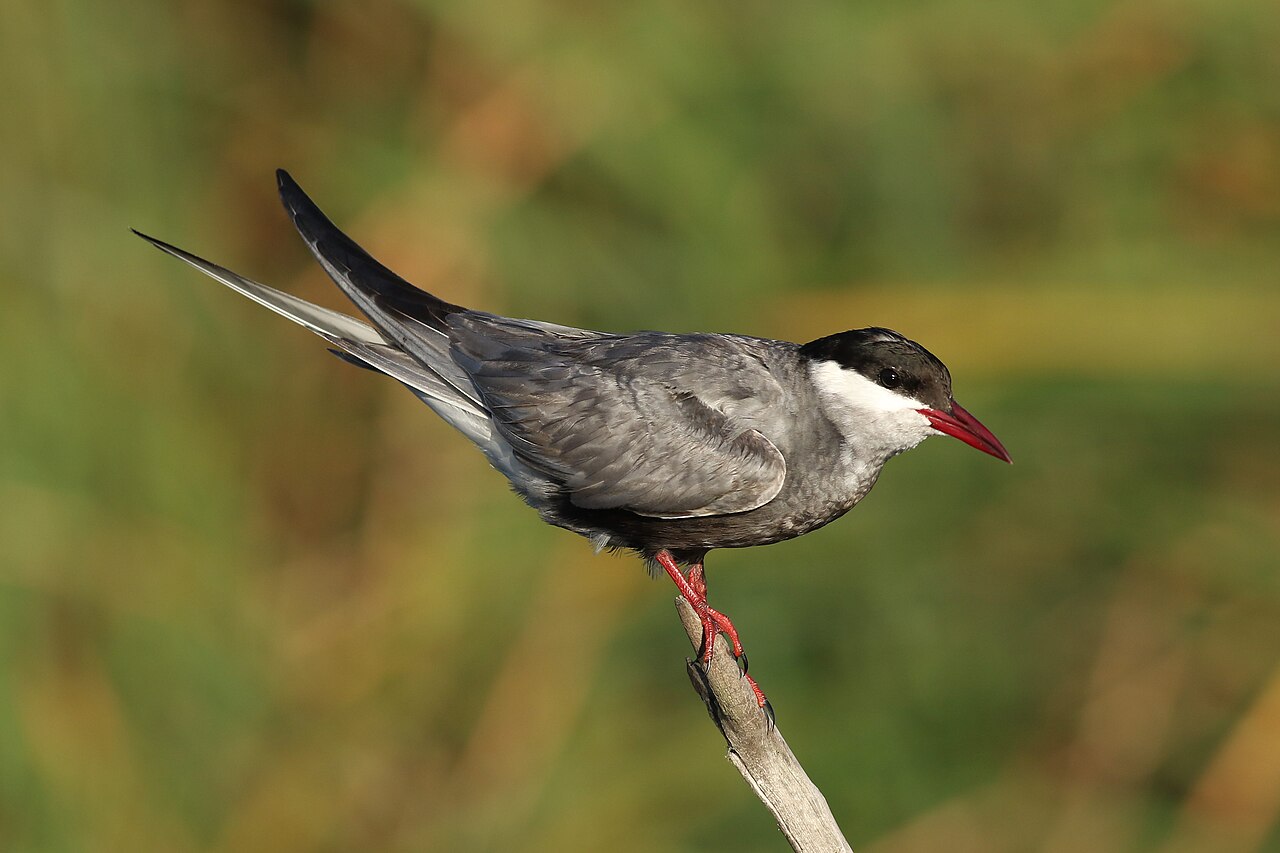
The Whiskered Tern is Australia's everyday marsh tern: a grey, red-billed tern that hunts not over the sea but over flooded land. In breeding dress it is dark grey from breast to belly with a sharp white cheek stripe between black cap and grey body, and with blood-red bill and legs. It nests in colonies on floating platforms of water plants, and so appears inland in numbers as soon as a wet season puts the plains under water.
Voice
The call is a harsh, clipped krek or kersh, often in quick series above the colony and drier than the notes of the sea terns. Disturbance at a breeding site swells this to a sustained rasping chorus that carries across the whole swamp. Feeding birds are quieter and give at most a soft kip as they keep company.
Recording: Christian Kerihuel — CC BY-NC-SA 4.0 · Réserve Ornithologique Du Teich (near Le Teich), Gironde, Nouvelle-Aquitaine, France · xeno-canto
Identification
A medium-sized tern of twenty-four to twenty-eight centimetres, heavier than White-winged Tern and with a longer, stouter bill. In breeding plumage the cap is jet black to below the eye, beneath it runs a narrow but sharp white cheek stripe, and the whole underside from breast to belly is dark slate-grey, with white under the tail projecting as a pale wedge behind the dark belly; bill and legs are deep red. In non-breeding dress it is pale grey above and white below, with a white forehead, a black-streaked crown running back behind the eye and a grey rump that does not contrast with the mantle. The tail is only shallowly forked. Young birds have a scaly, rusty-brown mantle. The flight is easy and swerving, with short dips to the surface.
Confusion species
White-winged Tern (Chlidonias leucopterus) is the constant companion and the hardest call: in non-breeding dress it has a white rump standing out clearly against grey mantle and grey tail, while on Whiskered everything runs through in even grey. White-winged is also smaller and shorter-billed, and has an isolated round ear patch instead of a dark crown joined to the eye-stripe. Black-fronted Tern (Chlidonias albostriatus) is the guide's third marsh tern: larger, with orange bill and legs, a white rump and a breeding range confined to the braided rivers of the South Island, where Whiskered Tern occurs only as a vagrant. White-fronted Tern (Sterna striata) and Common Tern (Sterna hirundo) are whiter, longer-tailed and hunt by plunge-diving over open water rather than quartering low across marsh; Gull-billed Tern (Gelochelidon nilotica) is paler and has a heavy, wholly black bill.
Habitat
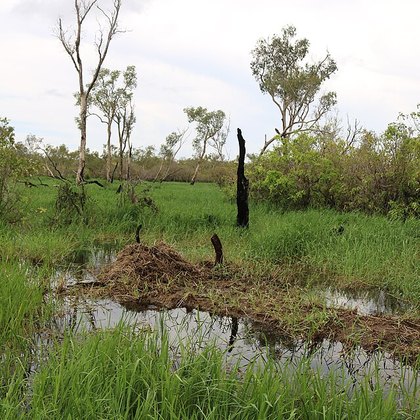
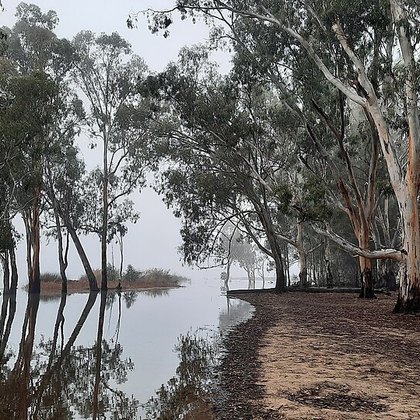
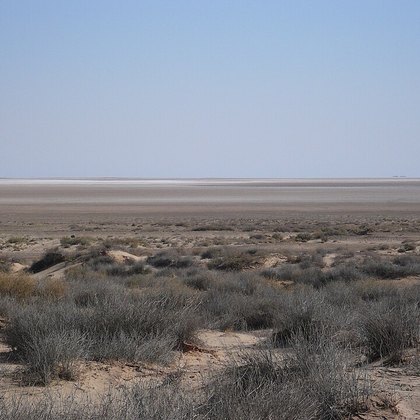
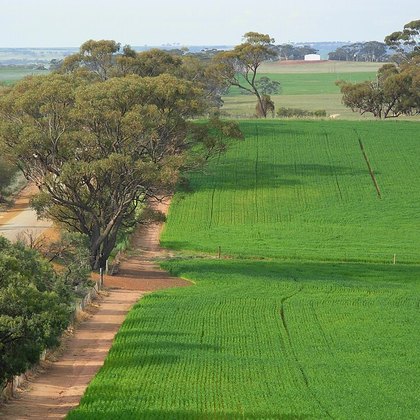
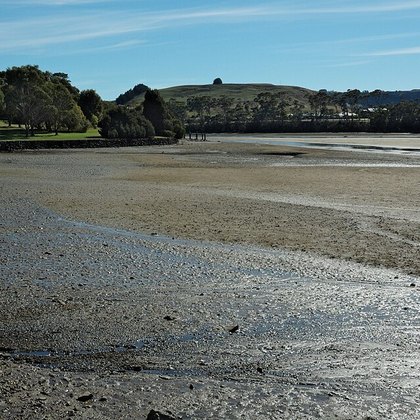
Shallow freshwater marshes, flooded plains and claypans (shallow clay basin that holds water for a time after rain), lakes, farm dams and reservoirs, and above all the temporary waters that form inland after a wet season. Beyond that, rice fields, irrigated farmland and sewage ponds, where it often feeds in large flocks. Outside the breeding season it also uses estuaries, mudflats and saltmarsh, but it avoids the open sea.
Where the bird is most often found, arranged by main group and formation.

Range and movements
Widespread across the whole of Australia, most numerous in the east and north and in the Murray-Darling basin, but its wandering habits can bring it almost anywhere water stands, into the arid interior and the south-west. Numbers swing enormously with rainfall: in wet years thousands of pairs breed on the inland floodplains, in dry years the birds move to the coast and north. In New Zealand it is a rare but almost annual visitor, with most records on North Island estuaries.
- Resident
- Breeding (summer)
- dark = core range, pale = thinly spread
Where and when to look
After a wet spell, drive past flooded paddocks and watch the terns swerving low across them; almost always these are Whiskered Terns. In non-breeding dress, concentrate on the rump, which here is as grey as the back — that separates it at a glance from White-winged Tern. Sewage ponds and rice fields on the edge of a town give the easiest year-round access to the species.
Conservation
Least Concern (LC), with a large range across Europe, Africa, Asia and Australasia and a population running into the tens of thousands in Australia alone. The species depends heavily on temporary inland waters and is therefore affected by water extraction and river regulation in the Murray-Darling basin, which damp down the natural floods on which breeding success rests. Against that, rice growing, irrigation and wastewater ponds have created new water for nesting and feeding, so the overall picture stays steady.
Scientific name
Chlidonias hybrida | (Pallas, 1811)
Pallas described the species in 1811 as Sterna hybrida; because it was later placed in another genus, author and year stand in parentheses. The name means literally 'hybrid': Pallas took the bird for a cross between White-winged Tern and Common Tern, and said so in print. The genus Chlidonias was introduced by Rafinesque in 1822, from Greek khelidonios, 'swallow-like'. Australian birds belong to the subspecies javanicus (Horsfield, 1821), which ranges from Java to Australia; African birds to delalandii (Mathews, 1912).