All species › Passerines › Bristlebirds › Western Bristlebird
Western Bristlebird | Dasyornis longirostris
Zwartkapborstelvogel | Picocerdas occidental
The Western Bristlebird is a brown skulker of the same Western Australian coastal heath as the Noisy Scrubbird, and is seen nearly as rarely. It stays in the lowest half metre, flies short and low if it flies at all, and gives itself away almost only by its clear whistled song. It is endangered and survives in no more than a handful of reserves.
Voice
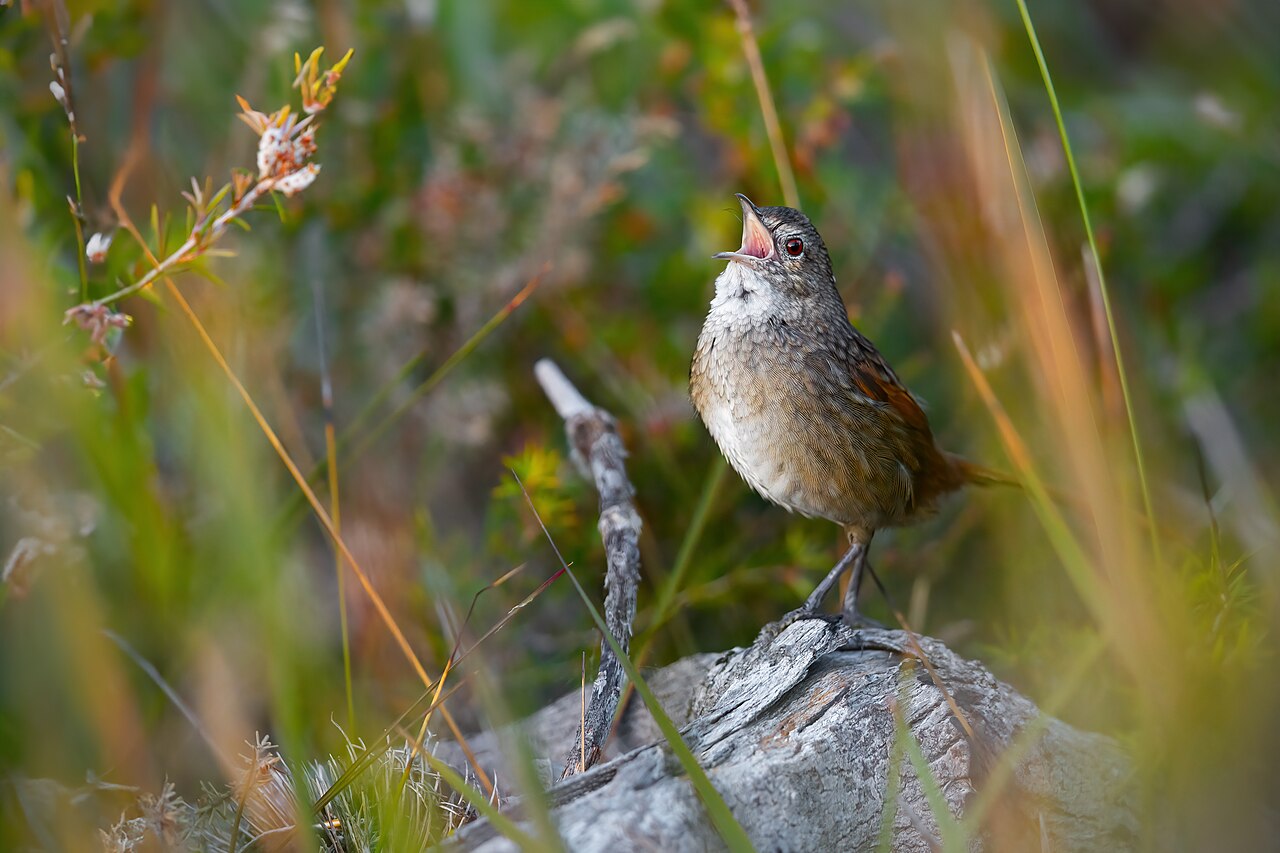
The song is a short, clear series of whistles in a fixed rhythm, often rendered chip-pee-tee-peetle-pet; over open heath it carries hundreds of metres and its direction misleads. The male usually sings from a low branch or the top of a bush, in the first hour after sunrise and again towards evening. In alarm comes a sharp, short chek, and a pair keeps contact in cover with thin squeaks. Song is heard all year, with a peak in spring, from August to November.
Recording: nick talbot — CC BY-NC-SA 4.0 · Arpenteur Nature Reserve, Cheynes Beach, Western Australia, Australia · xeno-canto
Identification
Eighteen to twenty-two centimetres, with a short, broad, red-brown tail barred darker and often carried slightly cocked. The upperparts are grey-brown, the underparts off-white with fine dark scalloping on breast and flanks. Face and throat are paler, with a pale line between bill and eye; the iris is red-brown. The bill is long and slender for a bird of this build. The sexes are alike, and young birds are duller and less clearly scalloped.
Confusion species
Noisy Scrubbird (Atrichornis clamosus) shares the heath, is as brown and as shy, but has a long graduated tail without bars, a black throat in the male, and a song many times louder and made of metallic notes. Rufous Bristlebird (Dasyornis broadbenti), of the southern coast of Victoria and South Australia, is larger and rufous-crowned and does not occur here. Thornbills and scrubwrens of the heath are half the size and move far more openly. A large brown bird that dives low through the heath and does not come back is, in this district, almost always one of the first two.
Habitat
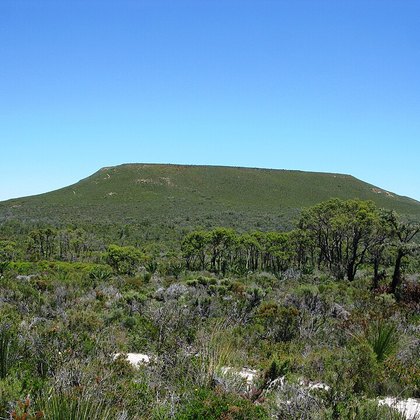
Low, very dense heath on coastal sand: kwongan (species-rich heath-like scrub of south-western Australia) with banksia, hakea and sedge, on dune ridges, clifftops and the sandplain behind them, with a closed roof at knee to hip height. The cover must be a few years to a decade unburnt; younger is too open, older grows too thin. It walks the ground between the stems and rarely rises above half a metre. Forest, cropland and grazed country are avoided.
Where the bird is most often found, arranged by main group and formation.
Range and movements
Only in the far south-west of Australia, in a handful of reserves east and west of Albany — Two Peoples Bay, Mount Manypeaks, Waychinicup — and in Fitzgerald River National Park further east. The type locality lies on the Swan River, where the species has long gone: the range has shrunk in a century and a half to a fraction of what it was. It is sedentary and territories are small; there is next to no exchange between reserves, because cropland lies between the heaths. No new colonies outside the existing areas are known.
- Resident
- dark = core range, pale = thinly spread
Where and when to look
The chance is small, and it is honest to say so. Go in still weather in early spring, September to November, at first light to a track through the heath at Two Peoples Bay or in Fitzgerald River National Park, and stand until you catch the rhythm of the song. Seeing it here means a brown bird crossing the track in one second. Leave playback alone; the species is endangered and the territories are counted.
Conservation
Endangered (EN), with the entire world population in a few reserves along a coastal strip of less than two hundred kilometres. Fire is the heaviest threat: a single summer fire can leave a whole subpopulation uninhabitable for years, and after the fires at Mount Manypeaks the birds had to come back in from the edges. The soil fungus Phytophthora cinnamomi attacks the banksia heath as well, and foxes and feral cats hunt a bird that cannot fly clear. Management turns mainly on breaking the heath into fire compartments.
Scientific name
Dasyornis longirostris | Gould, 1841
Gould described the species in 1841 as Dasyornis longirostris; the name has not changed genus since, and so author and year stand without parentheses. The genus Dasyornis is formed from Greek dasys (bristly) and ornis (bird), after the stiff bristles at the base of the bill that give the family its name. longirostris is Latin for 'long-billed'. The type locality is the Swan River in south-western Australia.