All species › Parrots › Cockatoos › Sulphur-crested Cockatoo
Sulphur-crested Cockatoo | Cacatua galerita
Grote geelkuifkaketoe | Cacatúa australiana
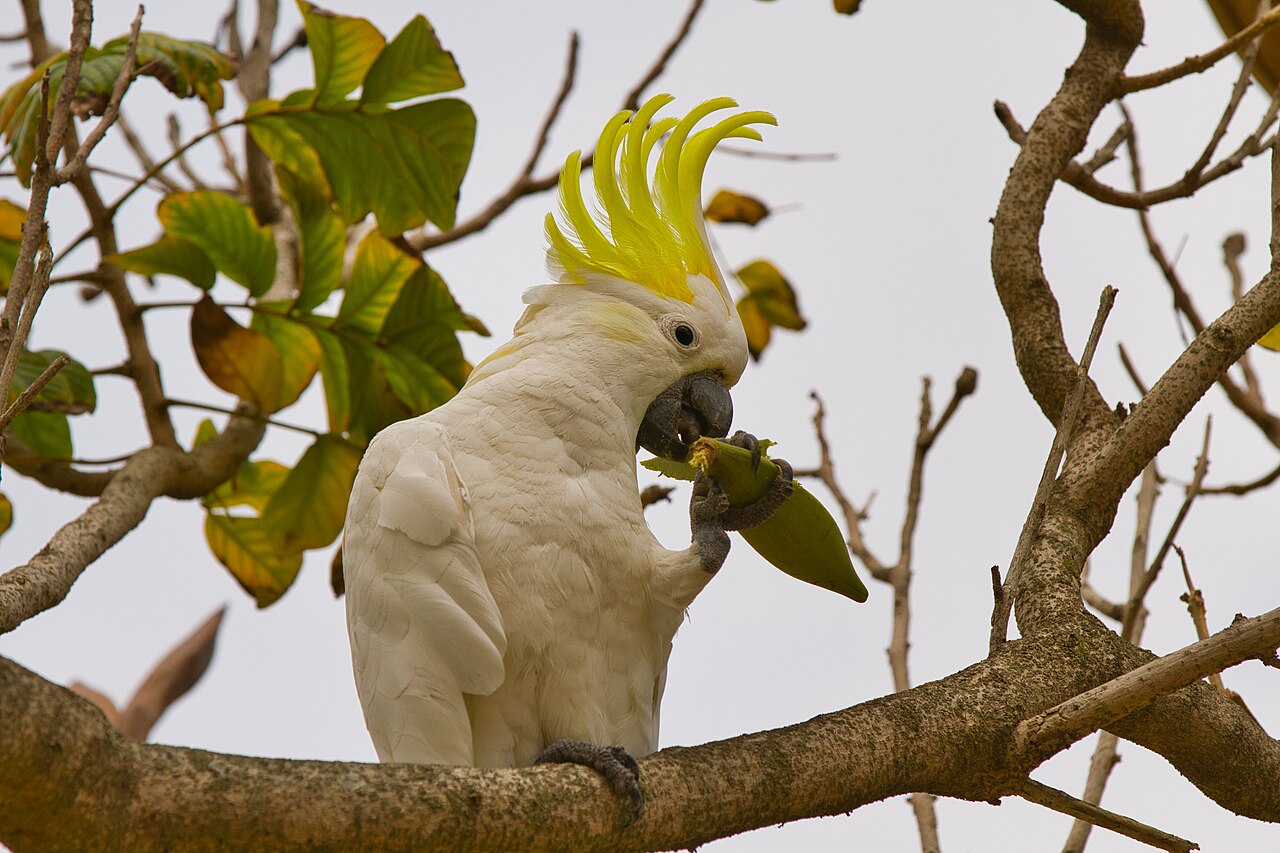
The Sulphur-crested Cockatoo is the white parrot with the sulphur-yellow crest that screeches over the rooftops of eastern Australia at every dusk. It is large, loud and inquisitive, lives twenty to forty years in the wild and easily seventy in captivity, and belongs as much to the rainforest as to the supermarket car park.
Voice
A loud raucous screech with a slight upward flick at the end is the usual call, and a party taking off turns that into a deafening chorus that drowns out a whole street. Feeding birds keep up soft grunting contact notes over the cracking of nuts and seeds. Alarm or a squabble brings a short high scream. At the roost the shouting goes on well past sunset.
Recording: Romuald Mikusek — CC BY-NC-SA 4.0 · Devils River, Murrindindi Shire, Victoria, Australia · xeno-canto
Identification
A large, all-white parrot of nearly half a metre, with a heavy grey-black bill, grey legs and a narrow white ring around the eye. The forward-curving crest of narrow sulphur-yellow feathers is raised in excitement and otherwise lies flat along the crown. A yellow wash runs under the wing and under the tail, most obvious in flight. The sexes look alike; close to, the female has a red-brown iris and the male a dark brown to black one. Young birds have a shorter crest and a dark iris. In flight it beats slowly and deeply and glides on stiff wings between bursts.
Confusion species
The small white cockatoos of the dry interior — Little Corella (Cacatua sanguinea) and Long-billed Corella (Cacatua tenuirostris) — have no yellow crest but a low white one, blue bare skin around the eye and pink at the bill base; the second also carries a strikingly long bill. Pink Cockatoo (Cacatua leadbeateri) is pale pink with a red-and-yellow banded crest. Galah (Eolophus roseicapilla) is grey with pink underparts and a white crest. A white cockatoo without yellow in the crest is therefore never this species.
Habitat
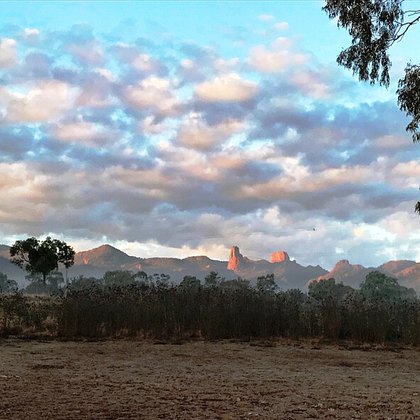
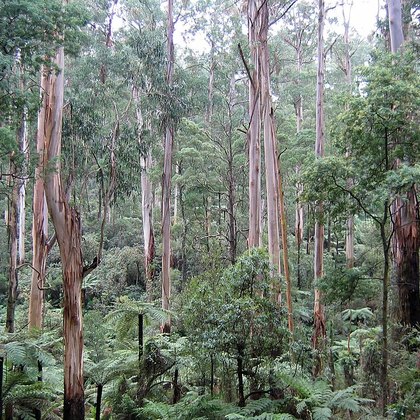
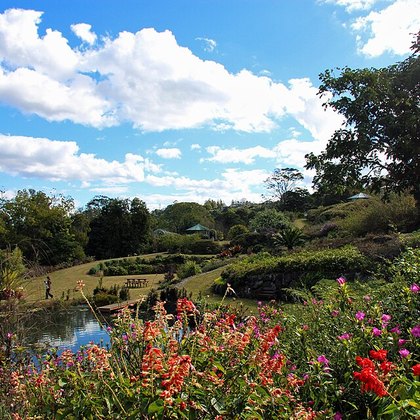
Dry and wet eucalypt forest, forest edge, riverine woodland and the margin of rainforest form the core; beyond that grain paddocks, orchards, grazing land with scattered trees, city parks, gardens and street trees. To breed it needs a deep hollow in an old thick eucalypt, usually high and often near water; such hollows are scarce and are reused year after year. It feeds largely on the ground, in flocks, with one or more birds always on watch in a tree above.
Where the bird is most often found, arranged by main group and formation.


Range and movements
Northern and eastern mainland Australia, from the Kimberley across the Top End and Cape York down the whole east coast to South Australia, and in Tasmania. A small released population holds on near Perth in the southwest. Outside Australia it occurs in New Guinea and the Aru Islands. In New Zealand it has been released and persists as an introduced bird on the North Island. It does not migrate; flocks move within a fixed area from roost to feeding ground and back, and in winter they come further into the towns.
- Resident
- dark = core range, pale = thinly spread
Where and when to look
Stand in the late afternoon by a river lined with old river red gums and wait for the flight to roost: the flocks come in noisily and the last birds settle only after sunset. To sex a bird you must get close and read the iris — red-brown in the female, near black in the male — and that is easiest on a bird chewing quietly on a branch. Do not feed them: cockatoos gathering at feeding tables pass psittacine beak and feather disease to one another.
Conservation
Least Concern (LC) and common over most of its range; in the settled east it has if anything increased. In some farming districts it counts as a pest for damage to grain, fruit and sown seed, and to the timberwork of buildings, and there it is shot or poisoned under permit, since it is a protected species. The real long-term limit is the supply of large old hollow-bearing trees, one of which goes with every tree felled or fallen and which take a century to replace.
Scientific name
Cacatua galerita | (Latham, 1790)
Latham described the species in 1790 as Psittacus galeritus; because it was later moved to another genus, author and year stand in parentheses. The genus Cacatua was introduced by Vieillot in 1817 and goes back to Malay kakatua, the name for these birds. galerita comes from Latin galeritus, 'hooded' or 'crested', from galerum, 'cap'. The described bird came from New South Wales. Of the four subspecies, galerita in the east and fitzroyi in the north belong to this region.