All species › Passerines › Bowerbirds › Spotted Catbird
Spotted Catbird | Ailuroedus maculosus
Gevlekte katvogel | Maullador manchado
The Spotted Catbird gives itself away with a sound that hardly seems to come from a bird: a drawn-out, wailing miaow rising out of the closed rainforest of north-east Queensland. Unlike nearly every other bowerbird it builds no bower and collects nothing — it lives in settled pairs that hold the same patch of forest for years.
Voice
The hallmark of the genus: a loud, nasal, sustained wailing miaow, nyaaaa-a-aa, like a cat or a crying child, carrying far through dense forest. The bird and the genus are both named for that call. Pairs call in duet, the two voices following each other so closely that they sound like one bird. Beyond that, clicking, rattling and creaking notes while foraging and a short sharp alarm. Song in the ordinary sense — a phrase with a melody — is absent.
Recording: Eddy Smith — CC BY-NC-SA 4.0 · Upper Barron, Tablelands Regional, Queensland, Australia · xeno-canto
Identification
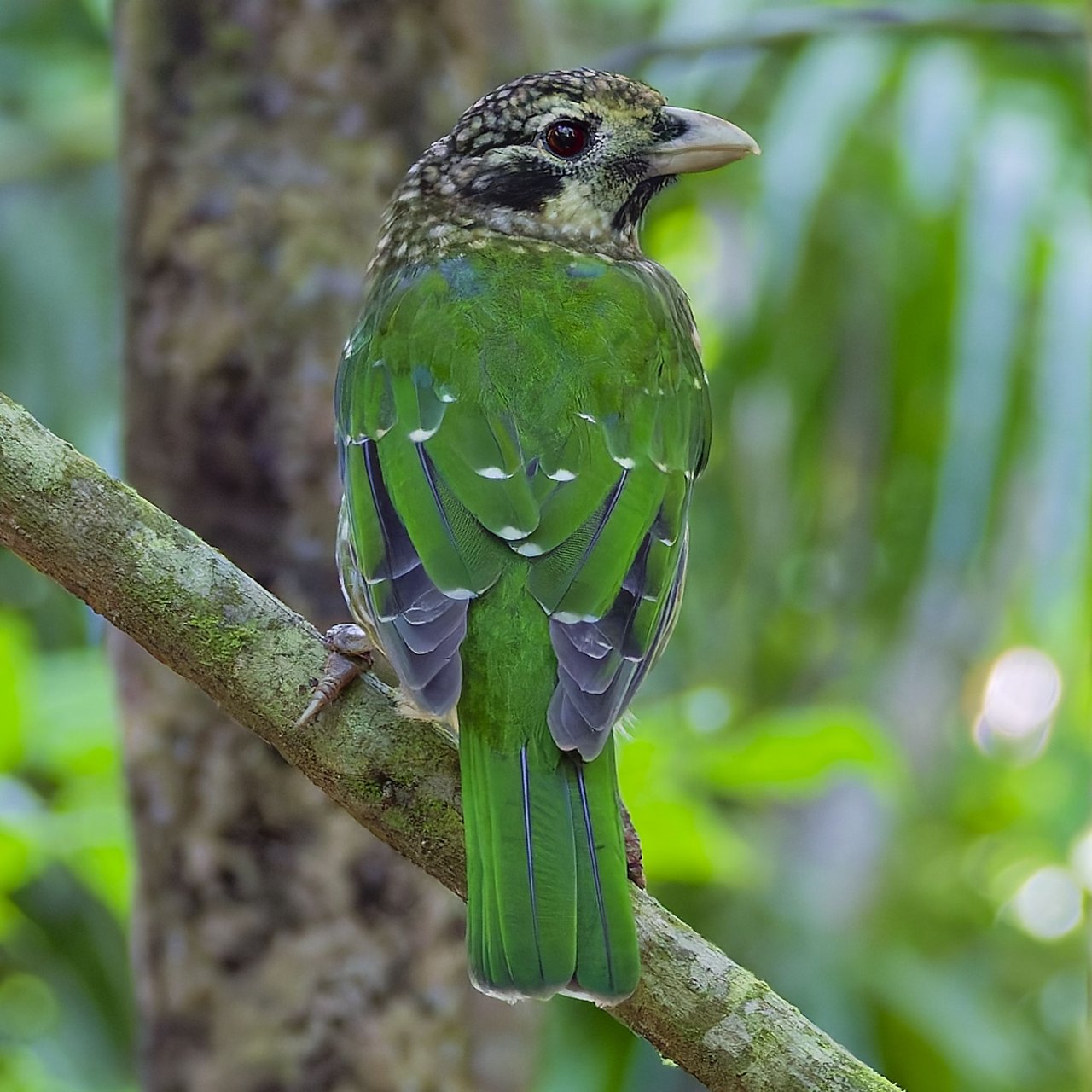
A stocky, heavily built bird of 26 to 30 centimetres, bright grass-green above, with a grey-brown crown finely flecked paler and a clear black patch across the ear-coverts. The underparts are green, closely set with large cream-white drop-shaped spots that grow larger towards the belly. The wing coverts carry small white tips and the tail is tipped white. The bill is short, thick and pale horn, the iris red-brown, the legs grey. The sexes look alike. Anyone searching for a structure searches in vain: catbirds build no bower and clear no court, but live monogamously in a fixed territory — the exact reverse of the other bowerbirds of the same forest.
Confusion species
The same rainforests hold the Tooth-billed Bowerbird (Scenopoeetes dentirostris), called a catbird in Dutch but not one: it is olive-brown rather than green and streaked rather than spotted below, and clears a court of upturned leaves on the forest floor. Northwards it is replaced by the Black-eared Catbird (Ailuroedus melanotis), smaller, with a darker and more sharply defined black ear patch and whiter, more contrasting spotting below; the two ranges do not overlap. Far to the south stands the Green Catbird (Ailuroedus crassirostris), with an evenly green head and no black ear patch. Green females and immatures of the Satin Bowerbird (Ptilonorhynchus violaceus) are scalloped below rather than spotted and have a violet-blue iris.
Habitat
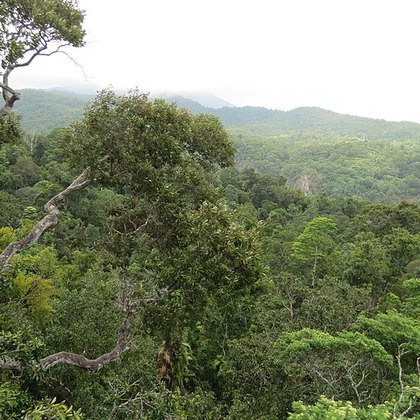
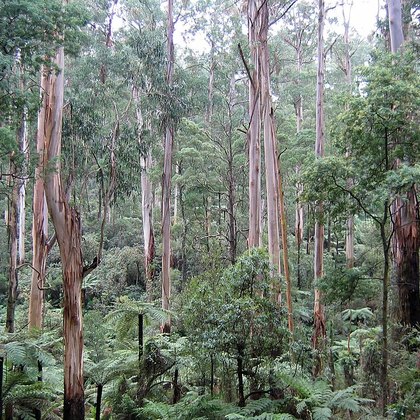
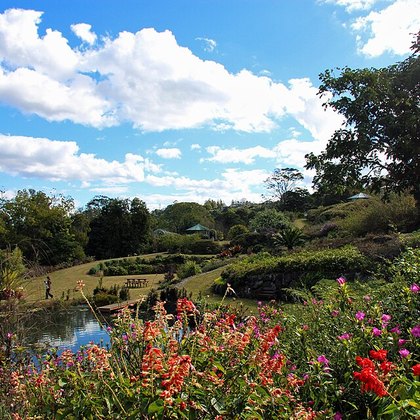
Tropical rainforest with a closed canopy, from sea level to above a thousand metres, and adjoining wet eucalypt forest with a rainforest understorey. Most numerous in the cooler upland forests of the Atherton Tableland. Where gardens and settlements abut the forest it comes into fruit trees and yards, but it always stays within calling distance of closed forest.
Where the bird is most often found, arranged by main group and formation.
Range and movements
The Wet Tropics of north-east Queensland: the narrow rainforest belt between Cooktown and Big Tableland in the north and Paluma and Mount Elliot south of Townsville. It occurs nowhere else. Sedentary in the strict sense: pairs hold the same territory all year and move at most up and down the slopes with the fruit supply.
- Resident
- dark = core range, pale = thinly spread
Where and when to look
Go by the wailing, because the bird is seldom seen: the green of the back all but disappears in the filtered light of the canopy. Walk a forest edge or a track with fruiting figs and stand still where the sound comes from; the bird usually hops in the middle storey and often comes closer when a second bird answers. Calling peaks early in the morning and after rain.
Conservation
The IUCN has not yet evaluated the species (NE), since the Red List has not yet weighed the split genus species by species; in the field the bird is common and locally numerous throughout its range. The vulnerability lies in the size of that range: a rainforest belt a few hundred kilometres long, largely protected as World Heritage, but whose cool upland forests are squeezed from below as the climate warms. For upland birds of the Wet Tropics that is the leading concern.
Scientific name
Ailuroedus maculosus | Ramsay, 1875
Ramsay described the species in 1875 as Aeluroedus maculosus, with Cardwell on Rockingham Bay in Queensland as type locality; author and year stand without parentheses, as the genus has since only been respelled. Ailuroedus is built from Greek ailouros, 'cat', and aoidos, 'singer' — so the wailing call sits in the scientific name too. maculosus is Latin for 'spotted', after the drop-shaped marks below, and the English and Dutch names translate it directly.