All species › Passerines › Bowerbirds › Spotted Bowerbird
Spotted Bowerbird | Chlamydera maculata
Grijsnekprieelvogel | Pergolero moteado oriental
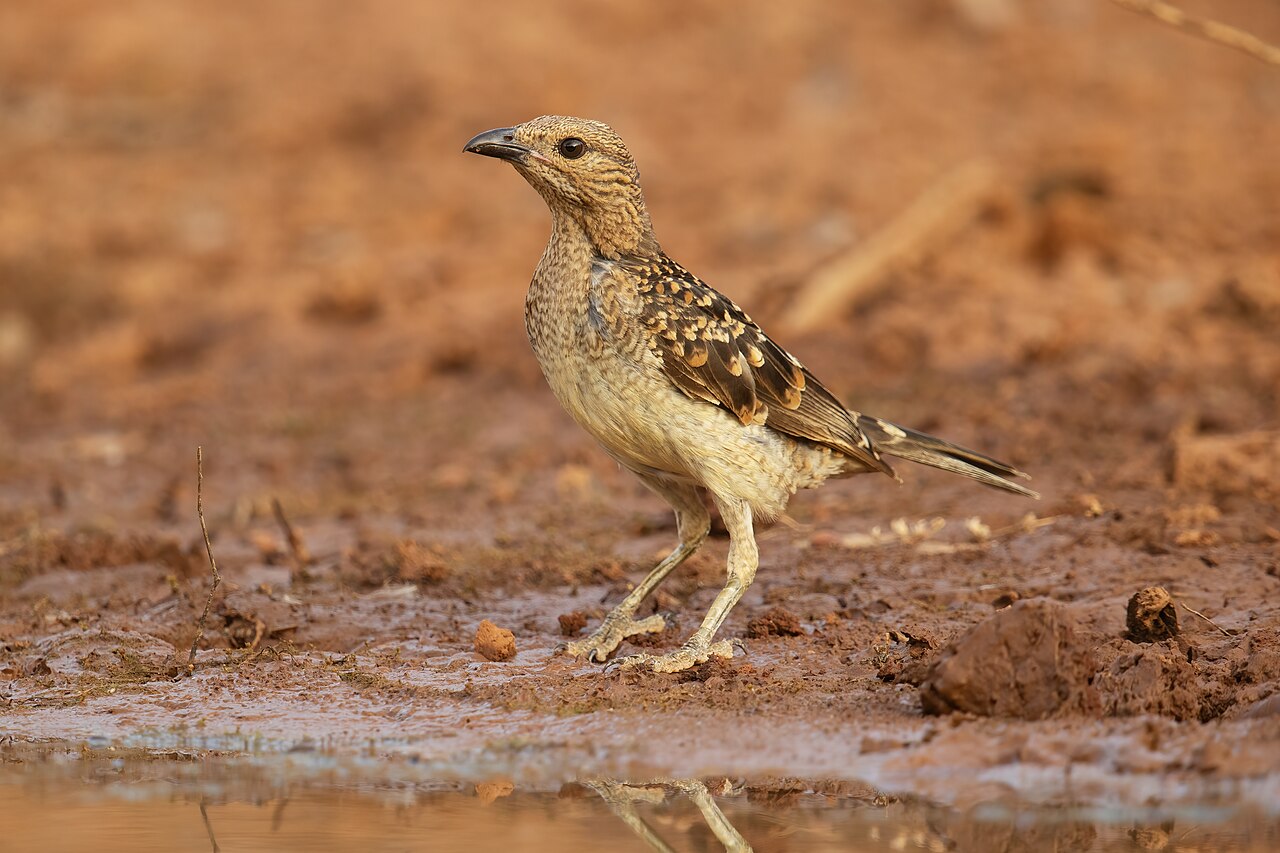
The Spotted Bowerbird is the bowerbird of the eastern interior: an unobtrusive, densely spotted bird that builds an avenue bower on the floor of dry woodland and crams it with bones, snail shells, green glass and scavenged metal. The structure draws more attention than the bird, and on the odd station it becomes a fixture known for years.
Voice
A hard, scraping repertoire of hisses, grating and rattling at the bower, laced with mimicry that ranks among the best in Australia: other bush birds, but also creaking gates, dogs, sheep and human voices at a distance. Many observers know the species by exactly that: a run of sounds that do not belong together, one after another, out of a single dense bush. The ordinary contact call is a short hoarse cherk.
Recording: Zebedee Muller — CC BY-NC-SA 4.0 · Weethalle, Bland Shire Council, New South Wales, Australia · xeno-canto
Identification
A grey-brown bird of 27 to 31 centimetres with a dense pattern of large buff to cream spots over mantle, scapulars and wing coverts, so that the upperside looks scalloped. The underparts are pale buff and almost unmarked. The crown is dark brown with pale flecks. On the nape lies a collar of lilac-pink elongated feathers, present in both sexes but larger in the male and fanned out in display; at rest it is hidden and the neck simply looks grey. The tail is long and square, the bill dark and stout.
Confusion species
The Western Bowerbird (Chlamydera guttata) is the closest relative: smaller, shorter-tailed, darker in ground colour, with smaller and more rufous spots and clearly vermiculated underparts. The two nowhere occur together, since a broad empty belt separates the eastern interior from the central ranges. The Great Bowerbird (Chlamydera nuchalis) is distinctly larger and longer-tailed, far plainer grey and all but unspotted; its range meets this one in central Queensland and there confusion is real. Young birds without a nape crest are the hardest and are then best judged on size and on the coarseness of the spotting.
Habitat
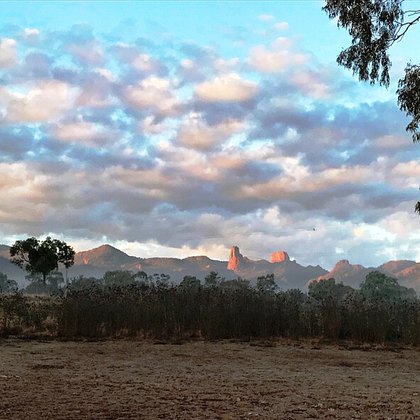
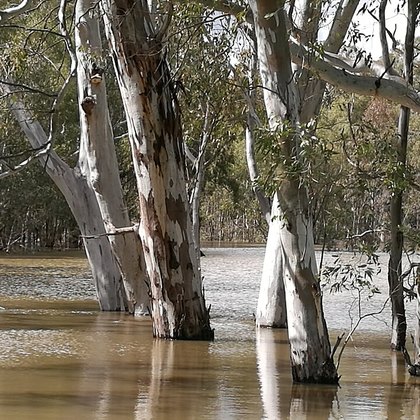
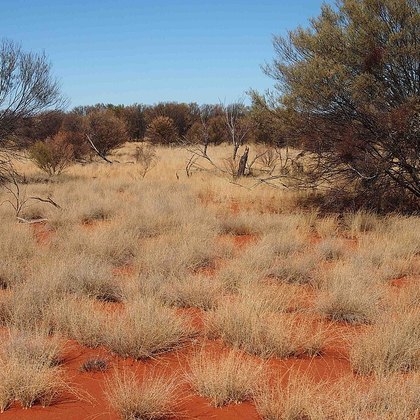
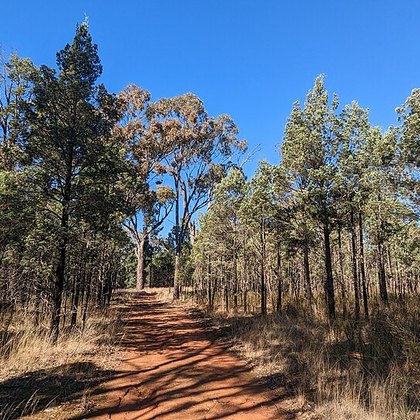
Dry eucalypt forest and open woodland of the interior, brigalow (dense acacia forest of inland Queensland), casuarina and cypress-pine woodland and the mulga (acacia scrub of the dry interior, dominated by Acacia aneura) edges, and above all the woodland along creeks, where water and shade come together. Bower sites lie in dense thickets, often in overgrown clumps around stations and at the edge of country towns, which is also where the bird gets its decorations: glass, bottle caps, nails and scraps of foil.
Where the bird is most often found, arranged by main group and formation.
Range and movements
The interior of eastern Australia, from northern Queensland through western New South Wales into northern Victoria. In the core of the range, the Queensland interior, it is common; southwards it has declined sharply and at the southern edge it has all but gone. Sedentary, with a fixed bower site that the male stays around all year.
- Resident
- dark = core range, pale = thinly spread
Where and when to look
Drive the creek woodlands of the interior and stop where the shrubbery is dense; search the ground for the bower and for the conspicuously pale, swept floor around it. Look at what is laid out: this species collects more bone and glass than green fruit. Seeing the lilac nape crest takes luck and patience, since it is raised only in display, usually shortly after sunrise in spring.
Conservation
Least Concern (LC) globally, but the picture within Australia differs sharply from region to region. In the south of the range the species collapsed during the twentieth century: in Victoria it is regarded as regionally extinct or nearly so, and in southern New South Wales it has become rare. The causes given are the loss of the shrub layer to grazing, the clearing of creek woodland, and persecution as a fruit thief in orchards. Keeping dense understorey along creeks is the key.
Scientific name
Chlamydera maculata | (Gould, 1837)
Gould described the species in 1837 as Calodera maculata, with the Liverpool Plains in New South Wales as type locality; because it was later placed in another genus, author and year stand in parentheses. Chlamydera comes from Greek chlamys, 'cloak', and dere, 'neck', after the nape collar; maculata is Latin for 'spotted', which the English name translates. The Dutch name instead picks the neck as its mark, while the western species is the one called 'spotted' in Dutch — a reversal worth knowing.