All species › Cranes, rails and allies › Rails, gallinules and coots › Spotless Crake
Spotless Crake | Zapornia tabuensis
Pacifisch porseleinhoen | Polluela de Tongatapu
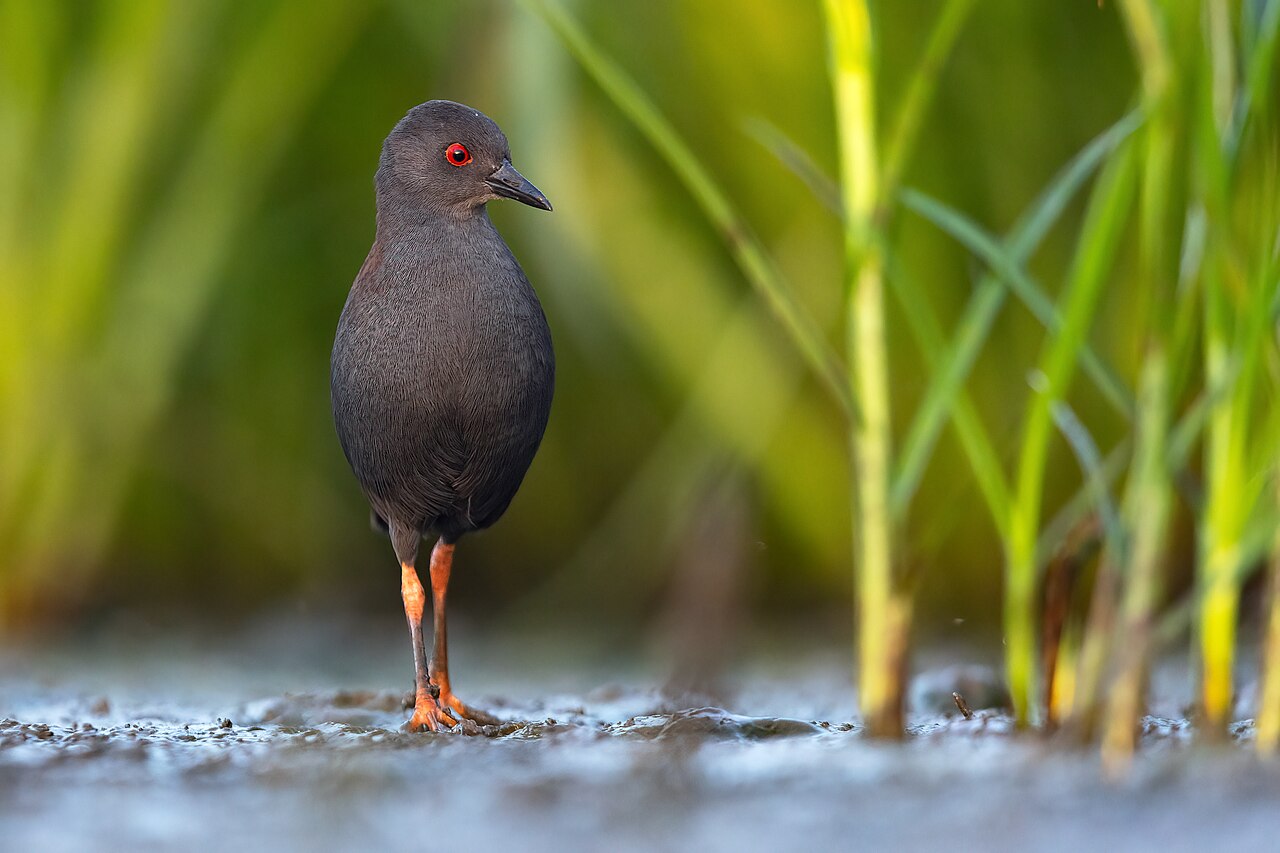
The Spotless Crake is a small, uniformly dark rail of dense reedbeds: slate-grey below without a single spot or streak, with a red-brown back, a jet-black bill, bright red eyes and orange-pink legs. It is one of the most widely spread birds of the Pacific and at the same time one of the least often seen species in this region.
Voice
The loudest and most characteristic call is a long, purring trill — prrrrrrr — of about twenty-five notes a second, which serves as the song and which makes survey work here almost entirely a matter of listening. With it go a sharp, high pit-pit, a repeated mook, and a bubbling, gurgling note. It calls mostly in the early morning and at last light.
Recording: Frank Antram — CC BY-NC-SA 4.0 · Bowral, Wingecarribee Shire Council, New South Wales, Australia · xeno-canto
Identification
A rail of seventeen to twenty centimetres. Head, neck and underparts are an even blue-grey to slate with no markings at all, the back is dark red-brown and the tail blackish-brown; only the undertail carries fine white barring. The bill is wholly black, the iris bright red, and the legs orange-pink — with a bird that passes only as a shadow, that leg colour is often the one thing that sticks. Young birds are duller and browner, with a pale chin and throat, dark legs and a brown-orange iris.
Confusion species
Baillon's Crake (Zapornia pusilla) is the close relative and the real trap: just as small, but warm brown above with white streaks and spots, black-and-white barred flanks, a short green bill and flesh-coloured legs instead of a black bill and red legs. On the Spotless Crake the underside is entirely plain; on Baillon's the flank is always barred. White-browed Crake (Poliolimnas cinereus) of the tropical north has a black mask with white brow and cheek stripes. Australian Crake (Porzana fluminea) is larger, olive-brown with white spotting and a red bill base.
Habitat
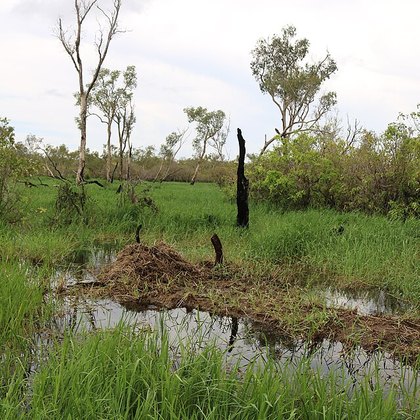
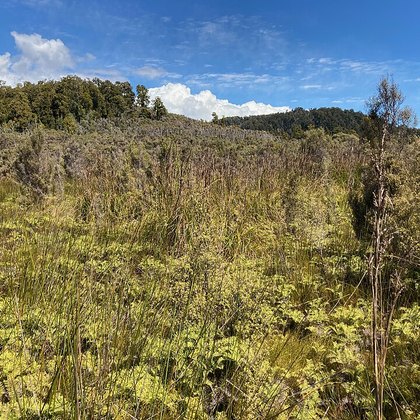
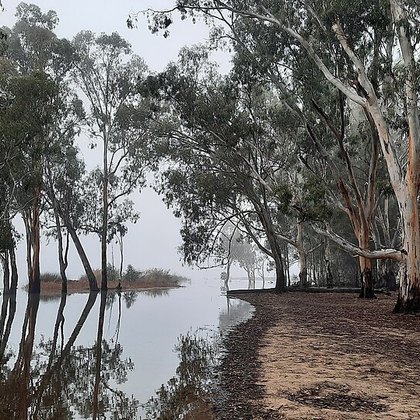
Freshwater wetland with dense standing vegetation: raupo bulrush, sedges, rushes, New Zealand flax and reed fringes along lakes, lagoons and slow creeks. On predator-free islands where little wetland exists it moves into dry forest and dense understorey and works the leaf litter on the forest floor. It forages in the dim space beneath the vegetation, seldom out in the open.
Where the bird is most often found, arranged by main group and formation.
Range and movements
In New Zealand it is widespread but patchy on the North Island and rare on the South Island, with Awarua-Waituna a known southern stronghold, plus island populations on Raoul in the Kermadecs, Great Barrier/Aotea, the Three Kings, the Poor Knights, Tiritiri Matangi and Motuora; there has been no confirmed Chatham Islands record since 1949. In Australia the range runs down the east coast from Brisbane through New South Wales to Victoria, across coastal Tasmania and the Murray system, with a second core in south-western Western Australia; elsewhere it is a wanderer. Beyond that the species spans the Pacific as far as the Marquesas and Pitcairn.
- Resident
- dark = core range, pale = thinly spread
Where and when to look
Find a raupo swamp with a firm edge or a boardwalk and sit down at sunrise. A short burst of the purring trill works: the bird often comes to it and then crosses an opening. Expect a silhouette rather than a view — then note what is missing, because a small dark crake with no streaking at all on flank or back is this species.
Conservation
Least Concern (LC) globally, thanks to the huge Pacific range. In New Zealand the picture differs: there it is ranked At Risk – Declining, because more than ninety per cent of lowland wetland has been drained and what reedbed is left is fragmented. Rats, cats, stoats and weasels take nests, and the water-level management of the remaining swamps decides whether dense raupo still stands. In Australia it is locally rare but not in danger.
Scientific name
Zapornia tabuensis | (Gmelin, 1789)
Gmelin described the species in 1789 as Rallus tabuensis; it now sits in Zapornia, so author and year stay in parentheses. The genus Zapornia was introduced by Leach in 1816 and is an anagram of Porzana. tabuensis refers to the type locality Tongatapu — Tongataboo in eighteenth-century spelling — and that island name lives on in the bird's Spanish name.