All species › Passerines › Fairywrens, grasswrens and emu-wrens › Splendid Fairywren
Splendid Fairywren | Malurus splendens
Prachtelfje | Maluro espléndido
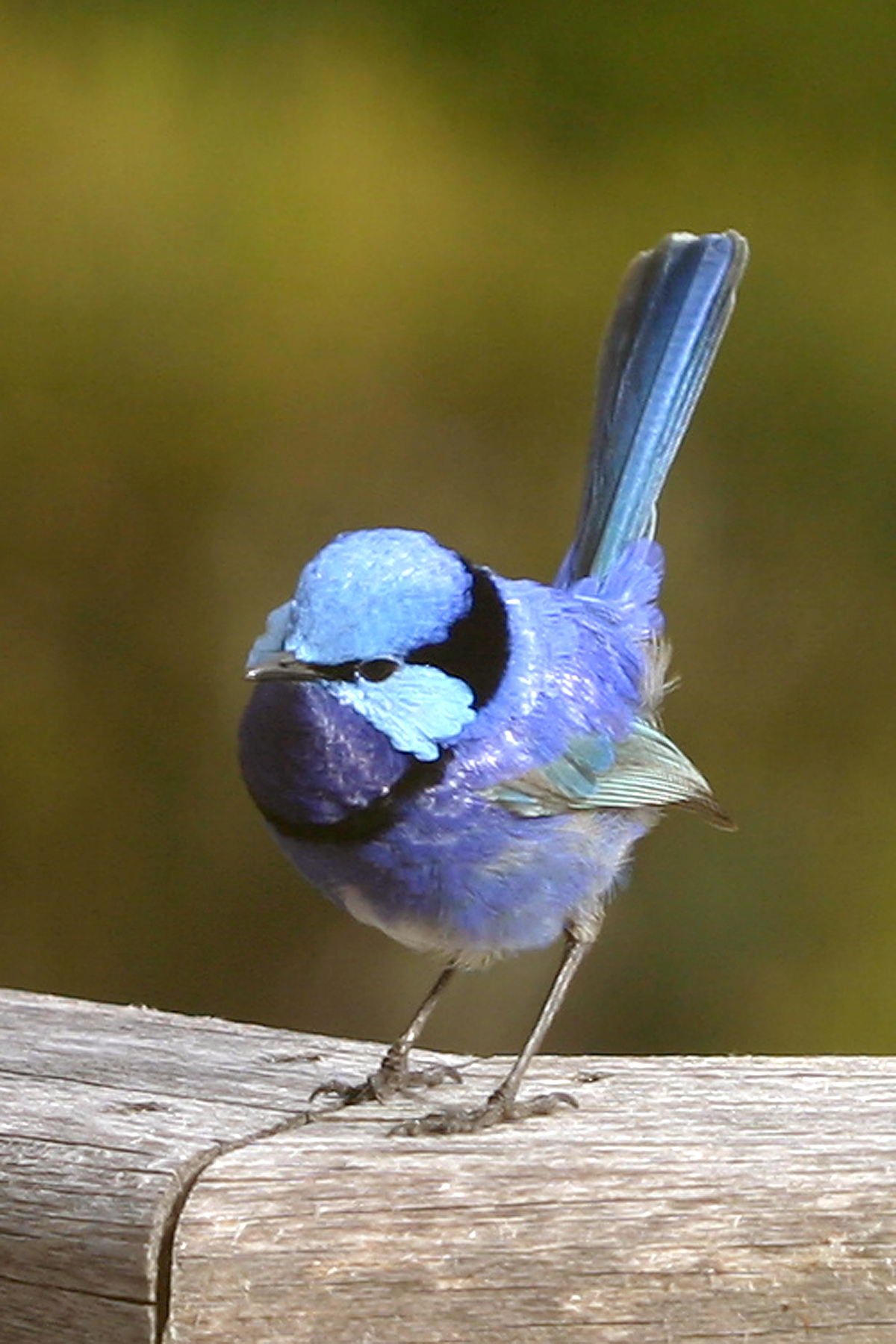
The Splendid Fairywren is the fairywren that is blue from head to tail: the breeding male has no brown or white below, only blue with black bands. It is the bird of the dry interior and the south-west, where in Australia it is simply called the blue wren.
Voice
A gushing, reeling trill, louder and harsher than that of the other fairywrens and varying from bird to bird. Within a foraging group a soft single trrt serves as the contact call, and a high tsit as the alarm. A brooding female purrs quietly on the nest, and intruders are met with a churring threat and a threat posture.
Recording: Greg McLachlan — CC BY-NC-SA 4.0 · Euabalong, Cobar Shire Council, New South Wales, Australia · xeno-canto
Identification
Twelve to fourteen centimetres, a good part of it tail. The breeding male is almost entirely blue: pale blue forehead and ear coverts, a violet throat and deeper blue on mantle, wing bend, breast and tail, with a black bill, a black eye band and a black breast band. Across the subspecies the blue shifts from cobalt in the east to violet-blue in the west, and the black bands are absent in the violet-blue birds. The eclipse male is brown with blue in the wings and tail; the female resembles him but has a chestnut bill and eye patch and lacks the blue in the wing.
Confusion species
The Superb Fairywren (Malurus cyaneus) is the closest relative but has a grey-white belly and a black nape band, and its blue is confined to crown, ear coverts and mantle; the ranges barely overlap, that being the bird of the south-east and Tasmania. The chestnut-shouldered fairywrens — Variegated Fairywren (Malurus lamberti), Purple-backed Fairywren (Malurus assimilis), Blue-breasted Fairywren (Malurus pulcherrimus) and Red-winged Fairywren (Malurus elegans) — all show a chestnut or red shoulder, which this species lacks entirely. In eclipse males the faint blue wash on the wing is what separates them from the other fairywrens; the female has a bluer tail than most.
Habitat
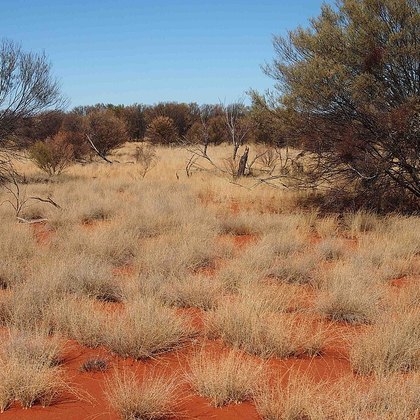
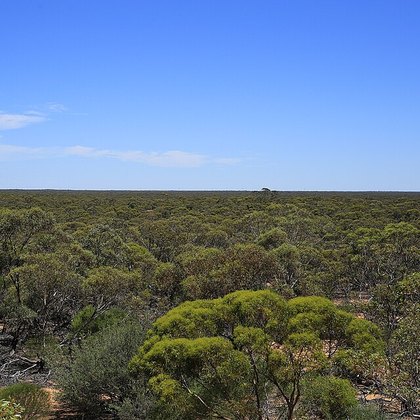
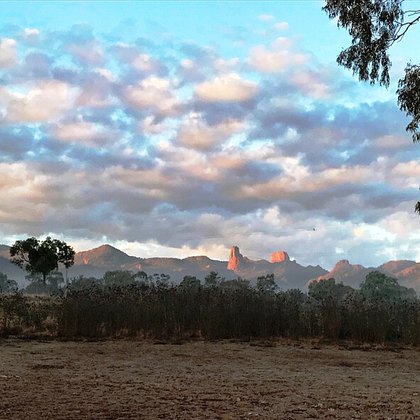
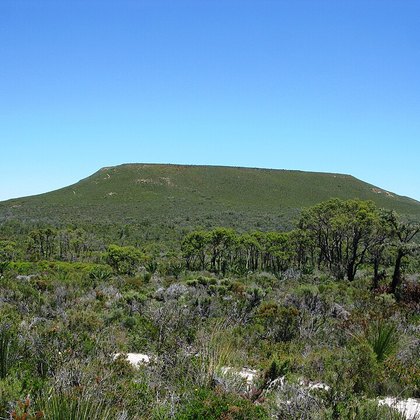
Arid to semi-arid country with a dense low layer: mulga (acacia scrub of the dry interior, dominated by Acacia aneura) and other acacia scrub, mallee (low, multi-stemmed eucalypt scrub of dry southern Australia) with a dense shrub storey and dry eucalypt woodland. In the far south-west it also occupies more wooded country and heath. Unlike the Superb Fairywren it has adapted poorly to settlement and has disappeared from some urbanised areas; pine and eucalypt plantations are unsuitable for want of undergrowth.
Where the bird is most often found, arranged by main group and formation.
Range and movements
Widely distributed through the arid and semi-arid interior in two blocks: one from about Shark Bay south through Western Australia and on through South Australia to the Flinders Ranges and across the southern and central Northern Territory; the other from the Flinders Ranges through the far north-west of Victoria and western New South Wales into south-central Queensland. Largely resident, holding territories of some four hectares year-round; in places it is semi-nomadic according to conditions, and young females disperse to other territories.
- Resident
- dark = core range, pale = thinly spread
Where and when to look
Work along dense, often thorny clumps of acacia or hakea — that is where the nest hangs and where the group forages. In display the male performs the sea horse flight, an exaggerated undulating flight in which, neck extended and head feathers raised, he descends slowly, and the face fan, in which the blue ear tufts are flared wide. Displaying males carry pink or purple petals in the bill.
Conservation
Least Concern (LC), but the shrub layer decides everything: clearing is the greatest pressure, and cats and foxes take birds out of low cover. They are not strong fliers and are often struck by vehicles when crossing roads.
Scientific name
Malurus splendens | (Quoy & Gaimard, 1832)
The French naval naturalists Jean René Constant Quoy and Joseph Paul Gaimard described the bird from material collected at King George Sound in the south-west, as Saxicola splendens, in the report of the voyage of the Astrolabe; because the species later moved to another genus, authors and year stand in parentheses. Three years on Gould still gave it the name Malurus pectoralis, but the older name had priority. splendens is Latin for shining.