All species › Waders, gulls and terns › Jaegers and skuas › South Polar Skua
South Polar Skua | Stercorarius maccormicki
Zuidpooljager | Escúa polar
The South Polar Skua is the skua of the Antarctic continent itself: a stocky, gull-like bird with a short black hooked bill and a conspicuous white flash in the hand of each wing, which breeds beside Adelie Penguin colonies and afterwards crosses half a hemisphere. In Australian and New Zealand waters it is a vagrant — the birds that pass here are usually on their way to or from the North Pacific. No other bird species is recorded across so wide a span of latitude: from the South Pole to Greenland, Japan and British Columbia.
Voice
In this region you will almost never hear it, because it is here only at sea and there it is silent. On the breeding grounds the repertoire matches that of the Brown Skua but higher and shriller: a raw descending long-call that sounds 'cracked' by comparison, given with both wings held straight up. Anxiety on the ground produces a quacking note, and anyone approaching a nest gets a piercing scream during the stoop.
Recording: steve — CC BY-SA 4.0 · Cuverville Island, Antarctica · xeno-canto
Identification
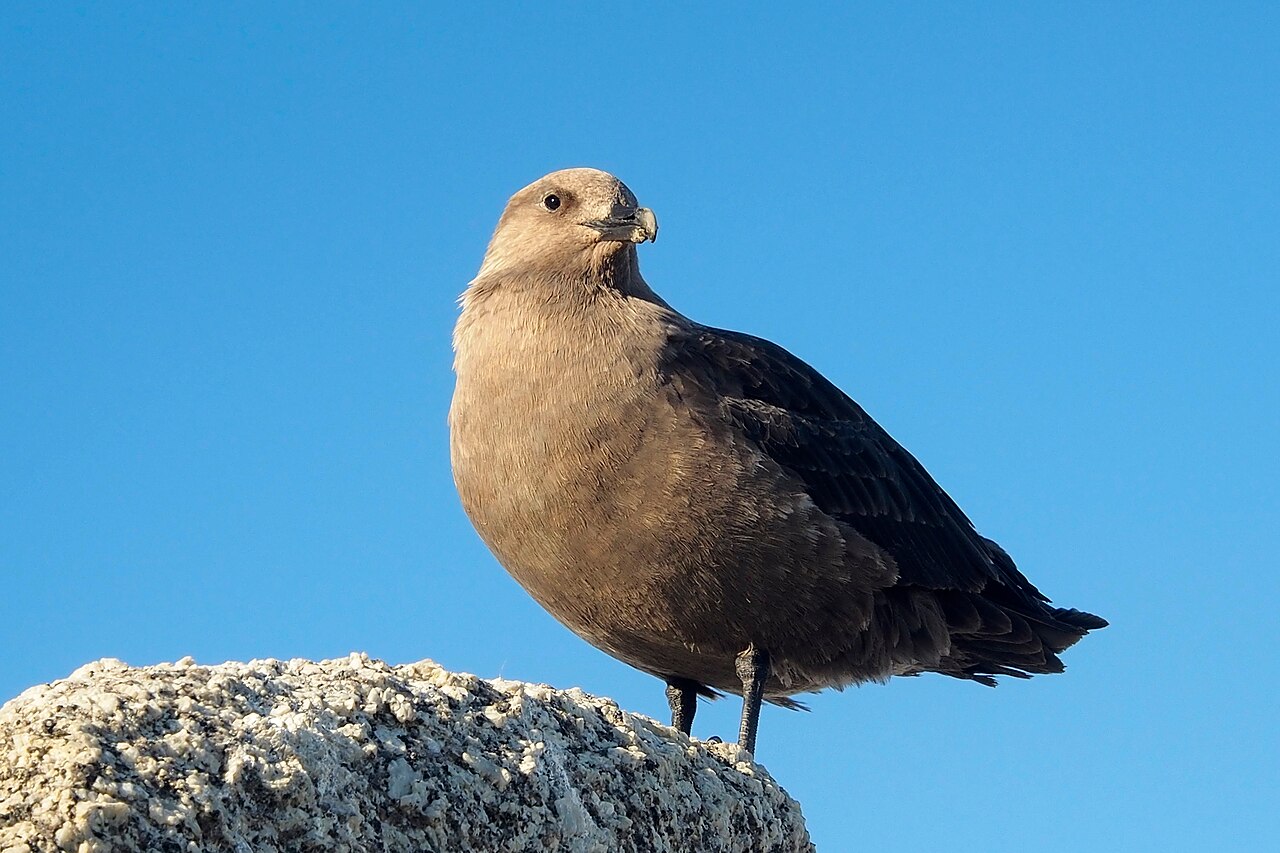
A stocky, medium-large skua of a little over half a metre and some one and a half kilos, with a short blunt black hooked bill, black legs and eyes, and broad pointed wings carrying a large white primary patch above and below. The tail is short and wedge-shaped. Three morphs occur — a pale one with honey and straw tones on the body, a chocolate-brown dark one and a grey-brown intermediate — but the best mark is on the pale birds: the sharp contrast between a light head and body and dark, almost black wings, which holds at range. Pale birds often show a yellowish nape patch. Stocky build, short bill and the white wing flash are the fixed characters; the morph is not.
Confusion species
Brown Skua (Stercorarius antarcticus) is the species it is repeatedly confused with in these waters: larger, heavier, with a longer and thicker bill, broader across the chest and without the head-to-wing contrast of a pale South Polar. Dark South Polar Skuas do lack that contrast, and then only size and bill weight remain; on the Antarctic Peninsula the two also hybridise, so not every bird can be named. Pomarine Jaeger (S. pomarinus) comes closest in size but is far more lightly built, with narrower wings, a smaller bill and, in the adult, twisted spoon-shaped tail feathers. Parasitic Jaeger (S. parasiticus) and Long-tailed Jaeger (S. longicaudus) are falcon-like and tern-like respectively and fall outside this size class. A young Kelp Gull (Larus dominicanus) lacks the white wing flash.
Habitat
It breeds on ice-free coastal strips of the Antarctic continent and the islands off it: gravel, bare rock and moraine terraces, usually within sight of an Adelie Penguin colony or of petrel breeding ground. Birds without a territory gather in loose clubs at meltwater pools and on small beaches. Outside the breeding season — the only condition in which it occurs in this map window — it lives entirely at sea without coming ashore: open ocean, the shelf break and cold subantarctic water.
Where the bird is most often found, arranged by main group and formation.
Range and movements
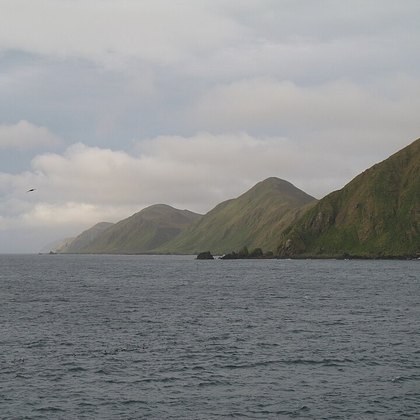
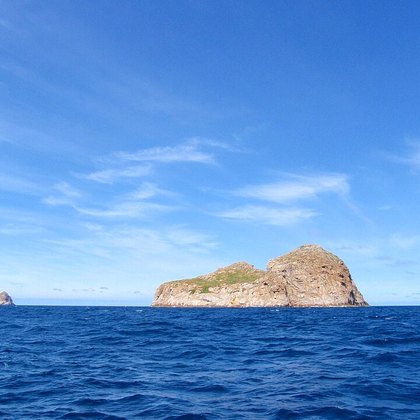
Within the map window it is a vagrant, with a few dozen accepted records, in most years in Australian waters and less often in New Zealand waters. Most sightings come from pelagic trips over the shelf break off southeastern Australia, from the Tasman Sea and from the water south and east of New Zealand. The background is migration: tracking data show that after the Antarctic breeding season the birds cross the equator in a loop shaped like a slip-knot, and that those wintering in the North Pacific come back past New Zealand. There are no records from Norfolk.
- Passage
- dark = core range, pale = thinly spread
Where and when to look
Do not count on seeing it from land: almost all records come from pelagic trips beyond the shelf break, and the best months are late spring and autumn, when migration is running. If a large dark skua turns up at the boat, measure it at once against a Kelp Gull or a Black-browed Albatross in the same view, because without that yardstick the difference from Brown Skua cannot be made. Photograph the head and bill above all, and the join of body to wing: that is where everything that can still carry an identification afterwards is found.
Conservation
Least Concern (LC). The world population is put at some tens of thousands of birds and is broadly stable; the species breeds in a region with virtually no introduced predators, an advantage most seabirds of this hemisphere lack. Where the pressure points lie, they lie indirectly: in the breeding season the South Polar Skua lives largely off Adelie Penguins and krill-eating seabirds, so changes in sea ice and in the krill fishery reach it through the food web in time. Disturbance of breeding sites around research stations is a second point of attention.
Scientific name
Stercorarius maccormicki | Saunders, 1893
Howard Saunders described the species in 1893 in the Bulletin of the British Ornithologists' Club, directly in the genus Stercorarius, so author and year carry no parentheses. The epithet maccormicki honours Robert McCormick, ship's surgeon and naturalist aboard the Erebus during James Clark Ross's Antarctic expedition, who collected the type material. The type locality is Possession Island off Victoria Land, at 71 degrees 14 minutes south and 171 degrees 15 minutes east — one of very few bird species with a type locality deep inside the Antarctic Circle. Stercorarius itself was introduced by Brisson in 1760, after Latin stercus, 'dung'.