All species › Tubenoses › Albatrosses › Sooty Albatross
Sooty Albatross | Phoebetria fusca
Zwarte albatros | Albatros ahumado
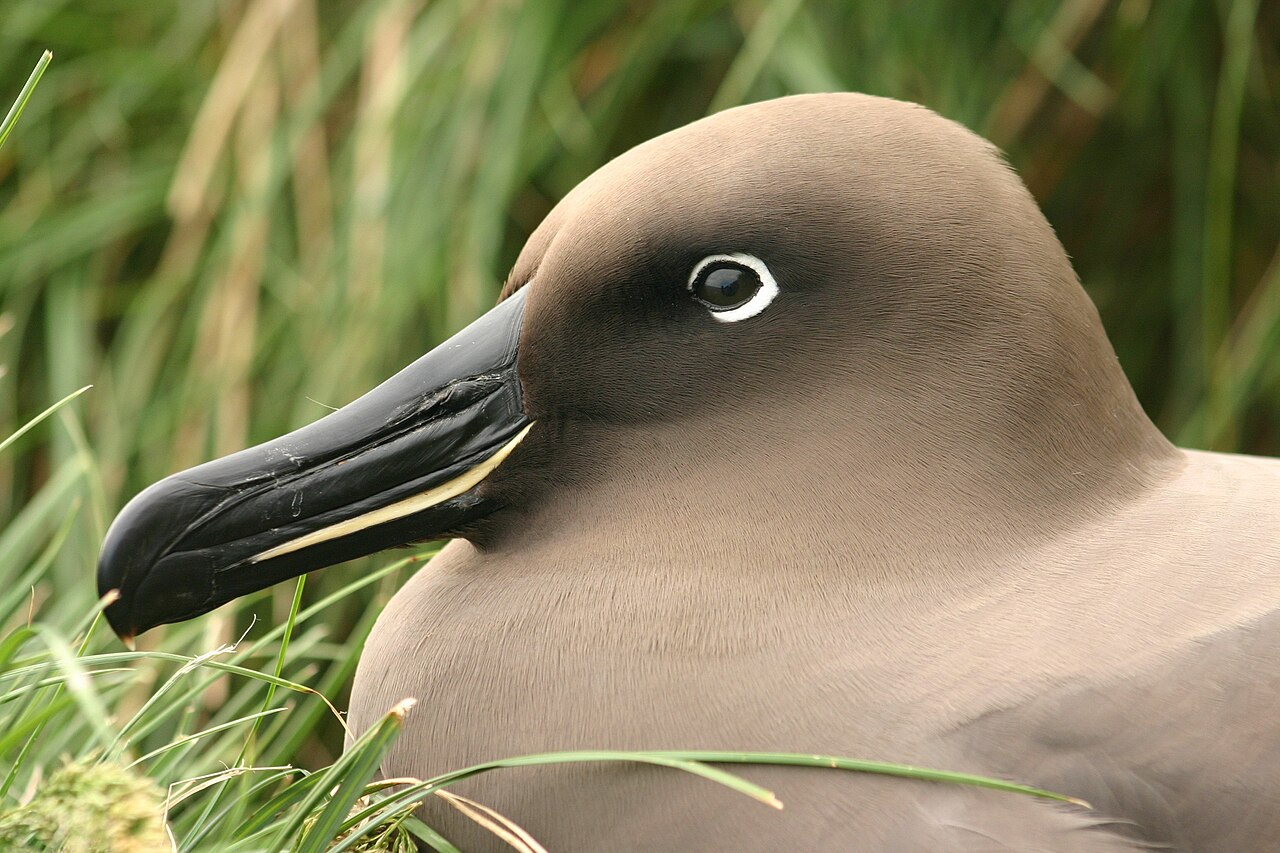
The Sooty Albatross is the darkest albatross of all: evenly chocolate brown from head to tail, with narrow pointed wings, a long wedge-shaped tail and a thin white crescent above and behind the eye. It belongs to the Atlantic and Indian Oceans and is the rarest albatross in this guide's region.
Voice
At sea it is entirely silent. At the colonies on the cliffs of Gough and Tristan da Cunha the display call is a two-note pee-oo, the so-called sky call, which observers describe as cutting through the heaviest pounding of the surf. There are braying threat calls and bill snapping at the nest.
No recording with a suitable Creative Commons licence has been found for this species yet; what to listen for is described below.
Identification
81 to 89 cm long, span around two metres, averaging some 2.5 kg. The plumage is evenly dark sooty brown over the whole body, at most slightly darker on the head than on back and belly; nowhere is there a pale panel. A white crescent sits above and behind the eye. The bill is black with a cream to orange-yellow stripe along the lower mandible. Wings narrow and pointed, tail long and wedge-shaped; flight is light and banking, with little flapping.
Confusion species
Light-mantled Albatross (Phoebetria palpebrata) is the only real confusion, and the difference is one mark wide. It has a pale ash-grey mantle, back and underparts that stand out clearly against the dark head, and the stripe on the lower mandible is pale blue rather than cream or orange-yellow. In good light the mantle contrast shows at range, but against the sun or on a bird passing briefly it disappears — and then the colour of the bill stripe is the only hard mark, which calls for a photograph. Distribution weighs heavily here: in Australian and New Zealand waters Light-mantled is the expected species and this one a rarity, so a dark Phoebetria should be called a Sooty only once the bill stripe or the even upperparts are settled. Giant petrels (Macronectes) are heavier, with a thick pale bill and a short tail; young Snowy Albatross (Diomedea exulans) and Antipodean Albatross (Diomedea antipodensis) are brown too but far larger, with a white face, white underwing and pink bill.
Habitat
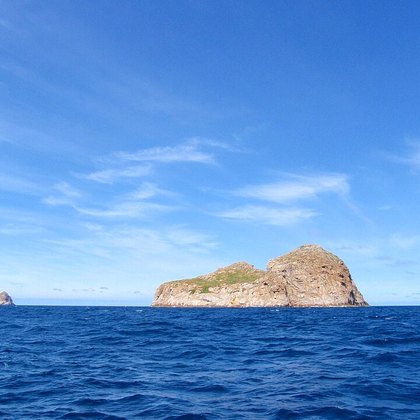
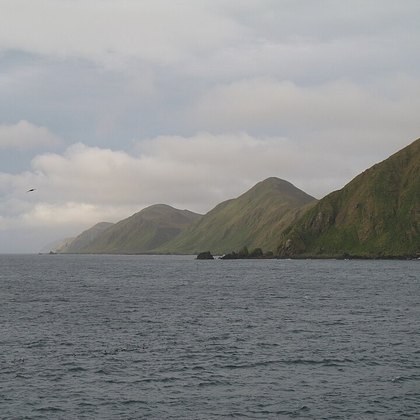
Warm-temperate to subantarctic ocean, mainly between about 20 and 65 degrees south. It breeds on narrow ledges of steep sea cliffs and in grassy gullies, where a single nest or a loose group of nests hangs above the surf.
Where the bird is most often found, arranged by main group and formation.
Range and movements
Within this map window it breeds nowhere: the colonies are on Gough and Tristan da Cunha in the Atlantic and on Prince Edward, Marion, the Crozet Islands, Amsterdam, Saint Paul and Kerguelen in the Indian Ocean. In Australian waters it is a rare visitor, most likely off the south-west and the south coast, where the Indian Ocean range abuts. In New Zealand it is a vagrant with four accepted records: north of the Auckland Islands in 1991, over the Pukaki Rise in 1993, at Antipodes Island in 1995 and off the Chathams in 2006.
- Winter
- dark = core range, pale = thinly spread
Where and when to look
Do not count on it here: this is the bird that makes a deep-water trip unforgettable, not the bird you book for. If you do meet a dark Phoebetria, keep shooting until the side of the bill is sharp — cream to orange-yellow names this species, pale blue the Light-mantled. Check as well whether the back is the same colour as the head: in this species it is, in Light-mantled it is not.
Conservation
Endangered (EN), with 11,000 to 14,000 breeding pairs left and a decline of about 75 per cent over ninety years; at some colonies the rate runs to seven per cent a year. Longline bycatch is the leading cause. Beyond that count introduced house mice on Gough that eat into chicks, predation by giant petrels, and plastic passed to chicks with the food. Because a pair rears at most one chick every two years, every loss works through for a long time.
Scientific name
Phoebetria fusca | (Hilsenberg, 1822)
Hilsenberg described the species in 1822 as Diomedea fusca; because it now sits in Phoebetria, author and year go in parentheses. fusca is Latin for 'dark' or 'dusky' and simply describes the plumage. The type locality is the Mozambique Channel, where Hilsenberg was sailing on his way to Madagascar. The genus Phoebetria was introduced by Reichenbach in 1853, from the Greek phoibētria, 'prophetess'.