All species › Passerines › Thornbills, scrubwrens, gerygones and allies › Scrubtit
Scrubtit | Acanthornis magna
Tasmaanse struiksluiper | Sedosito tasmano
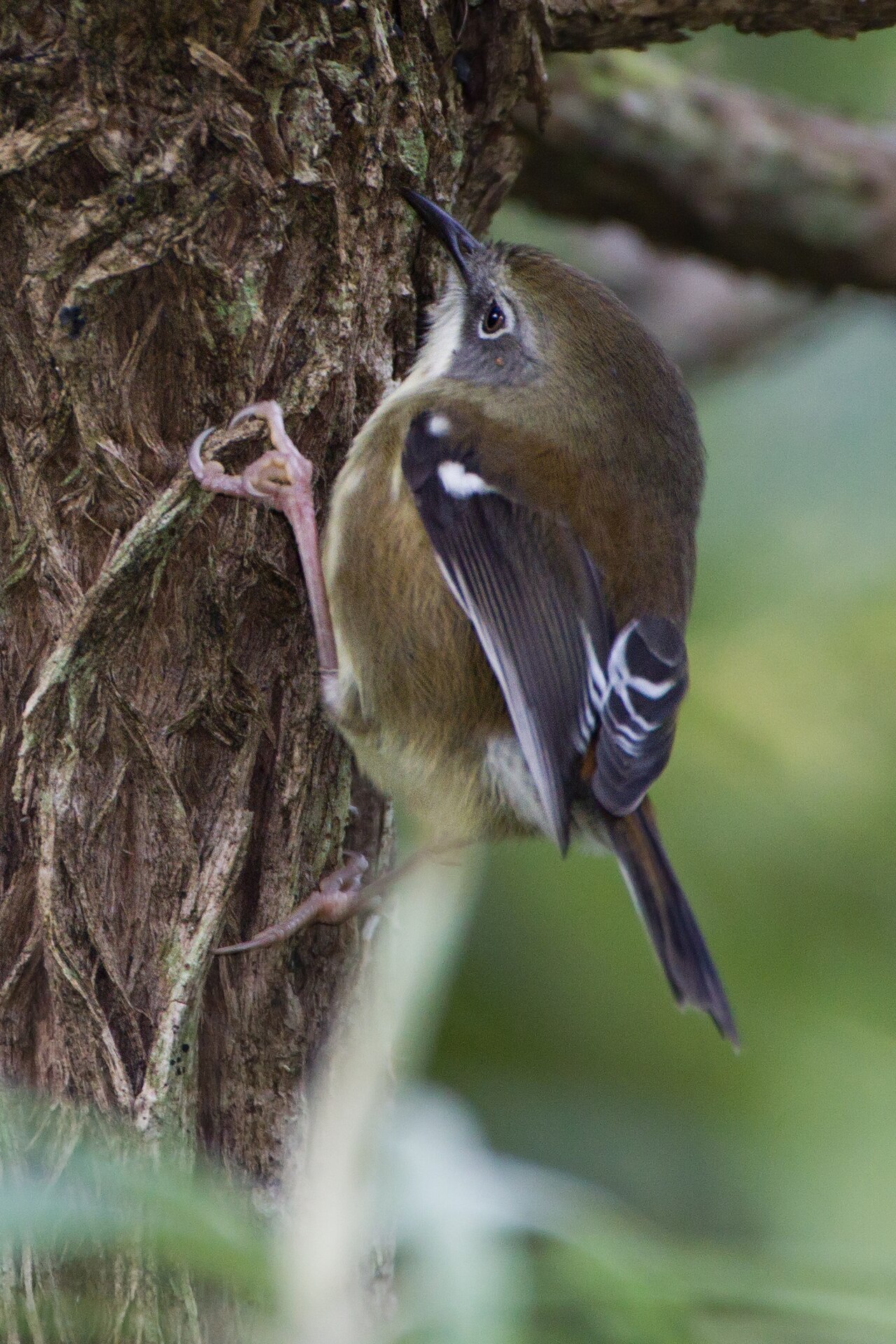
The Scrubtit is the only species in the genus Acanthornis and lives on Tasmania and King Island alone. It is a bird of eleven to twelve centimetres that works its way mouse-like along mossy trunks and fallen timber, showing a white throat, a pale eye and small white spots on the folded wing.
Voice
Mostly quiet, which is exactly why it is seldom noticed. The contact call is loud and clear; the song is sweet and musical but sparingly given. In the hushed, dripping rainforest that contact note carries well, and it is often the only thing that betrays a pair.
Recording: Erin Harris — CC BY-NC 4.0 · Pegarah, King Island Council, Tasmania, Australia · xeno-canto
Identification
Eleven to twelve centimetres, about ten grams. Brown on crown, back, flanks and tail, with a sharply demarcated white throat and white belly; that contrast is the best mark. The dark wing carries small white spots, the face is greyish, and the eye is strikingly pale. The bill is short, black and slightly decurved. Sexes are alike.
Confusion species
Tasmanian Scrubwren (Sericornis humilis) shares the forest and is about the same size, but lacks the sharply cut white throat and belly and has no white wing spots. Tasmanian Thornbill (Acanthiza ewingii) is smaller and finer, olive-brown without the white throat contrast, and shows a rufous wing panel instead of white spots; Brown Thornbill (A. pusilla) on Tasmania likewise lacks the white throat contrast and has a dark red eye. The pale eye together with the white throat rules out all three.
Habitat
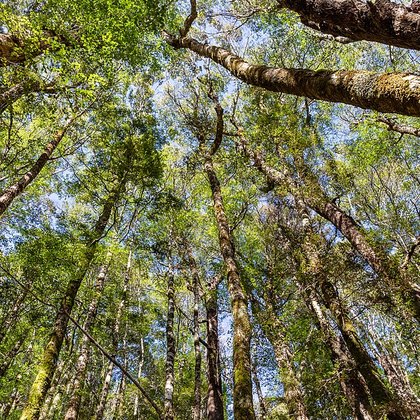
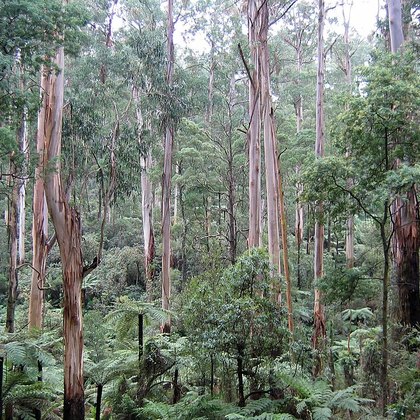
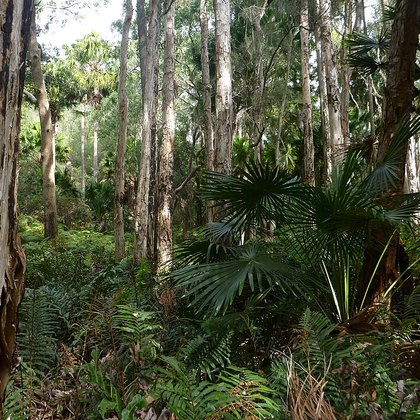
Temperate rainforest, southern beech forest with mossy trunks, and wet eucalypt forest with a dense fern understorey. On King Island the bird holds on chiefly in tall swamp paperbark forest, a habitat that has almost entirely gone from that island. It forages low, often within a few metres of the ground, on bark, fallen logs and in the litter.
Where the bird is most often found, arranged by main group and formation.
Range and movements
Endemic to Tasmania and King Island, and nowhere else. Two subspecies: the nominate form on Tasmania and A. m. greeniana on King Island, which is smaller and paler. On Tasmania the species is widespread in wet forest and not rare, though its quiet manner means it is seldom noticed.
- Resident
- dark = core range, pale = thinly spread
Where and when to look
Stand by a fallen, mossy log in temperate rainforest and wait. This bird walks more than it flies, working along the undersides of trunks and branches, and that creeping manner gives it away before any colour does. Then look for the pale eye and the white throat, and check the small white spots on the wing.
Conservation
The species as a whole is Least Concern (LC) and widespread on Tasmania. The King Island subspecies is anything but: about fifty birds remain in three isolated subpopulations, it is listed as Critically Endangered under both Australian law and Red List criteria, and it ranks among the Australian birds closest to extinction. Loss and fragmentation of the swamp forest, inbreeding, cats, rats and climate-driven bushfires are the causes.
Scientific name
Acanthornis magna | (Gould, 1855)
John Gould described the bird in 1855 as Acanthiza magna; the type locality is Tasmania. Because the species later moved to a genus of its own, author and year stand in parentheses. The genus Acanthornis is built from Greek akantha, 'thorn', and ornis, 'bird'. Latin magnus means 'large': not large in general, but large for a thornbill, which is where the species was first placed.