All species › Penguins › Penguins › Royal Penguin
Royal Penguin | Eudyptes schlegeli
Schlegels pinguïn | Pingüino real
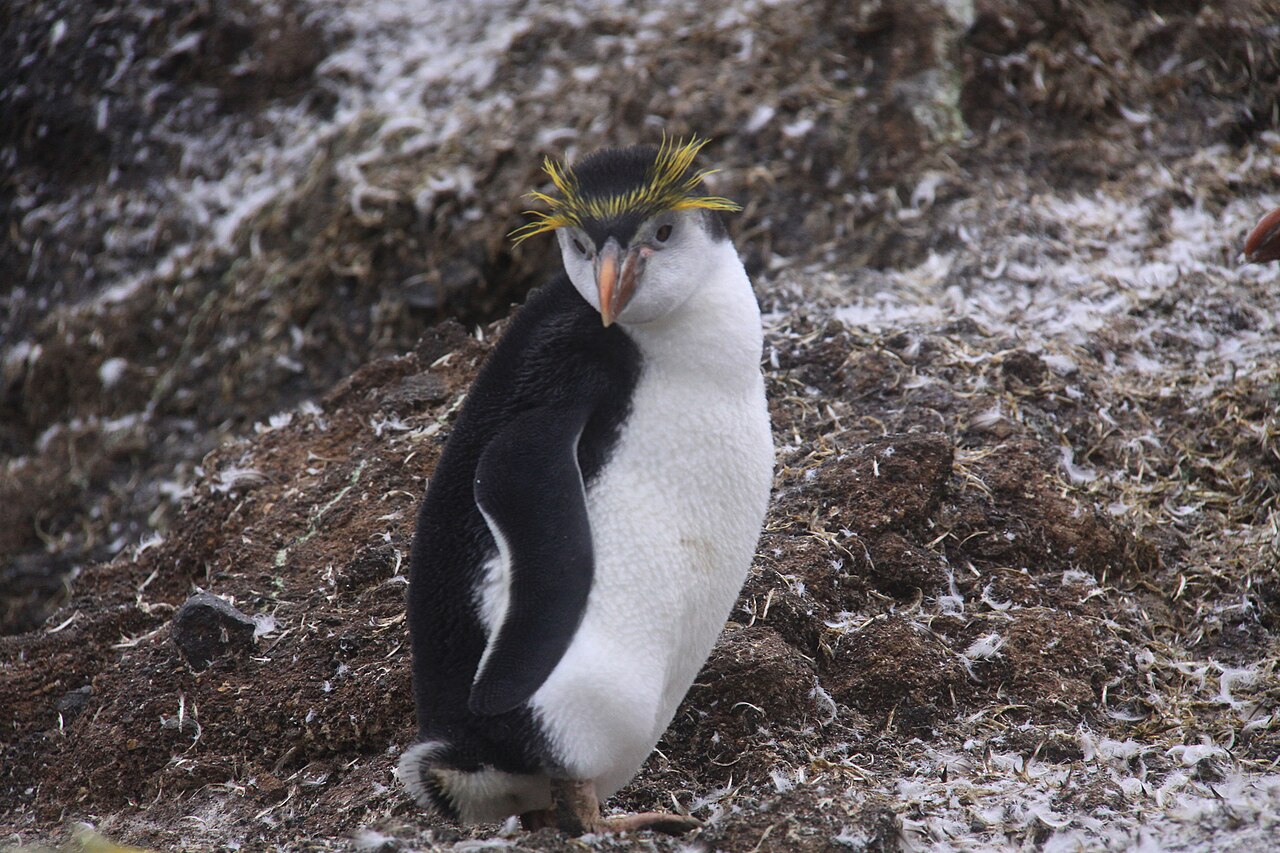
The Royal Penguin is the largest of the crested penguins and breeds only on Macquarie Island, where the colonies run far up the valleys. One character separates it from all its relatives: the face and chin are white to pale grey instead of black, so that the huge orange bill and the orange-yellow crests sit on a pale ground.
Voice
At the colony comes a deep throbbing bray or trumpet that the pair performs in duet with heads raised and flippers spread, carrying across the whole valley floor — a colony of tens of thousands can be heard kilometres away. As a contact call birds give a short bark at sea and on landing. Chicks beg with a shrill, persistent piping.
Recording: Sander Lagerveld — CC BY-NC-SA 4.0 · Sandy Bay, Macquarie Island, Australia · xeno-canto
Identification
The largest of the crested penguins, sixty-five to seventy-five centimetres and four to eight kilograms, blue-black above and silky white below. The face, cheek and chin are white to pale grey, which separates it from every other crested penguin in this area. From the forehead run long, slender orange-yellow crest plumes that meet in the middle of the forehead and droop out and back. The bill is heavy and orange with conspicuous pink bare skin at the base. Young birds have a much shorter crest, a darker bill and a less clean white face.
Confusion species
Macaroni Penguin (Eudyptes chrysolophus) is the only true confusion species and differs in exactly one character: a black face and black chin. The two interbreed on Macquarie Island, so birds with an intermediate, grey-mottled face occur there; with such a bird the identification cannot be closed with certainty, and that may be said plainly. Of the crested penguins breeding within this map window this is the largest: Snares Penguin (Eudyptes robustus), Erect-crested Penguin (Eudyptes sclateri) and Fiordland Penguin (Eudyptes pachyrhynchus) all have a black face and a shorter crest, and Eastern Rockhopper Penguin (Eudyptes filholi), which breeds alongside it on Macquarie, is not half the weight and has a thin parallel-sided yellow stripe. In Spanish, pingüino real (this species) and pingüino rey (King Penguin, Aptenodytes patagonicus) lie close together; the King Penguin is far larger at nearly a metre, has no crest and carries orange ear patches.
Habitat
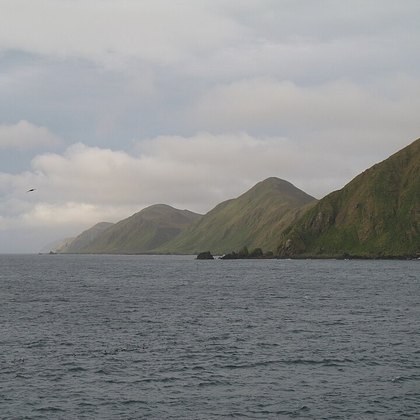
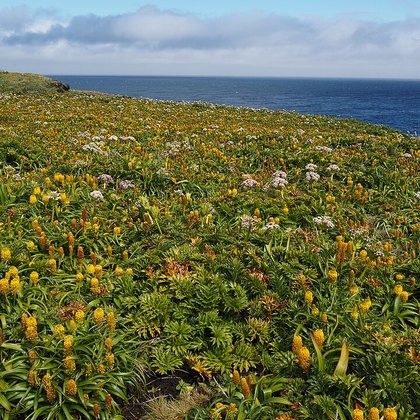
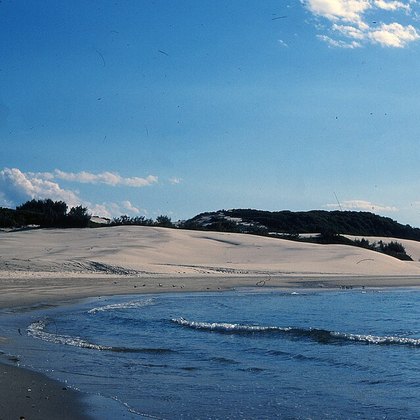
Subantarctic sea around the island, where the birds dive for krill, lanternfish and squid and in the breeding season forage hundreds of kilometres out. The colonies lie on the beach flats and in the creek valleys of Macquarie, often running a good way up the valley from the tideline and high onto the slopes; the nest is a shallow scrape among stones and poa tussock (grassland of loose, tall clump-forming grasses, especially in New Zealand). So many birds gather that the ground is trampled bare.
Where the bird is most often found, arranged by main group and formation.
Range and movements
Macquarie Island and the nearby Bishop and Clerk islets only — so the entire world population falls within this map window, on Australian territory administered from Tasmania. Outside the breeding season the birds range far across the southern ocean. In New Zealand it is a vagrant, with records from the subantarctic islands and Otago as far north as Napier, and a moulting bird turns up now and then on Tasmanian and southern Australian beaches too.
- Breeding (summer)
- dark = core range, pale = thinly spread
Where and when to look
The fixed address is the flat at Sandy Bay on Macquarie Island, where a boardwalk runs past the colony and where it can be seen alongside Gentoo and King Penguins; subantarctic voyages call at the island between November and February. With a penguin on a beach elsewhere there is one question: is the face white or black? White makes it this species, black makes it another crested penguin or a Macaroni.
Conservation
Least Concern (LC), today with something of the order of eight hundred and fifty thousand breeding pairs. That is a recovery: between 1870 and 1919 an average of a hundred and fifty thousand birds a year were boiled down for oil, and the population before that was put at some three million birds. Since the eradication of rabbits, rats, mice and cats — Macquarie Island has been pest-free since 2014 — the vegetation of the colony grounds has been recovering. What remains is the vulnerability of a species that breeds on one island alone: an oil spill or a disease outbreak would strike the entire world population.
Scientific name
Eudyptes schlegeli | Finsch, 1876
The German ornithologist Otto Finsch described the species in 1876 as Eudyptes schlegeli, and it has stayed in that genus, so author and year carry no parentheses. The epithet honours Hermann Schlegel, the German-born zoologist who for decades directed the natural history museum in Leiden — hence the Dutch name. The genus Eudyptes is Vieillot's, 1816, from Greek eu, 'good', and dyptes, 'diver'. The type locality is Macquarie Island. Whether the bird is a species of its own or a white-faced form of the Macaroni Penguin is still debated; this guide keeps it separate.