All species › Passerines › Australasian robins › Red-capped Robin
Red-capped Robin | Petroica goodenovii
Roodkapvliegenvanger | Petroica frentirroja
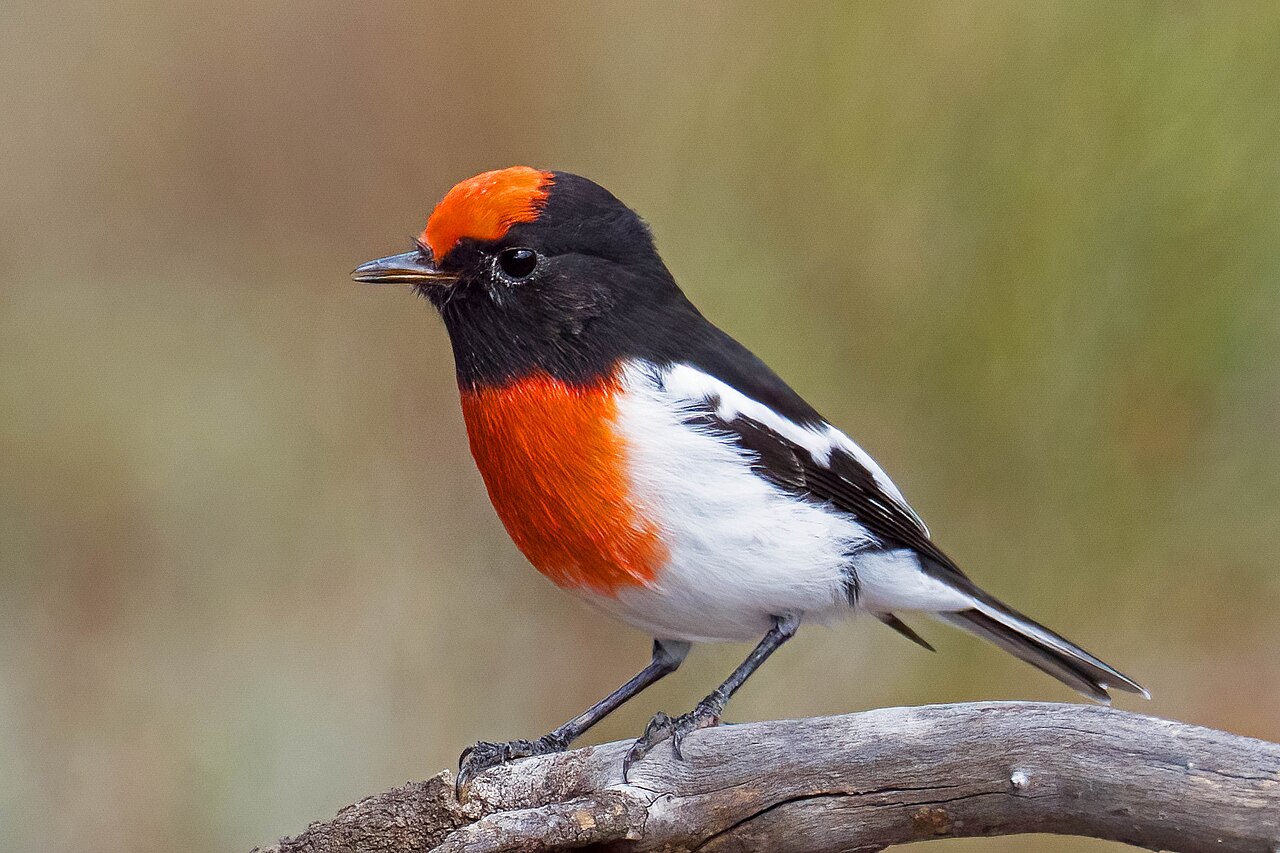
The Red-capped Robin is the smallest of the Australian robins and the only one that carries the red not just on the breast but on the head: the male has a bright red crown above a black head, and within this genus that is unique. It is also the robin of the dry inland — mulga, mallee and acacia scrub — where it sits on a low branch like a point of light in a landscape of grey and ochre. For many travellers it is the first red robin they see in Australia.
Voice
A high, dry, rattling voice, often rendered as a rapid insect-like dit-dit-dit-dit, with the sound of a small stick drawn along a comb. The song is short, mechanical and loud for so small a bird, and carries far in open scrub. There is also a sharp tick as alarm. In the quiet of the inland that rattling phrase is usually the first thing to betray the species' presence.
Recording: Chris Benesh — CC BY-NC-SA 3.0 · Little Desert Lodge, Victoria, Australia · xeno-canto
Identification
A very small, short-tailed robin. The male has a scarlet forehead and crown, a black head with black throat, black upperparts with a white wing bar, a scarlet breast and a white belly; in reasonable light the red cap shows from a distance. The female is grey-brown with a white belly but carries a distinctive reddish to rusty wash on the forehead — the only Australian robin female with red on the head, and therefore identifiable by that feature. Both sexes flick wings and tail continually.
Confusion species
The male cannot be confused with any other robin thanks to the red crown: Scarlet Robin (Petroica boodang) has a large white forehead patch in that position, Flame Robin (Petroica phoenicea) a small white spot, and both are distinctly larger and inhabit damper, more southerly forest. The female is the real test: that of P. boodang has a dull white to buff forehead spot and usually an orange-red wash on the breast, that of P. phoenicea is larger, plainer and has two clear buff wing bars and no red on the head — only in this species is the forehead reddish. Rose Robin (Petroica rosea) and Pink Robin (Petroica rodinogaster) are pink, longer-tailed and heavier-bodied respectively, and tied to wet, closed forest this species never enters. Range helps too: this is the only one of the five that inhabits the dry inland. The most threatened member of the genus, Black Robin (Petroica traversi), is entirely black and lives only on the Chatham Islands.
Habitat
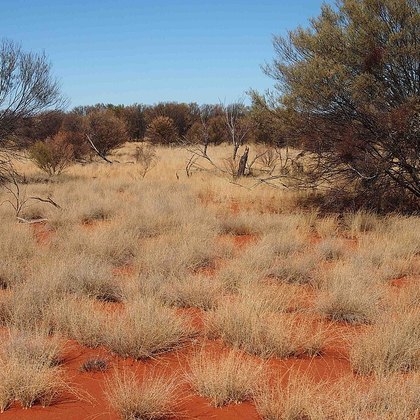
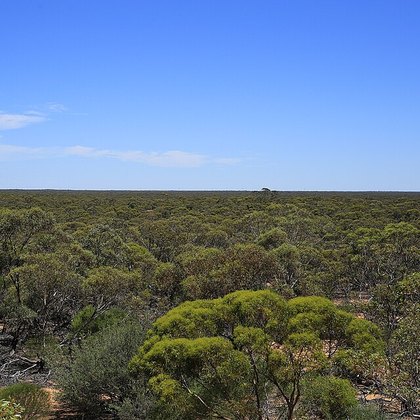
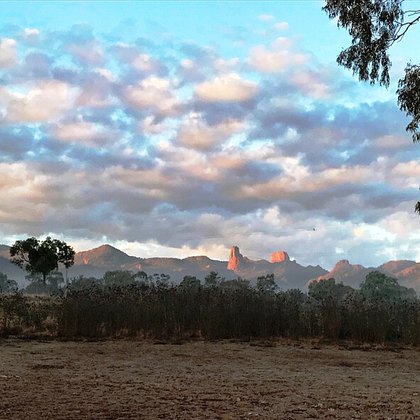
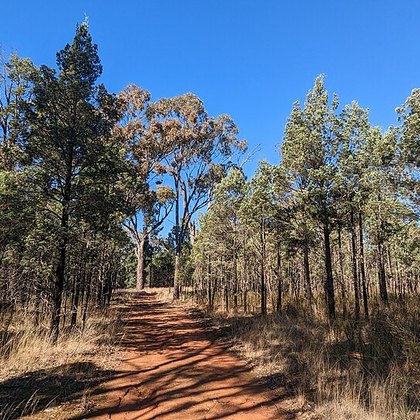
Dry and semi-arid inland country: mulga and other acacia scrub, mallee, dry eucalypt woodland and casuarina and callitris woodland, usually with an open, sparsely vegetated ground layer. The bird hunts from a low branch, a fence or a dead twig, dropping onto insects on the bare ground; it needs that combination of low lookouts and open ground. After rain it expands temporarily into districts where it is normally absent, and in dry years it withdraws again.
Where the bird is most often found, arranged by main group and formation.
Range and movements
Widespread over almost all of Australia, except the far north, the wetter southern and eastern fringes, and Tasmania. The type material comes from the south coast of New Holland, later attributed to South Australia. Within that large range the species is not everywhere equally numerous: numbers fluctuate strongly with rainfall, and the birds wander considerable distances to districts where rain has recently fallen. There is no fixed migratory pattern such as Flame Robin shows.
- Resident
- Winter
- dark = core range, pale = thinly spread
Where and when to look
In open mulga or mallee look for a small bird on a low branch flicking tail and wings without pause; the red cap catches the eye at once in the grey-green scrub. In the silence of the inland the dry rattling phrase is often heard before the bird is seen. On any plain bird, always check the forehead: a rusty-red wash there turns an indeterminate robin female into this species immediately.
Conservation
Least Concern (LC). With a very large range and a strong tolerance of drought this is among the least vulnerable members of the genus. There are, however, reported regional declines along the southern and eastern margins of the range, where woodland has been converted to farmland and where the open understorey and dead timber the species needs for its hunting method have disappeared. In the inland core there is no sign of this.
Scientific name
Petroica goodenovii | (Vigors & Horsfield, 1827)
Nicholas Aylward Vigors and Thomas Horsfield described the species in 1827 as Muscicapa goodenovii; because it now stands in Petroica, authors and year are in parentheses. The genus Petroica combines Ancient Greek petros ('rock') with oikos ('dwelling'). The epithet honours Samuel Goodenough, clergyman, naturalist and one of the founders of the Linnean Society of London, in whose transactions the description appeared. The English name Red-capped Robin, the Spanish petroica frentirroja and the Dutch roodkapvliegenvanger all three name the character that makes the species unique within the genus: the red on the head.