All species › Parrots › Old World parrots › Purple-crowned Lorikeet
Purple-crowned Lorikeet | Parvipsitta porphyrocephala
Purperkaplori | Lori coronipúrpura
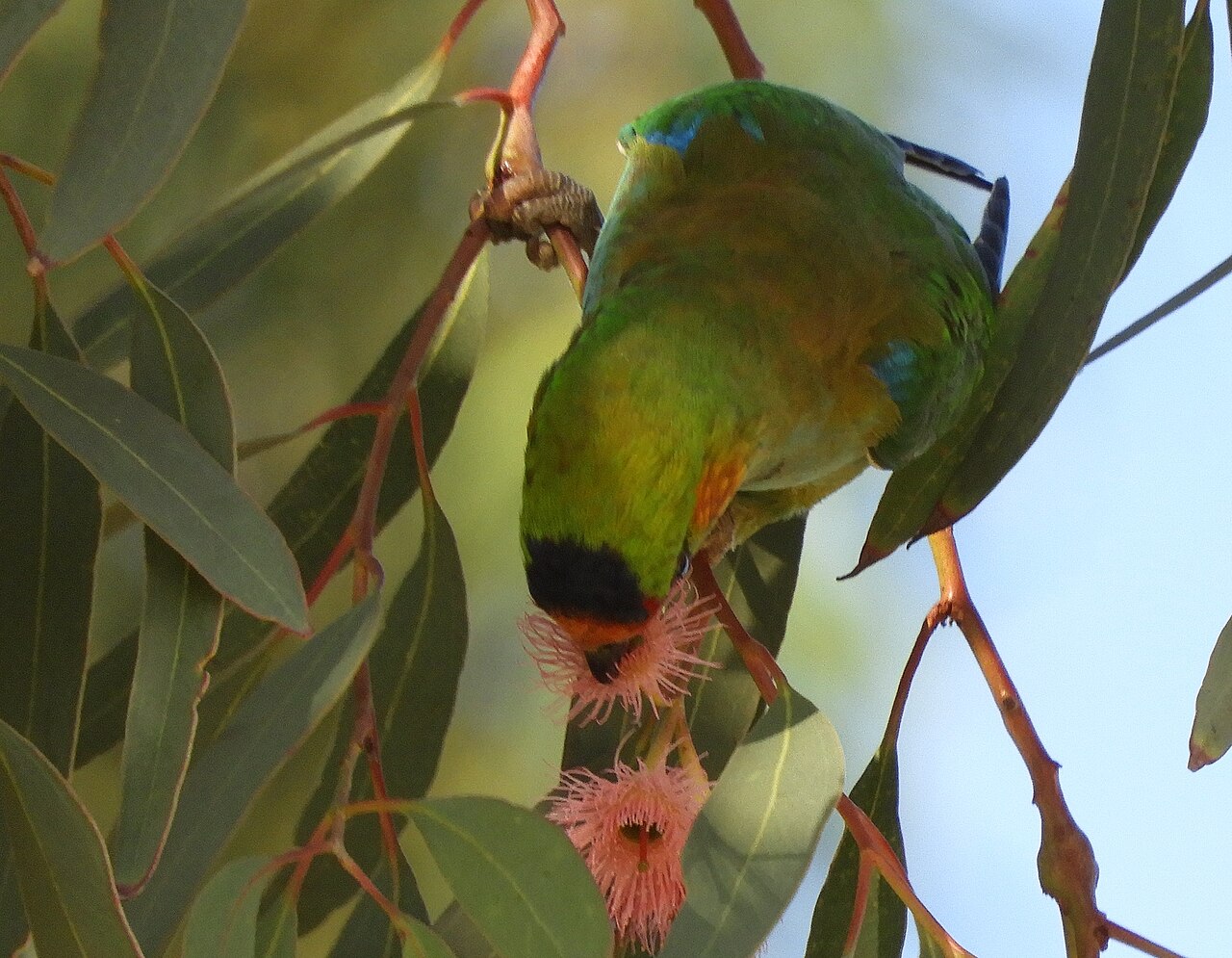
The Purple-crowned Lorikeet is the only native lorikeet of Western Australia and one of the smallest parrots on the continent: green above, powder-blue below, with a dark purple crown and an orange-yellow patch on forehead and ear. It wanders in small, noisy parties through flowering mallee (low, multi-stemmed eucalypt scrub of dry southern Australia) and wandoo (white-barked eucalypt of south-western Australia, and the woodland it forms).
Voice
A thin, high and distinctly buzzing tsit-tsit-tsit as the contact call, or a single quick zit; the pitch falls exactly between Little Lorikeet (higher) and Musk Lorikeet (lower). Feeding birds produce a sharp, metallic chatter from the canopy. A startled party calls loudly and continuously in flight until the whole group is away.
Recording: Nick Talbot — CC BY-NC-SA 4.0 · Staughton Vale, Greater Geelong City, Victoria, Australia · xeno-canto
Identification
Seventeen to eighteen centimetres and about forty-five grams, so barely larger than the Little Lorikeet. Dark green above, but powder-blue below on chin, breast and belly — the only small lorikeet in the region with blue rather than green underparts. The crown is deep purple-blue, forehead and ear coverts orange-yellow to salmon, and under the wing sit bright red coverts that flash red in flight. The bill is black, the tail short. The female is duller; juveniles lack the purple crown entirely and are then confusingly plain green.
Confusion species
Little Lorikeet (Parvipsitta pusilla) is equally small but has a red face running onto the throat, no purple crown and green rather than blue underparts. Musk Lorikeet (Trichoglossus concinnus) is larger, green below, with a red eye-stripe, a blue crown and a red bill tip. Rainbow Lorikeet (Trichoglossus moluccanus) also shows a blue head and blue belly, but is nearly twice as long with an orange-red breast and a red bill. Young Purple-crowned Lorikeets without crown colour are the hardest: then watch for the blue wash on the breast and the red underwing. In Western Australia any native lorikeet is this species, since there is no other.
Habitat
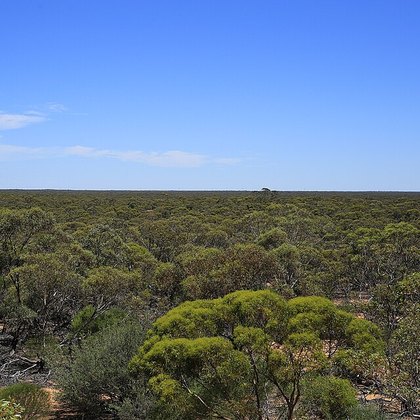
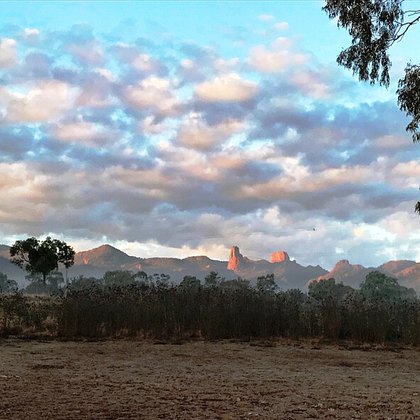
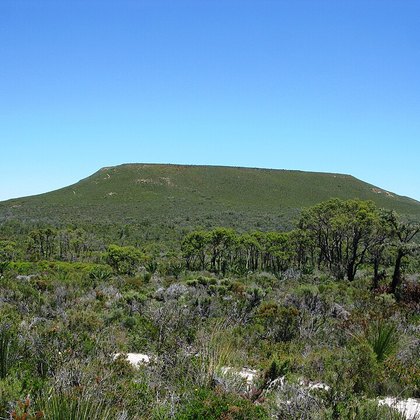
Open, dry eucalypt forest, woodland and shrubland of the temperate and semi-arid zone. Mallee is the core habitat, together with wandoo and jarrah woodland in the south-west and river red gums along the creeks. It usually stays in flowering canopies but will drop into low shrubs when the blossom is good, and it visits urban parks and gardens with flowering eucalypts. It nests in hollows and hollow limb stubs of eucalypts, by preference near water.
Where the bird is most often found, arranged by main group and formation.
Range and movements
The southern rim of Australia, in two large blocks: south-western Western Australia, roughly south of 30°S and west of 127°E, and southern South Australia including Kangaroo Island, running on through western Victoria into south-western New South Wales. It is the only native lorikeet of Western Australia. It scarcely reaches Tasmania. Within that range it wanders far and unpredictably after the eucalypt blossom.
- Resident
- dark = core range, pale = thinly spread
Where and when to look
In mallee country stand by a flowering eucalypt and wait: the parties come in high and fast, calling with that buzzing note, then drop into the canopy. The best mark comes free at that moment — as the wings open the red underwing flashes against the green. Look from below: the powder-blue belly is paler against the sky than that of any other small lorikeet and settles the bird even without a view of the crown.
Conservation
Least Concern (LC), with a large range and no demonstrated national decline; no major threats are known. Broadscale clearing of mallee for cropping in the wheatbelts of Western Australia and South Australia has fragmented its habitat, and as with the other small lorikeets the supply of old hollow-bearing eucalypts is the limit on breeding. Because it wanders widely it can absorb a poor flowering year in one district by searching elsewhere — a buffer the more range-restricted parrots lack.
Scientific name
Parvipsitta porphyrocephala | (Dietrichsen, 1837)
Lionel Dietrichsen described the species in 1837 as Trichoglossus porphyrocephalus, in the Transactions of the Linnean Society of London; the type locality is given as 'New Holland' and was later fixed on South Australia by Mathews. Author and year take parentheses because the species later changed genus. The epithet is Greek: porphyra, 'purple', and -kephalos, '-headed', for the dark purple crown. The genus Parvipsitta was introduced by Mathews in 1916, from Latin parvus, 'small', and psitta, from psittacus, 'parrot'; this guide places the species there with the Little Lorikeet, after a long spell in Glossopsitta.