All species › Cranes, rails and allies › Rails, gallinules and coots › Pale-vented Bush-Hen
Pale-vented Bush-Hen | Amaurornis moluccana
Olijfbruin waterhoen | Gallineta filipina
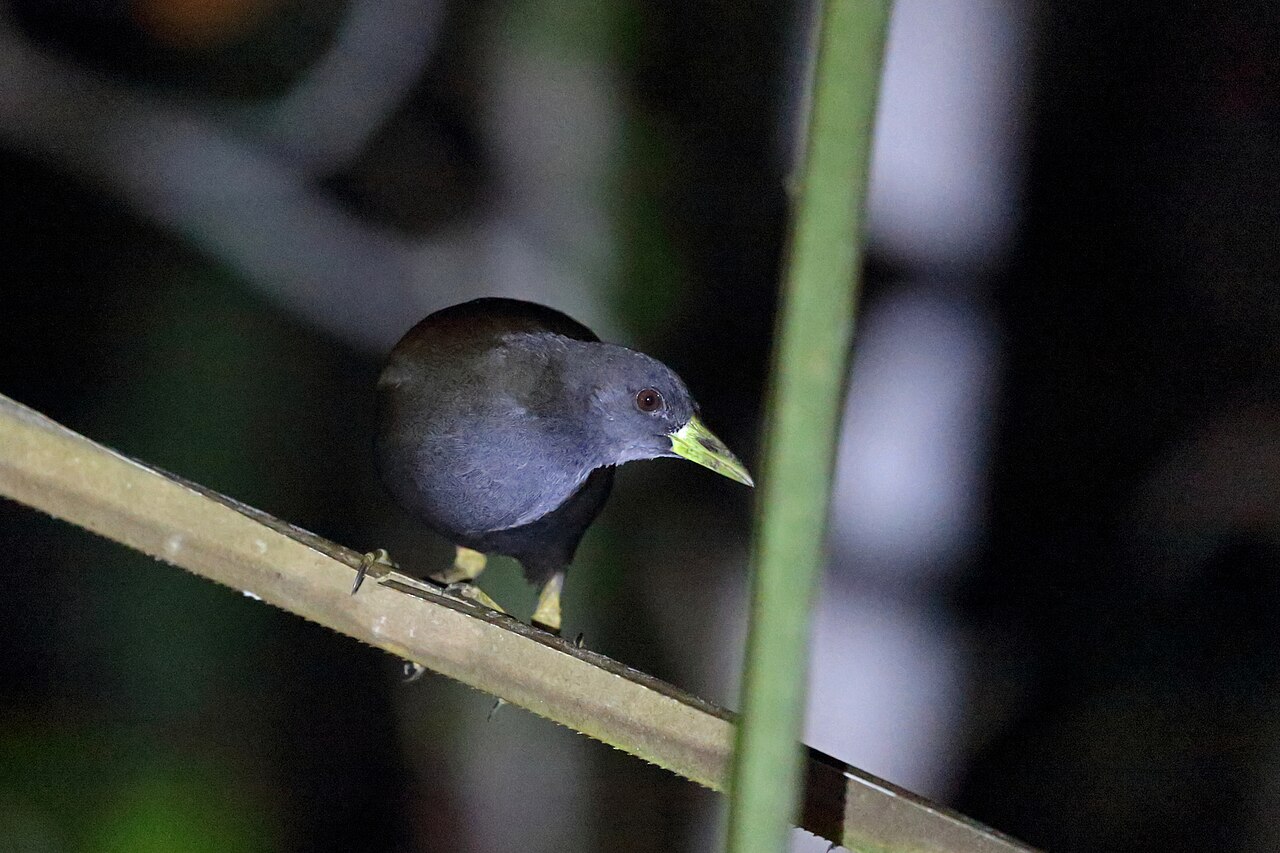
The Pale-vented Bush-Hen is the rail of dense cover along creeks and swamp edges in northern and eastern Australia: dull blue-grey head and underparts, olive to red-brown back and wings, and a pale rufous vent. The bill is lime-green. It is extremely shy and in practice is heard far more often than seen.
Voice
Its presence is almost always given away by the voice: a loud, squawky and rapidly repeated wark-wark-wark, or an agitated wark-woop, wark-woop. Clucks and clicks go with it, and in the wet season a shrieking, almost wailing duet from a pair that stays hidden in the reeds. Calling peaks at dawn, at dusk and under heavy cloud.
Recording: Kelle Moreau — CC BY-NC-SA 4.0 · Samofa, Biak Numfor Regency, Papua, Indonesia · xeno-canto
Identification
A medium rail of twenty-five to thirty centimetres, with a dull grey-blue head, neck and breast and olive to red-brown wings and tail. The undertail coverts are pale rufous to cream and, together with the bill colour, give the best mark: the bill is lime-green with a small orange-red shield at the base in the breeding season. Legs are olive-yellow, the iris red-brown. Young birds are paler and duller and lack the orange bill base. It rarely swims and flies only briefly and low, legs dangling.
Confusion species
Dusky Moorhen (Gallinula tenebrosa) is larger and much darker, has a red frontal shield and red bill base, a white flank stripe, and swims out on open water, while the bush-hen keeps to cover at the edge. Buff-banded Rail (Gallirallus philippensis) is finely barred black and white, with a white supercilium, a chestnut eye-stripe and an orange-buff breast band. Red-necked Crake (Rallina tricolor) walks the same dense green of north Queensland but has a rufous head and neck and boldly barred flanks. If only a shape remains, the green bill and yellow legs settle it.
Habitat
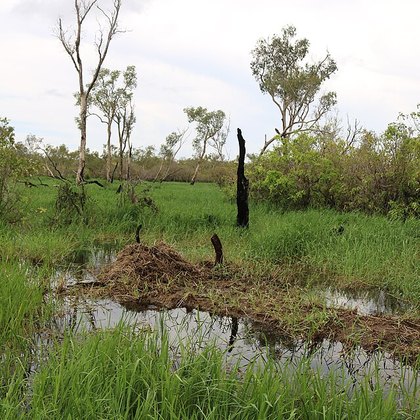
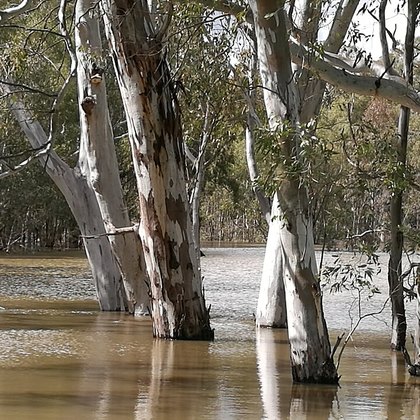
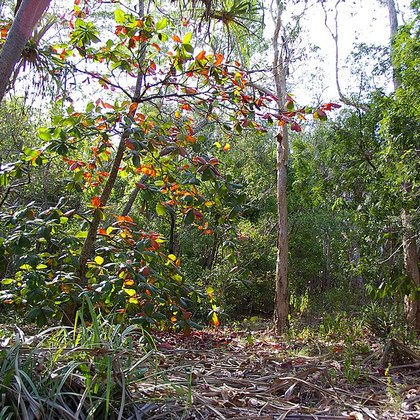
Dense low growth at the edge of creeks, pools and swamps: tall grasses and reeds, sometimes bamboo, thickets of introduced lantana, vine tangles and the understorey of monsoon forest and rainforest margins. It also uses overgrown drains and the edges of cane fields and neglected waterside gardens, up to about fifteen hundred metres. Open water and bare shore it avoids.
Where the bird is most often found, arranged by main group and formation.
Range and movements
The coastal and subcoastal belt from Cape York south through eastern Queensland into north-eastern New South Wales, with the southern limit around the Clarence and Richmond rivers. It is scarce in the Top End of the Northern Territory and very scarce in the Kimberley. Most of the range lies outside the map window: the Moluccas, New Guinea, the Bismarck Archipelago and the Solomon Islands. Australian birds belong to the subspecies ruficrissa.
- Resident
- Breeding (summer)
- dark = core range, pale = thinly spread
Where and when to look
Go at first light in the wet season, November to March, to a vegetated creek line behind the north Queensland coast and stand still; that is when it calls most. Watch for the narrow runway it makes through the grass and wait at the gap — it crosses a track or a drain in one movement. Trying to flush it out of cover gets you nothing.
Conservation
Least Concern (LC). The world range is large and the bird is common in New Guinea and on the islands; Australia holds only an edge of it. Regionally it is more delicate: New South Wales lists it as Vulnerable and the Northern Territory as Near Threatened. Draining of creek swamps, clearing of bankside vegetation and wholesale control of lantana — the very thickets it hides in — are the pinch points there.
Scientific name
Amaurornis moluccana | (Wallace, 1865)
Wallace described the species in 1865 as Porzana moluccana, with Ternate in the Moluccas as the type locality; it now sits in Amaurornis, so author and year stay in parentheses. The genus Amaurornis is built from Greek amauros, 'dark or dim', and ornis, 'bird' — a name for the sombre plumage and the crepuscular habits. moluccana means 'from the Moluccas'; the Australian subspecies is ruficrissa, 'red-vented'.