All species › Passerines › Fairywrens, grasswrens and emu-wrens › Opalton Grasswren
Opalton Grasswren | Amytornis rowleyi
Opaltongrassluiper | Maluro herrumbroso
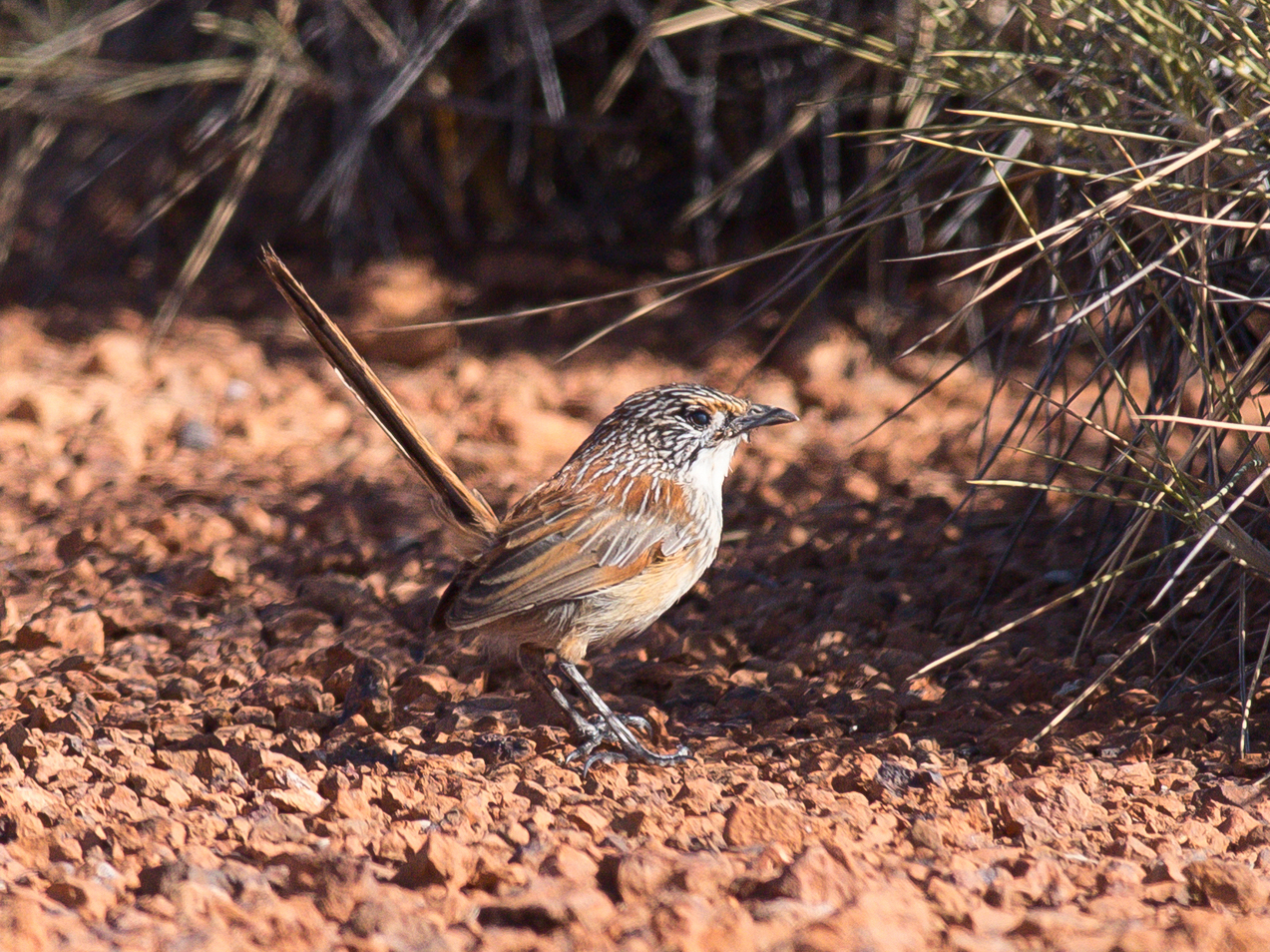
The Opalton Grasswren is the most enigmatic of the thirteen grasswrens in this guide: a mouse-like, long-tailed bird that lives among the spiny hummocks of spinifex (spiny, hummock-forming desert grass of the interior) on the stony hills near Opalton in central-western Queensland. It was only named as a distinct form in 1999 and raised to species rank shortly afterwards; its entire world range is thought to cover a few hundred square kilometres.
Voice
Like all grasswrens it sings high, thin and fast: a reeling little song of a few seconds that is lost to the wind within a few tens of metres. The contact call is a fine, sharp tsip by which birds keep track of one another between hummocks. The repertoire of this species has hardly been described separately; to the ear it does not differ clearly from that of the Striated Grasswren (Amytornis striatus), from which it was split.
Recording: JACOB Hervé — CC BY-SA 4.0 · Lark Quarry Communication Tower Opalton, Winton Shire, Queensland, Australia · xeno-canto
Identification
Fourteen to sixteen centimetres, well over half of it tail, and that tail is often carried straight up when the bird runs. The upperparts are warm rufous-brown with fine white shaft streaks, each edged in black, so the back looks streaked at close range and plain rusty at a distance. The throat is white and sharply defined; the male has a black malar stripe along that white throat, the female does not, but has rufous flanks. The bill is fine and dark, the legs long and strong — this is a bird that runs rather than flies.
Confusion species
Plumage is of little help here: the grasswrens of the striatus group look much alike and range is in practice the only workable distinction. The Kalkadoon Grasswren (Amytornis ballarae), likewise a recent split, occurs several hundred kilometres to the north-west in the Selwyn Range near Mount Isa. The Striated Grasswren (Amytornis striatus) lives far to the south, in mallee (low, multi-stemmed eucalypt scrub of dry southern Australia) and sandplain in New South Wales, Victoria and South Australia. The Dusky Grasswren (Amytornis purnelli) of the MacDonnell Ranges is darker and much less strongly streaked and lacks the crisp black-and-white throat pattern. The Carpentarian Grasswren (Amytornis dorotheae) lives in the sandstone country of the Gulf of Carpentaria. None of these occurs at Opalton: a grasswren in spinifex in that area is this species.
Habitat
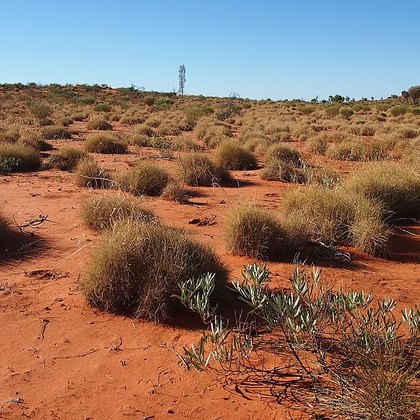
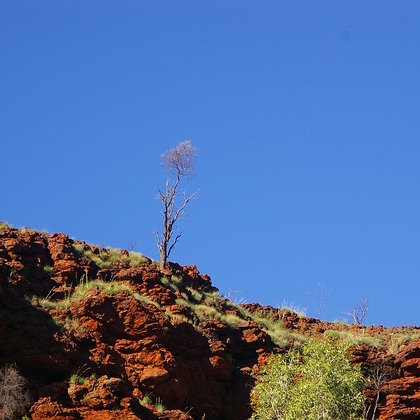
Dense, old hummocks of spinifex (Triodia) on rocky ridges, scree slopes and the rims of the jump-ups — flat-topped, boulder-strewn mesas. It needs hummocks that have gone long unburnt and are large and dense enough to shelter and nest in; small young hummocks regrowing after fire are avoided. Open flat grassland between the hills is crossed at most.
Where the bird is most often found, arranged by main group and formation.
Range and movements
Endemic to a small area of central-western Queensland: the Forsyth Range and surrounding rocky hills around the Opalton opal field, south-west of Winton. It is one of the smallest ranges of any Australian songbird. Resident: birds stay for life within the same system of spinifex slopes and there is no evidence of migration or nomadism.
- Winter
- dark = core range, pale = thinly spread
Where and when to look
Go early, while it is still cool, and walk slowly along the foot of a rocky spinifex slope. Listen first and look second: the thin song gives the birds away before you see them. Flush them and you will usually see only a brown shape running from hummock to hummock with its tail cocked; stand still and wait, because a disturbed party will often reappear on top of a rock after a few minutes.
Conservation
The IUCN has not yet assessed this species under its own name: on the Red List it still falls within the broadly circumscribed Striated Grasswren (Amytornis striatus), which is listed as of Least Concern (LC). For a bird with a range of a few hundred square kilometres that is a reassurance which says nothing. The real risks are fire that is too frequent or too extensive, removing the old spinifex hummocks in a single season, grazing by stock and feral horses, and predation by feral cats. Because the entire world population sits in one landscape, a single bad fire year can affect a large part of it.
Scientific name
Amytornis rowleyi | Schodde & Mason, 1999
Richard Schodde and Ian Mason described the bird in 1999 in their Directory of Australian Birds: Passerines as the subspecies Amytornis striatus rowleyi; it was later raised to species rank on genetic and morphological grounds; because it has stayed in Amytornis, author and date are not bracketed. The name honours Ian Rowley (1926–2009), the Australian ornithologist whose long-running studies of fairywrens put the Maluridae on the map. The genus was first called Amytis, after a Persian noblewoman, but that name was already taken by another group of animals; Leonhard Stejneger therefore proposed Amytornis in 1885, adding the Greek ornis (bird). The Dutch name opaltongrassluiper, like the English name, refers to the Opalton opal field, the hamlet near which the bird was refound.