All species › Kiwis › Kiwis › North Island Brown Kiwi
North Island Brown Kiwi | Apteryx mantelli
Noordelijke bruine kiwi | Kiwi pardo de la Isla Norte
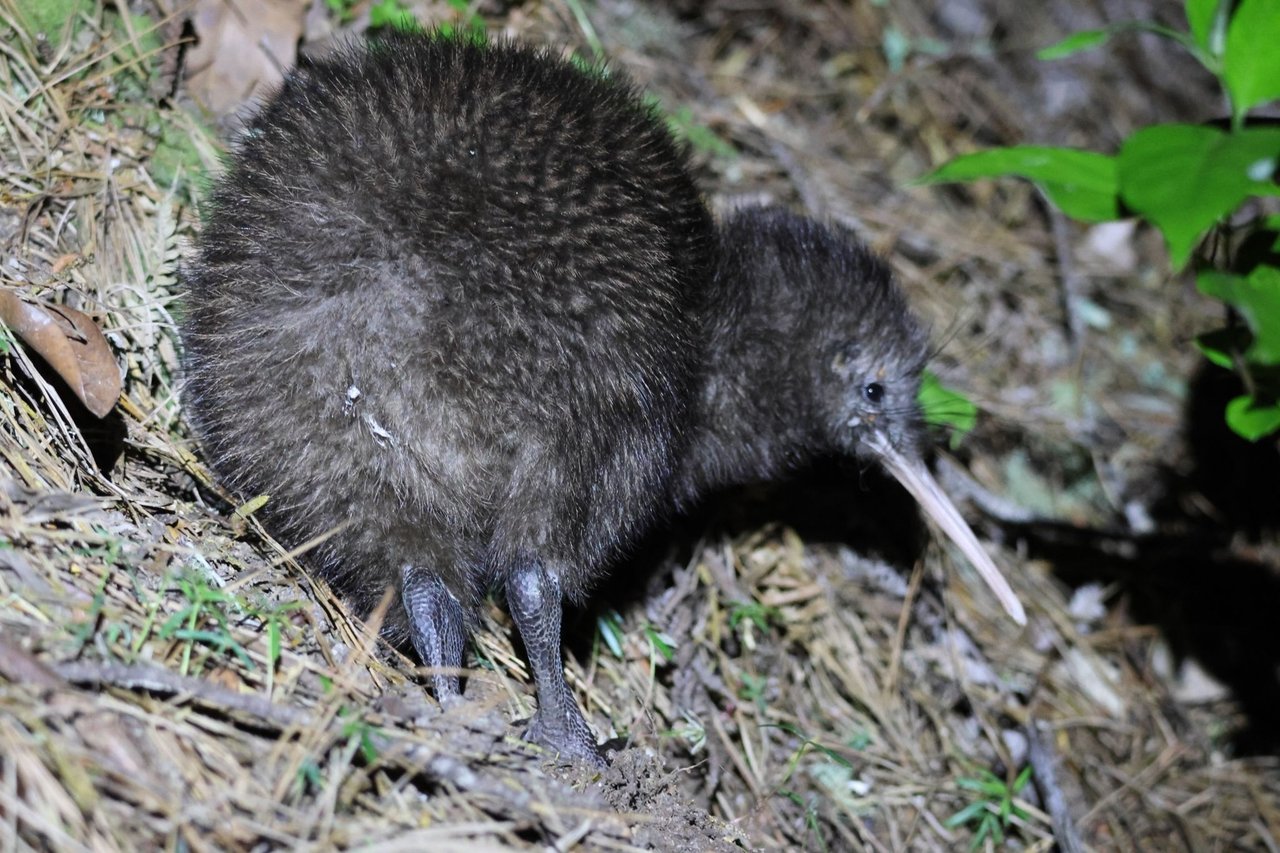
The North Island Brown Kiwi is the bird most New Zealanders mean when they say 'kiwi': no visible wing, no tail, and a long pale bill with the nostrils at its tip. It is the most numerous of the five kiwi and the only one living wild on the North Island.
Voice
The call is the best field mark, because the bird itself stays out of sight. The male gives a high, rising whistle repeated fifteen to twenty-five times, kee-wee ... kee-wee; the female answers with a lower, rasping cry given ten to twenty times. The first hour after dark is the time to listen, and on still nights the call carries more than a kilometre.
Recording: Meena Haribal — CC BY-NC-SA 4.0 · Tawharanui Regional Park (near Tāwharanui Peninsula), Auckland, Auckland, New Zealand · xeno-canto
Identification
A bird the size of a hen but far more heavily built, rufous to dark brown, the black and brown streaking giving the plumage a coarse, hair-like look. The bill is long, slightly curved and pale, distinctly longer in the female; legs and toes are short, pale and heavy. It walks hunched, bill in the leaf litter, snuffling audibly as it probes. Females weigh 2.7 kilograms against 2 for males; otherwise the sexes look alike in the field.
Confusion species
The four other kiwi do not overlap with this one: Southern Brown Kiwi (Apteryx australis) lives in Fiordland and on Stewart Island and is larger, Okarito Kiwi (A. rowi) is confined to a single west coast forest and is smaller and greyer, and Little Spotted Kiwi (A. owenii) and Great Spotted Kiwi (A. maxima) are grey with fine barring rather than rufous streaking. Anything calling in the wild on the North Island is therefore A. mantelli. In the dark a rustling Weka (Gallirallus australis) is often taken for a kiwi, but it has a visible tail and a short bill.
Habitat
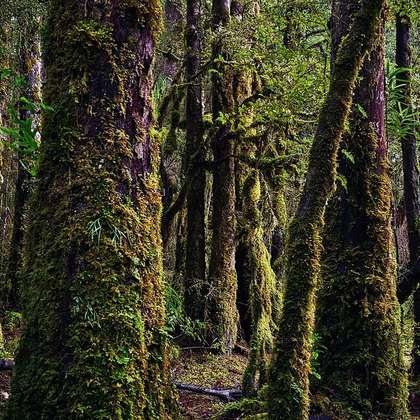
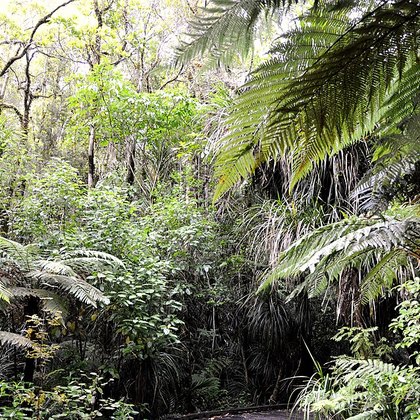
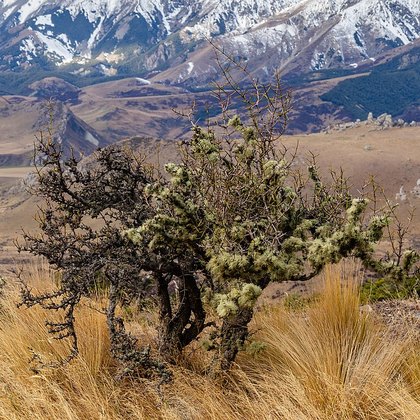
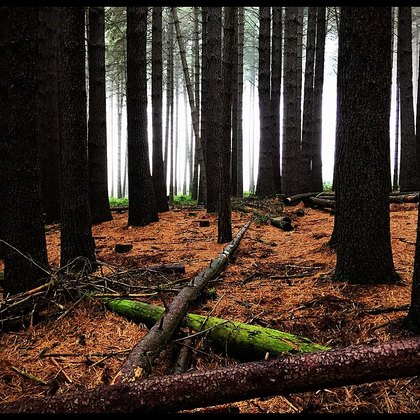
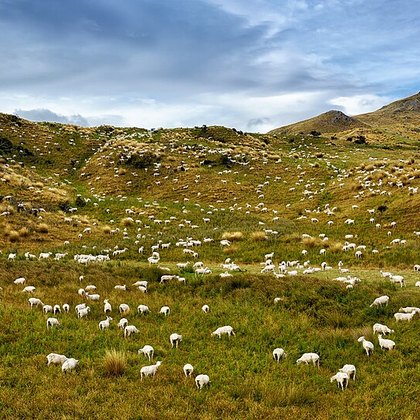
Podocarp-broadleaf and kauri forest with a deep litter layer are the core, but it does as well in manuka and kanuka scrub, in Pinus radiata plantation and on rough farmland with shelterbelts. It needs moist, workable ground with worms and grubs, and dense cover for the day. It ranges from sea level to about 1400 metres.
Where the bird is most often found, arranged by main group and formation.
Range and movements
The North Island north of the Manawatu Gorge: Northland, Coromandel, the Bay of Plenty, Gisborne, Hawke's Bay, Taranaki, Whanganui and the Tongariro country, densest in Northland. It is also established on predator-free islands and in fenced sanctuaries. Over much of the island it disappeared during the twentieth century, so the picture is a patchwork of strong sites and empty forest.
- Resident
- dark = core range, pale = thinly spread
Where and when to look
Sit at the edge of a block after dark and listen rather than search; two people a hundred metres apart can fix between them where a calling pair is. Do not walk in with a light, and choose the first still nights after rain.
Conservation
Vulnerable (VU) on the IUCN Red List; the national estimate stood at about twenty-five thousand birds and measured call rates are slowly falling. The bottleneck is the chick: in unmanaged forest stoats kill roughly nine in ten, and roaming dogs kill adults. Where trapping is done, or young are reared on a predator-free island, the population recovers quickly.
Scientific name
Apteryx mantelli | Bartlett, 1852
Bartlett described the bird in 1852 as Apteryx mantelli, and it has stayed in that genus, so author and year carry no parentheses. The genus Apteryx was introduced by Shaw in 1813, from Greek a-, 'without', and pteryx, 'wing'. The epithet honours Walter Mantell, who collected the New Zealand bird and moa material on which much early description rests. The type locality is simply 'North Island'.