All species › Grebes › Grebes › New Zealand Grebe
New Zealand Grebe | Poliocephalus rufopectus
Nieuw-Zeelandse fuut | Zampullín maorí
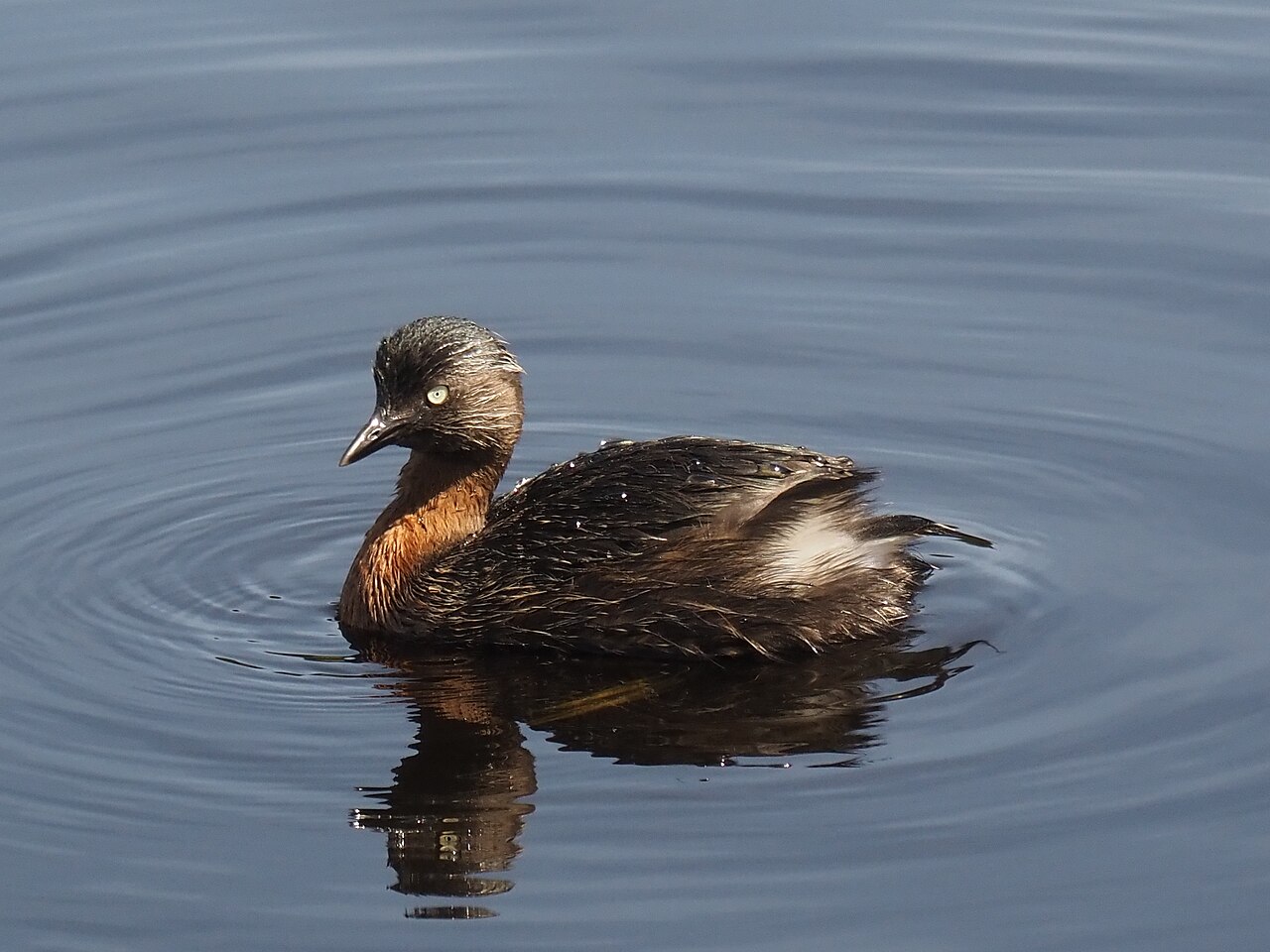
The weweia or New Zealand Grebe is the small dark grebe of the shallow lakes of the North Island: a compact diver with a glossy black head swept with fine silvery feathering, a rufous breast and a striking yellow eye. It is endemic to New Zealand and is found nowhere else in the world.
Voice
Not a noisy bird. In the breeding season and when alarmed it gives a short, high chattering babble, chee-chee-chee, that hangs among the marginal plants; mates sometimes answer one another with it across a few tens of metres of water. Away from the territory it is all but silent, and its presence is given away by a bird that suddenly is not there rather than by any sound.
Recording: Nathan El — CC BY-NC-SA 4.0 · Taupō Marina, Waikato, New Zealand · xeno-canto
Identification
A stocky little grebe of 28 to 30 cm and a quarter of a kilo, with a short straight black bill, olive-grey legs marked with yellow, and a tail that is no more than a tuft of silky black feathers. The head is dull glossy black with fine silvery plumes swept back along the sides; breast and foreneck are a warm rufous in breeding plumage and the flanks are dark. At close range the yellow eye is the most conspicuous feature. Outside the breeding season the whole plumage is paler and the rufous is largely gone.
Confusion species
Hoary-headed Grebe (Poliocephalus poliocephalus), which crosses from Australia and has now established itself in New Zealand, is the same size but far paler: a dark brown eye instead of yellow, no rufous on breast or neck, and silver streaking spread evenly over the whole head rather than gathered into swept-back plumes. Great Crested Grebe (Podiceps cristatus) at 48 to 61 cm is incomparably larger, with a long white neck and a double crest with chestnut frill, and keeps to the deep high-country lakes of the South Island. Australasian Grebe (Tachybaptus novaehollandiae) is smaller, has a yellow bill base and shows a black neck with rufous on the side of the face rather than on the breast.
Habitat
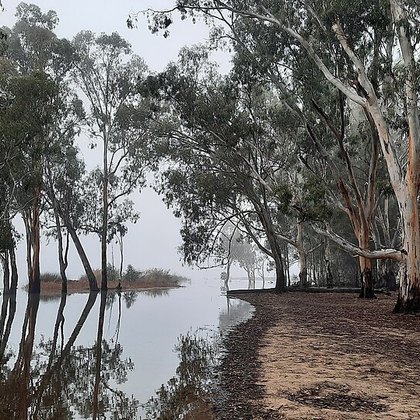
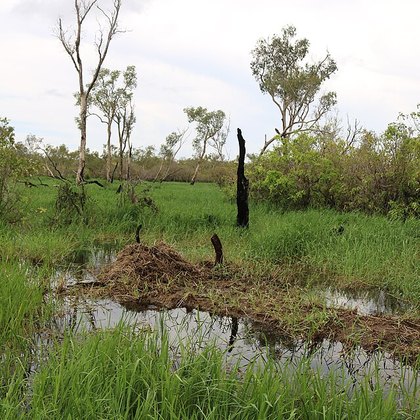
Shallow freshwater lakes and pools with plenty of water plants and a vegetated edge, dune lakes, lagoons and sheltered inlets up to about 740 metres. It also uses water made by people: stock dams, farm ponds and small reservoirs have noticeably enlarged its ground. Outside the breeding season birds gather on wider, more open water.
Where the bird is most often found, arranged by main group and formation.
Range and movements
Patchily over the North Island from Northland to the Wairarapa, densest around the Rotorua lakes, on the volcanic plateau, in Hawke's Bay and in the Wairarapa. On the South Island it was once widespread but disappeared as a breeder around 1940; it has lately returned there, establishing in the Nelson and Marlborough districts. Outside New Zealand the species does not occur.
- Resident
- Winter
- dark = core range, pale = thinly spread
Where and when to look
Walk the edge of a shallow lake or a large farm pond on the volcanic plateau and look for a small dark grebe diving close to the waterweed and surfacing tens of metres further on each time. Through binoculars go to the eye first: yellow settles the identification at a glance. Young birds ride on their parents' backs, which gives the easiest search image when a clutch has just hatched.
Conservation
Least Concern (LC) on the IUCN list, after recovery from a far worse assessment in the 1990s; the New Zealand national assessment calls the species increasing, on a population of some nineteen hundred to two thousand birds. The main threats remain predation by introduced mammals, drainage of wetlands, falling water quality and disturbance by recreational boating; keeping vegetated margins on farm ponds does a great deal of good.
Scientific name
Poliocephalus rufopectus | (Gray, 1843)
Gray described the bird in 1843 as Podiceps (Poliocephalus) rufopectus, in Dieffenbach's account of his travels in New Zealand; because Poliocephalus was later raised to a genus of its own, author and year stand in parentheses. The genus comes from Greek polios, 'grey', and -kephalos, '-headed'; rufopectus is Latin for 'rufous-breasted'. The type locality is the North Island of New Zealand. The Maori names are weweia, and locally totokipio, taihoropi and taratimoho.