All species › Passerines › Flowerpeckers › Mistletoebird
Mistletoebird | Dicaeum hirundinaceum
Roodstuithoningvogel | Picaflores golondrina
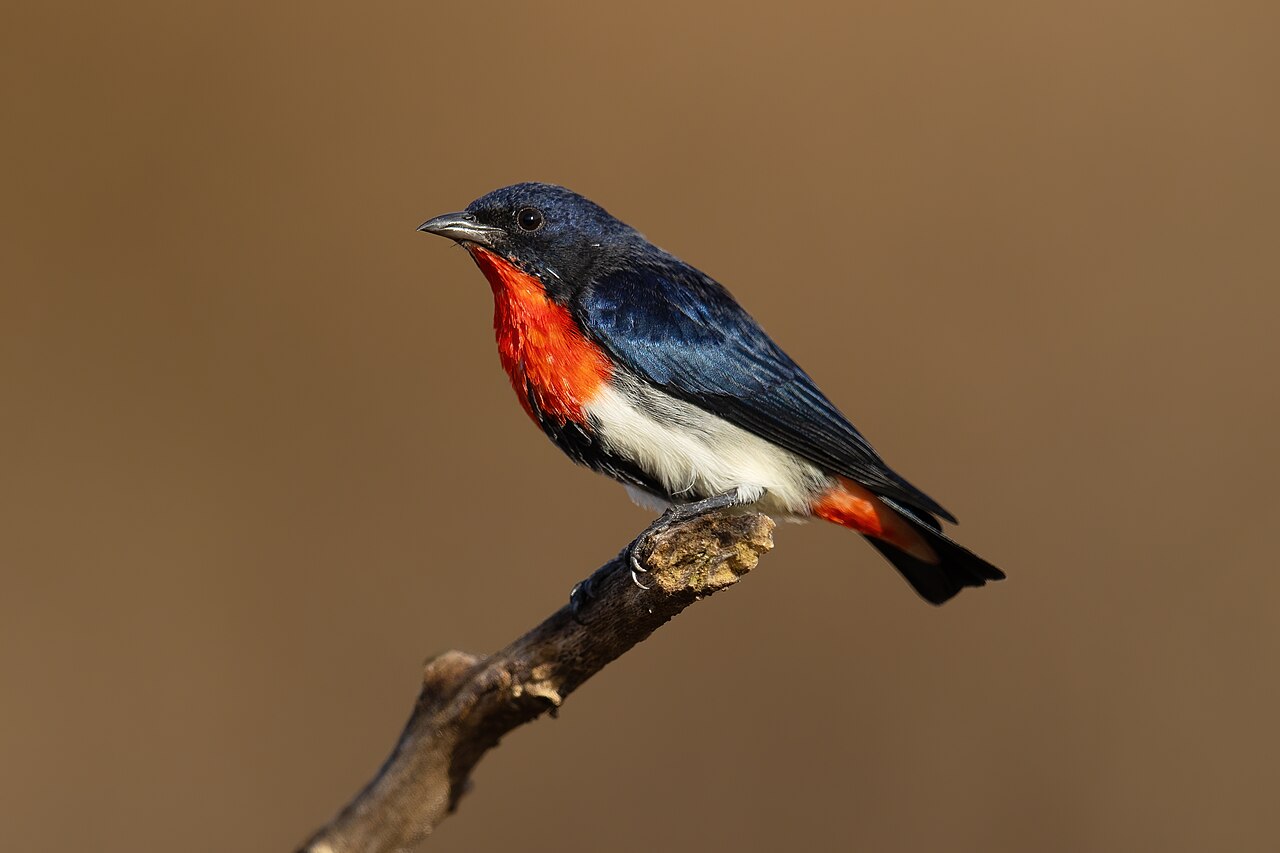
The Mistletoebird is a bird of barely ten centimetres that has hung its whole existence on one group of plants: the mistletoes. It eats the fruit, digests it in minutes, wipes the sticky seed onto a branch, and out of that grows the next mistletoe — a reciprocity so tight that the distribution of the bird and that of the plant coincide over large parts of Australia. The male is glossy blue-black with a scarlet throat and scarlet undertail; the female is grey and inconspicuous.
Voice
The species is heard more often than seen, and nearly always from above. The flight call is a sharp, high, metallic dzee or tzew, a single note, repeated as the bird passes high and fast overhead; it is a sound that cuts through the canopy and that one learns in Australian woodland as 'there goes another one'. The song is a thin, high and fairly musical twitter, low in volume and at close range varied, and regularly includes imitations of other small birds of the neighbourhood. At feeding and in disputes around a fruiting mistletoe comes a fast sharp ticking. By the sharp flight call the species can be recorded in dry woodland across the continent.
Recording: Étienne Leroy — CC BY-NC-SA 4.0 · Bloomfield, Douglas Shire, Queensland, Australia · xeno-canto
Identification
A tiny, compact bird of nine to eleven centimetres with a short straight finely tapering bill, a short tail hardly reaching past the wingtips and a restless manner high in the crown. The male is glossy blue-black on head, back, wings and tail, with the scarlet set beneath it: a bright red throat running onto the upper breast, and again bright scarlet undertail coverts. The belly is white with a narrow sooty grey streak running down its centre from breast to legs — a character that is decisive when seen well. The female is wholly different and much plainer: grey to grey-olive above, dirty white below, with only a soft pink to pale red wash on the undertail coverts and a dark bill. Young birds resemble the female but have an orangey bill base and lack the pink beneath the tail entirely.
Confusion species
Red-capped Flowerpecker (Dicaeum geelvinkianum), which reaches the islands of Torres Strait, is the nearest relative: its male has, besides the red throat and rump, a scarlet crown, which this species lacks entirely. The females of both are grey and inseparable in the field; in that region a grey bird is better left unnamed. Scarlet Myzomela (Myzomela sanguinolenta) is larger, has a longer and clearly curved bill and carries its red over head and back and not on the throat alone. Red-headed Myzomela (Myzomela erythrocephala) of the mangroves likewise has a curved bill and a red head. Spotted Pardalote (Pardalotus punctatus) has a red rump but is white-spotted on head and wings and has a blunt broad bill. In case of doubt: short straight bill plus dark belly streak plus red on throat and undertail only settles it.
Habitat
Wherever mistletoe grows, and in Australia that is virtually wherever trees stand: dry sclerophyll forest and woodland, mulga (acacia scrub of the dry interior, dominated by Acacia aneura) and acacia shrubland in the interior, monsoon vine forest and vine thicket in the north, casuarina and callitris woodland, and in good measure gardens, parks and street trees in village and town, where old eucalypts and wattles carry mistletoes of their own. The bird is thus tied not to a forest type but to a parasite occurring in many forest types. It keeps almost always to the upper half of the crown and rarely comes below about five metres. Closed rainforest and treeless desert are avoided, though the deep interior is crossed along timbered creeks.
Where the bird is most often found, arranged by main group and formation.





Range and movements
The whole Australian mainland, from the west coast to the east and from the tropical north coast to southern Victoria and South Australia; the species is absent from Tasmania, where the mistletoes are all but absent as well, and it is no more than a great rarity there. Beyond that it occurs on the Aru Islands and some other islands of eastern Indonesia. There is no migration in the ordinary sense, but a striking nomadism: the birds follow the mistletoes that are in fruit, and because different mistletoe species ripen in different months, densities shift the year round. Banding shows movements of hundreds of kilometres. That wandering makes the species occasionally present in almost any patch of woodland, but seldom numerous for long in the same place.
- Resident
- dark = core range, pale = thinly spread
Where and when to look
Find the mistletoe first and the bird second. A wood with no ball of mistletoe in the crowns will yield at most a call passing over; a tree with ripe fruit will yield the bird within half an hour. Learn the sharp flight call, for that is by far the commonest way the species is recorded — often without being seen at all. For the male against the sky, look not at the red but at the silhouette: short, rounded, with a tail that looks too small. And watch for the nests: the hanging pear-shaped purse of plant down and spider web with a slit in the side, slung from a thin outer twig, is unmistakable and betrays the species with no bird in view.
Conservation
Least Concern (LC): the species is widespread and numerous across Australia and reaches into inner cities wherever mistletoes grow in street trees. Its ecological role is meanwhile larger than its size suggests, for virtually all Australian mistletoes depend on this one bird for dispersal, and those mistletoes are in turn a key source of nectar and fruit for a whole range of other animals. Where mistletoes are systematically cut out of trees because they are held to be harmful, the bird goes with them and the whole web around them falls away; in fragmented farming country the opposite problem has been described, where mistletoes accumulate in isolated trees.
Scientific name
Dicaeum hirundinaceum | (Shaw, 1792)
Shaw described the bird in 1792 as Motacilla hirundinacea, from 'New Holland' material; because the species now sits in another genus, author and date are bracketed. The epithet hirundinaceus means 'swallow-like' and refers to the short, fast, direct flight and the compact silhouette, not to relationship — taxonomically the species stands far from the swallows. The genus Dicaeum was introduced by Cuvier in 1816, after dikaion, the name of an Indian bird in Aelian. The English Mistletoebird takes the food and thereby the most telling thing about the species; the Dutch roodstuithoningvogel and the Spanish picaflores golondrina take other handles, the red beneath the tail and that swallow-like flight respectively. Note that the Dutch 'roodstuit' refers to the red undertail coverts and not to a red rump proper; the rump itself is blue-black in the male.