All species › Passerines › Australasian robins › Mangrove Robin
Mangrove Robin | Melanodryas pulverulenta
Tapuitvliegenvanger | Petroica de manglar
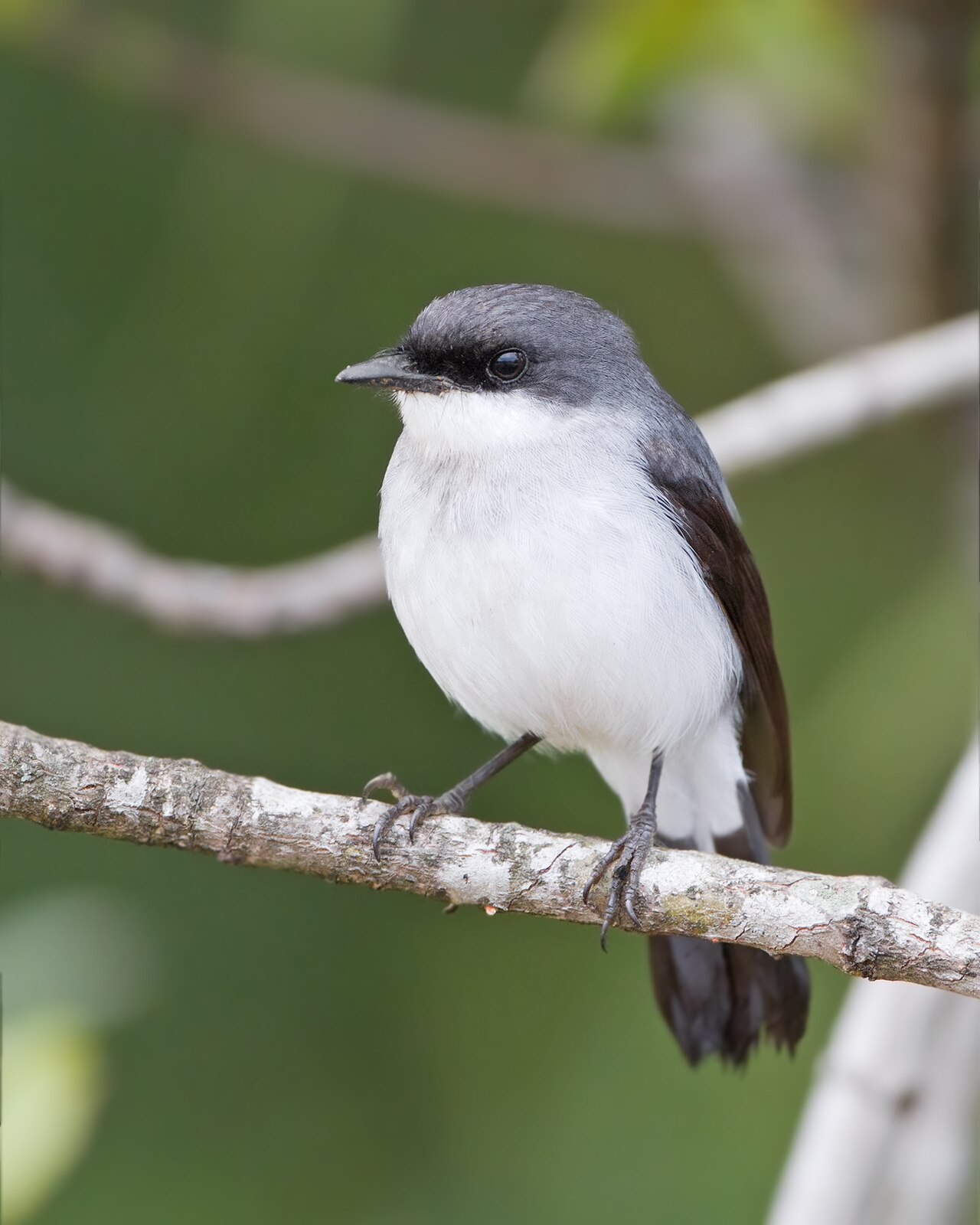
The Mangrove Robin is the robin of the mangroves and occurs almost nowhere else. Grey-brown above, white below, with a dark lore and white outer tail feathers that flash at every landing: a plain bird that sits on a root arch or a leaning trunk waiting for the water to drop, and then goes out onto the mud. Its plaintive, drawn-out whistle belongs to the sound of every northern mangrove creek.
Voice
A drawn-out, plaintive, slightly falling whistle, often in two parts — a long opening and a shorter, lower close — with a mournful quality that carries far over the water and is the commonest sound in the stillness between the mangrove roots. Alongside it a hard, short chak when uneasy and a soft rattling throat note between partners. The bird calls most in the early morning and around low tide.
No recording with a suitable Creative Commons licence has been found for this species yet; what to listen for is described below.
Identification
Fourteen to sixteen centimetres and about nineteen grams, a slim, upright bird. The upperparts are plain grey-brown to dark grey, the underparts white with a light grey wash across the breast; the lore is dark, which gives the face a faintly masked look. The bill is black and fine, the eye dark. On taking off and when the tail is fanned, white outer tail feathers show — the clearest character in the field. The sexes are alike; young birds are browner and rustily mottled.
Confusion species
Within the genus there is no practical problem, but the two other species deserve mention: Hooded Robin (Melanodryas cucullata) of the open inland woodland has, in the male, a glossy black head and breast with a sharp white wingbar, and never enters mangrove; Dusky Robin (Melanodryas vittata) is a uniformly dull brown species confined to Tasmania, thousands of kilometres further south. The real confusion happens in the mangrove itself. Lemon-bellied Flyrobin (Microeca flavigaster) sits in the same trees but has a yellow belly. Broad-billed Flycatcher (Myiagra ruficollis) is grey and white with a rufous throat and constantly quivers its tail. Mangrove Gerygone (Gerygone levigaster) is half the size, with a red eye and a thin pointed bill. White-browed Robin (Poecilodryas superciliosa) has a broad white brow and white wing markings and lives along rivers, not in salt water.
Habitat
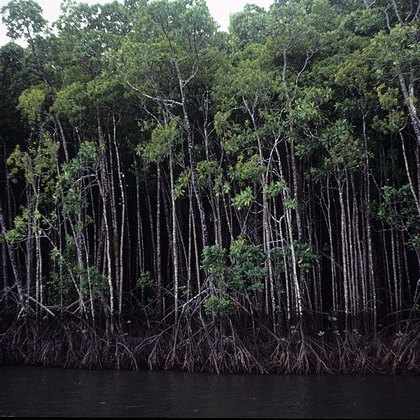
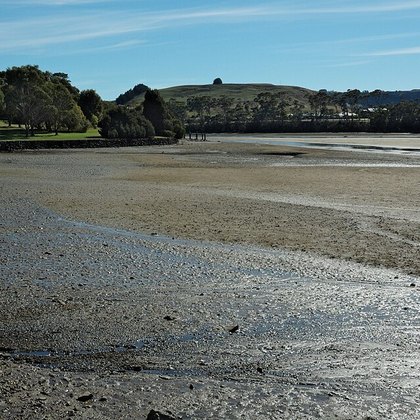
Mangrove, and above all the inner and oldest parts of the forest, where the trees stand tall and the root arches meet. It hunts from a low perch on a root or a leaning trunk, looks down and pounces on prey on the bare mud exposed at low tide — small crabs, worms and insects. At high water it withdraws into the crowns. It rarely goes more than a few tens of metres beyond the mangrove, at most into adjoining swamp forest or saltmarsh growth. The cup nest of bark and cobweb sits in a mangrove fork just above the water.
Where the bird is most often found, arranged by main group and formation.
Range and movements
The mangrove coasts of tropical northern Australia: from the Western Australian coast east along the Kimberley, around the Top End and the Gulf of Carpentaria, and down the Queensland east coast. Beyond that it lives in southern New Guinea and on the Aru Islands; the type locality lies on the Utanata River in southern New Guinea. The range is therefore very long but extremely narrow — a ribbon at most a few hundred metres wide, exactly as wide as the mangrove belt. It is sedentary on a fixed territory.
- Resident
- dark = core range, pale = thinly spread
Where and when to look
Take a mangrove boardwalk or a jetty on a falling tide — at Darwin, Broome, Karumba or Cairns this is easy anywhere — and wait at the first water. Listen for the plaintive whistle; it nearly always comes from a bird sitting at eye level on a root arch. Once you have it, watch the moment it drops to the mud: the white outer tail feathers flash open, and that is at once the character by which you will know it at a distance next time.
Conservation
Least Concern (LC). The range is long, the habitat is still intact across much of northern Australia, and mangrove enjoys fairly strict legal protection in Australia. The vulnerability lies in the narrowness of the ribbon: the species has nowhere to go if the mangrove belt disappears. Coastal development, port expansion and construction near the larger northern towns remove forest locally, and the large-scale mangrove dieback in the Gulf of Carpentaria in 2015 and 2016, following a heatwave and an exceptionally low sea level, showed how quickly it can happen.
Scientific name
Melanodryas pulverulenta | (Bonaparte, 1850)
Bonaparte described the bird in 1850 as Myiolestes pulverulentus, from material out of southern New Guinea; because it was later placed in another genus, author and year stand in parentheses. pulverulenta is Latin for dusted or dusty, after the dull grey plumage. Many authorities place the species in a genus of its own, as Peneoenanthe pulverulenta, formed from Latin paene (almost) and Oenanthe, the genus of the wheatears — and that is where the Dutch name, which means 'wheatear flycatcher', comes from. This guide keeps the species in Melanodryas; the Dutch name thus preserves the memory of a generic name no longer used in this guide.