All species › Waterfowl › Ducks, swans and geese › Maned Duck
Maned Duck | Chenonetta jubata
Manengans | Pato de crin
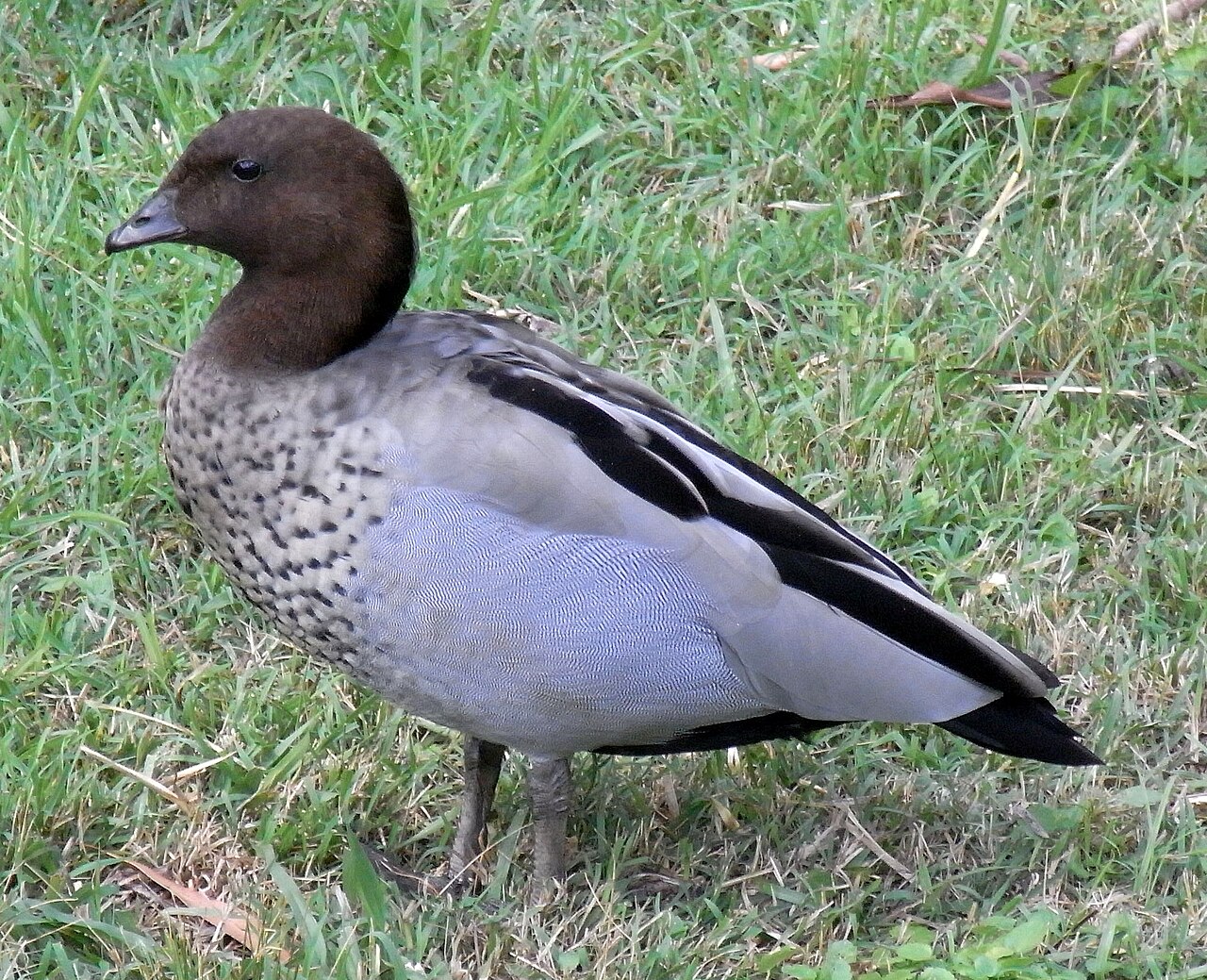
The Maned Duck is the duck you meet on the grass rather than on the water: a goose-shaped, short-billed bird with a dark brown head and a pale grey, finely speckled body, grazing in pairs or loose flocks across paddock, sports field and golf course. It nests in a tree hollow, sometimes hundreds of metres from the nearest water, and on departure day the ducklings simply jump.
Voice
The usual note is a drawn-out, plaintive, rising gnow. The female gives it loud and low and repeats it steadily; the male answers shorter, smoother and higher, so a pair sounds like a duet. Grazing flocks keep up a soft staccato chatter audible only at close range. When a flock lifts, the call speeds into a sharp, nervous repetition that carries the length of a paddock.
Recording: Chi-Hsuan Shao — CC BY-NC-SA 4.0 · Risdon, Clarence City Council, Tasmania, Australia · xeno-canto
Identification
A duck of 44 to 50 cm with the stance and walk of a small goose: upright, neck held high, bill short. The body is pale grey with two black stripes down the back, the breast brown and finely speckled, belly and undertail black. The male has a plain dark brown head with the short shaggy nape feathers that give the bird its name; the female has a paler head with a white stripe above and below the eye. In flight the pale grey wing shows up, with a black tip and a white bar across the underwing.
Confusion species
No other Australian duck grazes like this. Cape Barren Goose (Cereopsis novaehollandiae) walks the same southern paddocks but is far larger, plain grey, and has a short greenish-yellow bill. Magpie Goose (Anseranas semipalmata) is black and white, long-legged and tied to northern swamps. At dusk a grazing flock can suggest coots out on the grass, but the straight neck, the pale wing and the brown head settle it at once.
Habitat
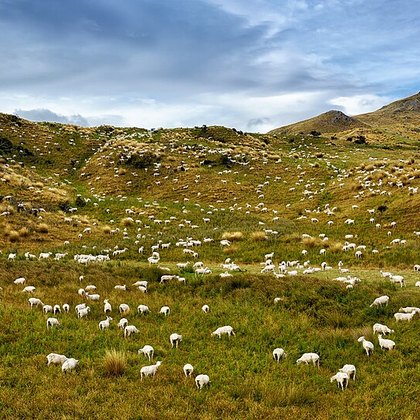
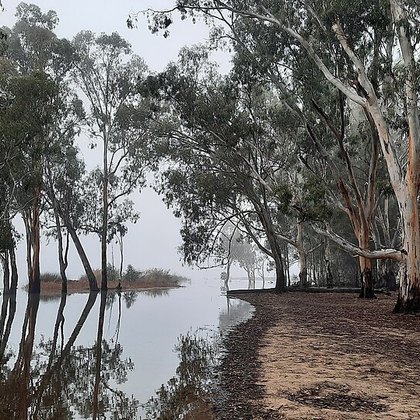
Open grassland with trees along its edge is the picture: grazed paddock, grain stubble, sports field, golf course and city park, always within walking distance of water. For the nest a hollow tree is needed, usually an old eucalypt beside a stock dam or creek. It uses open water little, dabbling in the shallows at most and swimming out to the middle of a dam to rest in safety.
Where the bird is most often found, arranged by main group and formation.
Range and movements
Across virtually all of Australia including Tasmania, commonest in the southeast and southwest; the western sand deserts and Cape York stay empty. Stock dams and the clearing of woodland for pasture have carried it forward and into the inner suburbs. In New Zealand it is a rare visitor. It does not migrate, but in dry years flocks drift towards the coast.
- Resident
- dark = core range, pale = thinly spread
Where and when to look
Scan a grazed field beside a dam early in the morning and in the last hour of daylight; that is when the flocks are out feeding and heads can be compared. From September to November look at old eucalypts with hollows above the water: the female sits in the entrance with the male on watch on a branch alongside.
Conservation
Least Concern (LC). The Maned Duck is one of the few Australian waterbirds that farming has suited: stock dams, sown pasture and suburban ponds have raised both numbers and range, and in several states it is legal game without the population suffering. What does bite locally is the loss of old hollow trees from open paddocks — without a hollow there is no nest, however much grass there is.
Scientific name
Chenonetta jubata | (Latham, 1801)
Latham described the bird in 1801 as Anas jubata; because it was later moved to another genus, author and year stand in parentheses. The genus Chenonetta was introduced by Brandt in 1836 and combines Greek khēn, 'goose', with nētta, 'duck' — exactly the double creature the bird is in the field. jubata is Latin for 'maned', from iuba, 'mane', after the short shaggy nape feathers of the male. The type locality is New South Wales.