All species › Cranes, rails and allies › Rails, gallinules and coots › Lord Howe Woodhen
Lord Howe Woodhen | Gallirallus sylvestris
Lord Howe-ral | Rascón de Lord Howe
The Lord Howe Woodhen is a flightless, olive-brown forest rail found on Lord Howe Island alone, where it wrote one of conservation's best-known rescue stories: from some twenty birds on two mountain summits to more than fifteen hundred across the whole island. It is almost fearless and comes towards a sound rather than away from it.
Voice
Pairs give a loud, high, penetrating series of screams taken up in turn, so that it sounds like one unbroken call; it carries down the forest aisles and is heard mostly at dawn and dusk. Between partners and with the young come soft grunting and squeaking contact notes. An unfamiliar noise in its territory — a squeak, a rustle — is more likely to bring it closer than to send it away.
No recording with a suitable Creative Commons licence has been found for this species yet; what to listen for is described below.
Identification
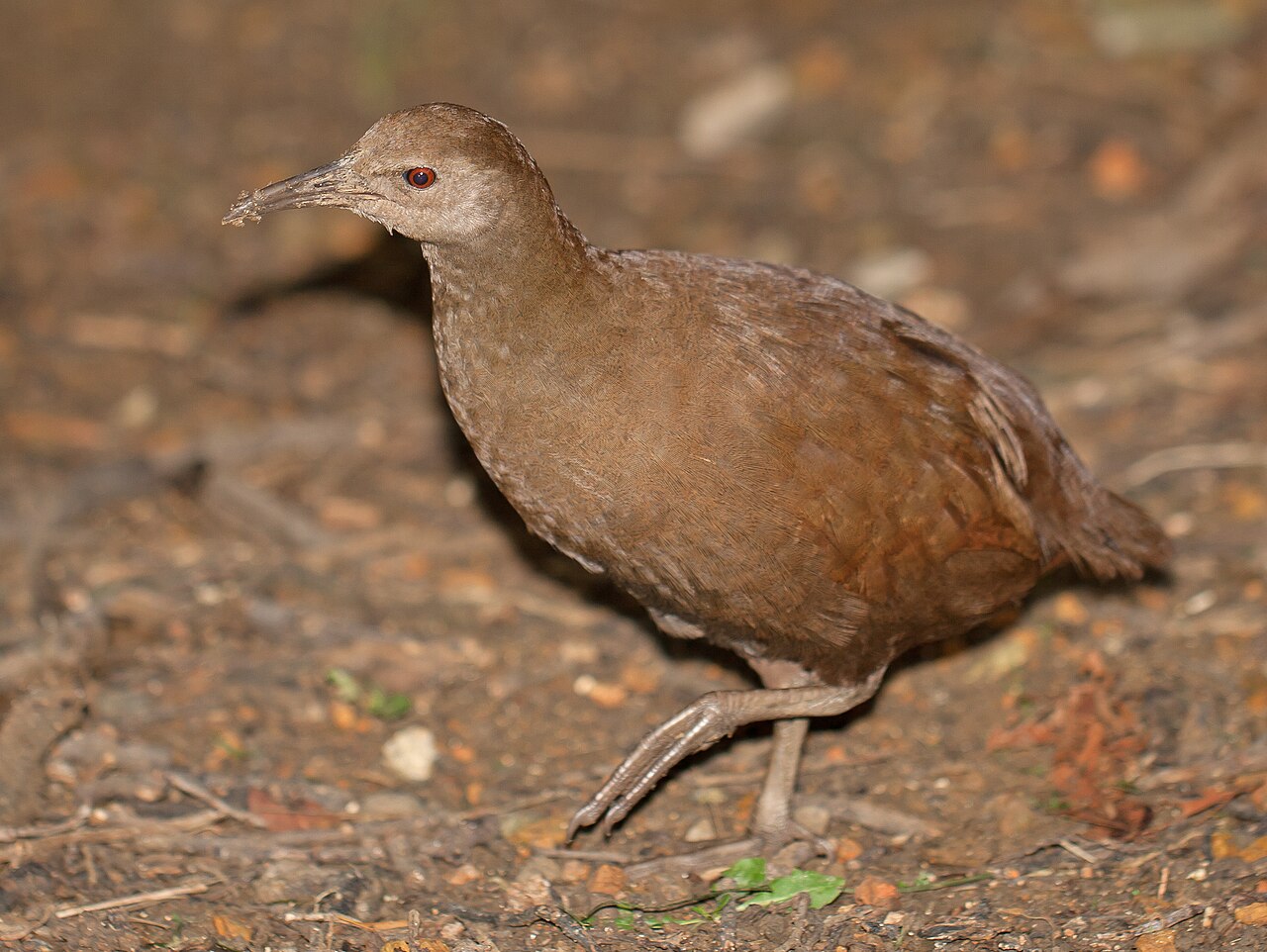
A sturdy flightless rail of thirty-two to forty-two centimetres and roughly four hundred and fifty to six hundred grams, with a short tail and a heavy, downcurved bill. The plumage is dull olive-brown, paler and greyer on head and throat, with no barring below; only the wings carry chestnut with dark bars, which shows mainly when the wing is stretched. Bill and legs are flesh to grey-pink, the iris bright red. Males are about fifteen per cent heavier than females. It does not fly and walks the forest floor with short, measured steps.
Confusion species
The same island holds Buff-banded Rail (Gallirallus philippensis), its nearest mainland relative: smaller, able to fly, with a white eyebrow, an orange-brown breast band and sharply barred black-and-white underparts — the plain olive-brown of the woodhen rules out confusion at once. Weka (Gallirallus australis) is likewise flightless and superficially similar, but far larger and heavier and confined to New Zealand. Chestnut Rail (Gallirallus castaneoventris) is bigger, chestnut below, and lives in tropical mangrove in northern Australia.
Habitat
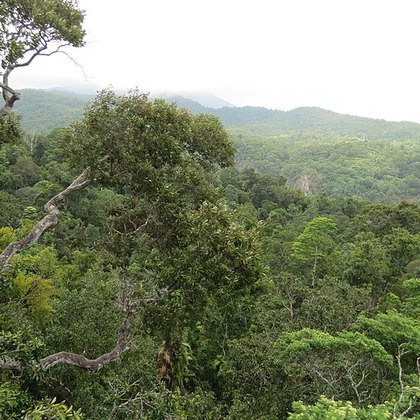
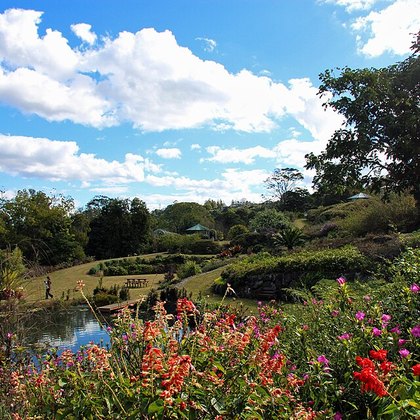
Forest across the island's whole altitude range: kentia palm forest in the lowlands, mixed subtropical rainforest in humid, sheltered gullies, and the mossy mist forest on the summits of Mount Gower and Mount Lidgbird up to around eight hundred and fifty metres. It forages in the litter layer under closed canopy and avoids open grassland. As numbers have grown it also walks the gardens, the campground and the yards of the settlement.
Where the bird is most often found, arranged by main group and formation.
Range and movements
Lord Howe Island only, some six hundred kilometres east of the Australian coast; the area it occupies comes to less than two square kilometres. It occurs nowhere else on earth, not on nearby Ball's Pyramid nor on Norfolk Island. Within the island it was confined until the 1980s to the two southern summits; it now holds almost the whole main island, apart from the northern hills.
- Resident
- dark = core range, pale = thinly spread
Where and when to look
Walk the forest tracks near Little Island and the approach to Mount Gower, or simply the edges of the settlement, and stand still where the leaf litter is deep; it will often come within minutes to see what made the noise. Let it come to you rather than following it, and keep dogs leashed — they are one of the few threats left. Look early in the morning, while the pair is still calling.
Conservation
Endangered (EN), and at the same time one of the best-documented recoveries anywhere. Hunting, feral pigs, cats, dogs and goats pushed the species back to about twenty birds on the summits of Mount Gower and Mount Lidgbird by the early 1970s. A captive breeding programme between 1980 and 1984 released more than eighty birds, alongside removal of pigs, goats and cats, after which the population settled at around two hundred — the island's carrying capacity at the time. The rodent eradication project of 2019, costing over ten million Australian dollars, was decisive: from 208 birds in 2019 to 598 in November 2021, 778 in March 2022 and more than fifteen hundred in December 2024. The species remains vulnerable through its tiny range; predation by black rats, Australasian Masked Owls and loose dogs, and vehicle strikes, are the risks that remain.
Scientific name
Gallirallus sylvestris | (Sclater, 1870)
Philip Lutley Sclater described the species as Ocydromus sylvestris, read in 1869 and published in the volume of the Proceedings of the Zoological Society of London that appeared in 1870; because it later moved to another genus, author and year stand in parentheses. The genus Gallirallus was introduced by Lafresnaye in 1841, from Latin gallus, 'cock', and rallus, 'rail'; molecular work now also places the species in Hypotaenidia. sylvestris means 'of the forest'. The type locality is Lord Howe Island itself.