All species › Owls › Owls › Little Owl
Little Owl | Athene noctua
Steenuil | Mochuelo europeo
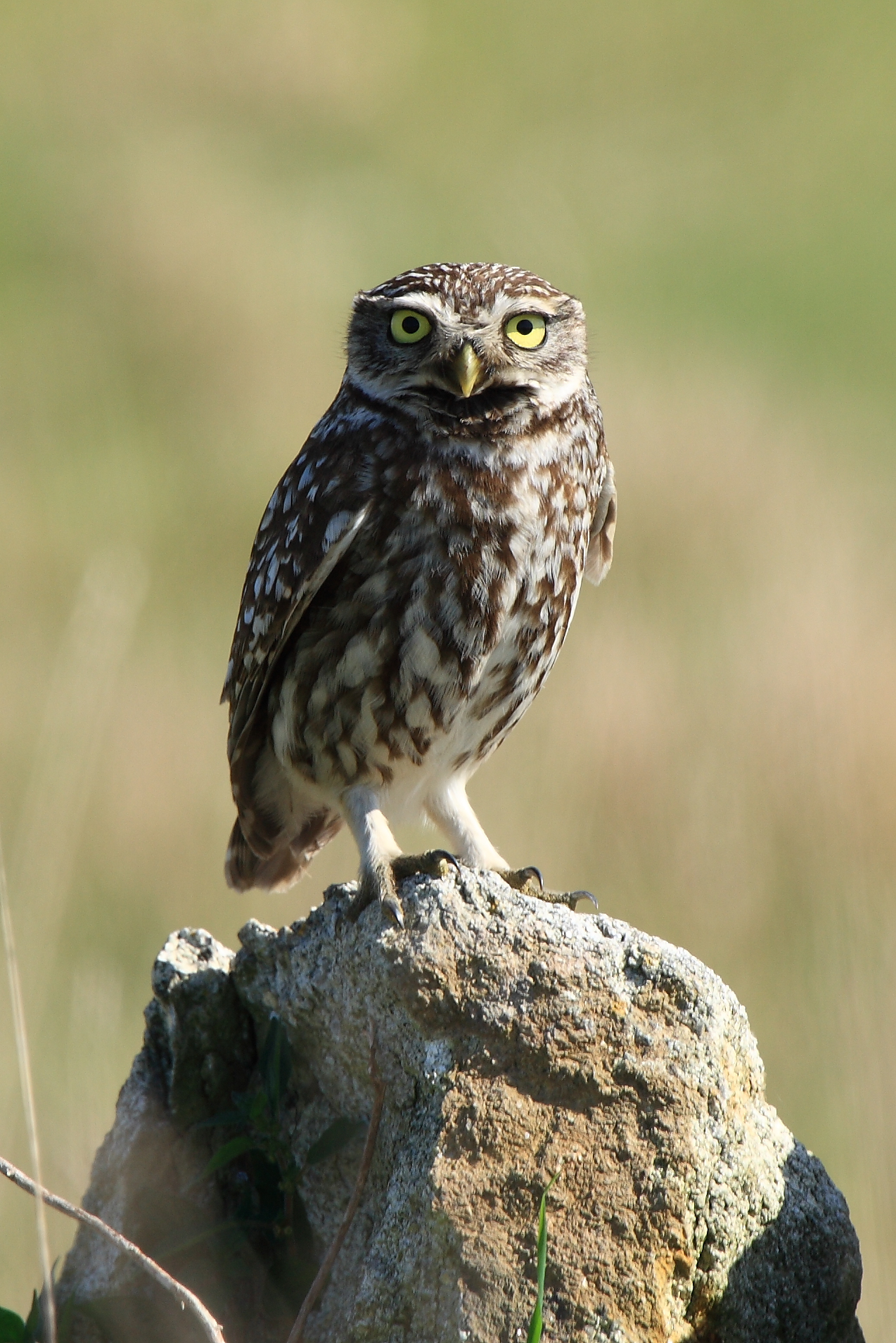
The Little Owl is the one owl in New Zealand that does not belong there: imported from Germany and released on the South Island between 1906 and 1910. It is a small, squat, grey-brown owl with a flat head and stern yellow eyes, living not in forest but in open farmland, and often showing itself in daylight, upright on a fence post or a shed roof.
Voice
The ordinary contact note is a shrill, upward-drawn kiew, given one note at a time and repeated at intervals; through lowland Nelson, Marlborough, Canterbury, Otago and Southland it is a familiar evening sound. There is also a short barking werp when excited and a fast yapping chatter between the pair. In spring the male gives a drawn-out, plaintive goo-eck from a set post. The repertoire is sharper and higher than the Morepork's and lacks its unmistakable two-note more-pork.
Recording: Le Louaver Manuel — CC BY-NC-SA 4.0 · Parc des Cèdres (near Soliers), Calvados, Normandie, France · xeno-canto
Identification
A small, compact owl of 23 centimetres, much smaller than a Morepork and much paler: grey-brown with close white streaks and spots. The head is strikingly flat and broad, with pale grey facial discs below the eyes, a broad white brow band above the yellow eyes and a white band below the chin, which together give it a frowning expression. The tail is short, the legs thickly white-feathered down to pale yellow toes. In flight it stands out by a bounding, woodpecker-like course, fast beats between short closures. When excited it bows and bobs with the whole body.
Confusion species
Morepork (Ninox novaeseelandiae) is the only other owl in the area and is larger (29 against 23 cm), darker and warmer brown, with a rounder head, a longer tail and none of the white brow and chin bands; it also sits in forest rather than open pasture. Eastern Barn Owl (Tyto javanica), in Northland since 2008, is far larger, golden brown and pure white below, with dark eyes and a heart-shaped disc. A Little Owl on a post in daylight in the bare farmland of the eastern South Island is nearly always what it seems.
Habitat
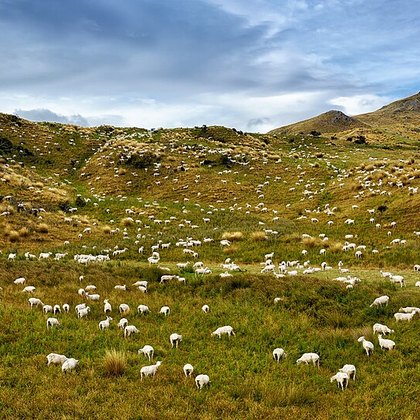
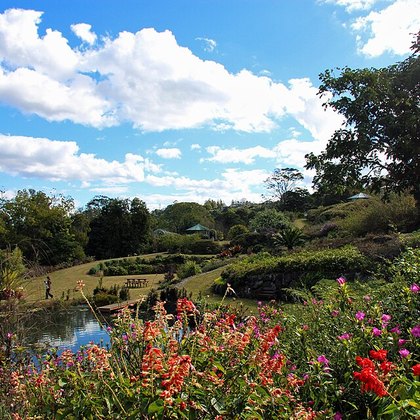
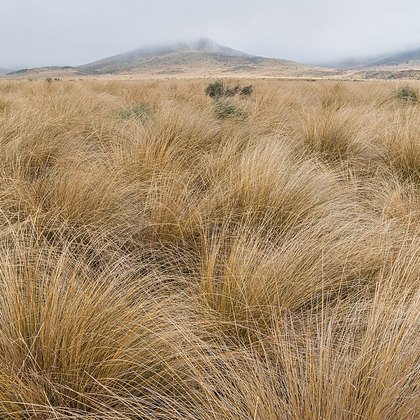
Open farmland: pasture with scattered trees, cropland and orchards, shelterbelts and hawthorn hedges, and beyond that the edges of towns, gardens and parks. It breeds in a cavity — an old tree, a hole in a wall, a haystack or a shed — and hunts from a low perch for ground beetles, earwigs, moths, ants, worms, mice and small birds. In the dry tussock country of Central Otago it sits far from any farmstead. Closed native forest, the home of the Morepork, it leaves alone.
Where the bird is most often found, arranged by main group and formation.


Range and movements
The South Island only, where it is common in the dry eastern districts — Marlborough, Canterbury, Otago and Southland — and also present in Nelson; on the wet West Coast it is rare. It never established on the North Island, and it does not occur in Australia at all: within the map window it is strictly a South Island bird. It is sedentary and stays year round in the same small territory.
- Resident
- dark = core range, pale = thinly spread
Where and when to look
Drive the back roads of Central Otago or North Canterbury in daylight and watch the fence posts, shed ridges and dead poplar branches: unlike the Morepork, the Little Owl is often out by day, and the upright, flat-headed silhouette is recognisable at range. At dusk the shrill kiew gives it away at almost any farmstead. Look into old sheds and dovecotes too, which it readily uses for nesting.
Conservation
Least Concern (LC) globally, and classed in New Zealand as Introduced and Naturalised: here the species is a matter of management, not protection. Nor is it native — between 1906 and 1910 the Otago Acclimatisation Society imported 219 Little Owls from Germany and released them, hoping they would control the equally introduced songbirds damaging fruit and grain. The owls spread rapidly across the eastern South Island. The feared slaughter of native birds never came — diet studies show the menu is mostly insects — but one shadow remains: where the Little Owl hunts on the sand flats near Cromwell in Central Otago it eats the critically endangered Cromwell chafer beetle (Prodontria lewisi), which occurs nowhere else on earth. In Europe, where it does belong, the species is in decline.
Scientific name
Athene noctua | (Scopoli, 1769)
Scopoli described the species in 1769 as Strix noctua, with Carniola as the type locality — the Krain of the day, present-day Slovenia; because it later moved to Athene, author and year stand in parentheses. The epithet noctua is the ordinary Latin word for a night owl and is related to nox, night. The genus Athene was introduced by Boie in 1822 and refers to Pallas Athena, goddess of Athens, whose bird this owl was: it appears on the city's silver coinage. The Dutch name steenuil points at its liking for wall holes and stone heaps; the English name Little Owl translates its size, and the Maori ruru nohinohi means literally 'small ruru'.